




TL;DR: When floodwater reaches a Miele dishwasher, the real danger isn’t what you can see — it’s the dense acoustic insulation packed inside the cavity. That insulation absorbs water like a sponge and creates ideal conditions for mold growth within 24–72 hours. By the time mold is visible, the remediation process — and the surrounding cabinetry and flooring — often costs more than the appliance itself. Here’s what to know, and what to do.
If your Miele dishwasher sat in floodwater — even for a few hours — the real cost conversation is about what’s behind the panel.
Miele’s dishwashers are engineered for near-silent operation, which means the cavity is packed with dense insulation — materials designed to absorb vibration and sound. In a flood, that same insulation absorbs water with equal efficiency. And once it’s wet, the clock starts.
The EPA’s mold guidance is direct: “It is important to dry water-damaged areas and items within 24–48 hours to prevent mold growth.” Porous materials that aren’t dried in that window need to be removed and discarded. For a sealed appliance cavity that can’t be dried from the outside, the practical window is even shorter.
The Hidden Cost: Why Cavity Insulation Is the Real Problem
The visible portions of a submerged dishwasher — the stainless tub, the spray arms, the filter basket — can be cleaned. Those surfaces are designed to contact water.
The cavity is a different story. Miele packs dense insulation between the outer cabinet and the inner tub on multiple sides — door, side panels, base — typically a combination of bitumen-backed mats and fiber-based padding. When floodwater intrudes, this insulation absorbs and holds moisture long after the floors dry and the kitchen looks normal.
Mold doesn’t need much invitation. It needs moisture and a food source. Organic debris and paper-backed insulation in a dark, warm appliance cavity are exactly that.
EPA’s 24/48/72-Hour Mold-Growth Timeline
Speed matters more than diagnosis in the first hours after a flood.
The EPA is direct: if wet or damp materials are dried within 24–48 hours of a water event, mold growth can be prevented in most cases. The corollary — porous materials like insulation that become moldy may have to be thrown away because “the mold may be difficult or impossible to remove completely” — is the guidance that determines appliance fate.
After 48 hours, the question shifts from prevention to remediation. After 72 hours in a warm environment — and Houston’s post-storm temperatures run in the high 80s to mid-90s — mold colonies are producing spores.
For a dishwasher, drying the cavity is not a realistic DIY option. The insulation isn’t accessible without disassembling the appliance. You can’t aim a fan at it, and a kitchen dehumidifier doesn’t reach inside a sealed machine.
This is why the NC State Cooperative Extension’s flood-appliance guidance is explicit: flooded appliances with internal insulation should be replaced rather than repaired. The same principle that applies to refrigerators — “refrigerators and freezers with wet insulation cannot be salvaged” — applies to any sealed appliance cavity that has absorbed standing water.
Why Miele Is Uniquely Affected
Not all dishwashers carry the same flood risk. A builder-grade unit with minimal insulation has less material to absorb water. Miele is a different category.
Acoustic insulation volume. Miele’s dishwashers — the G 7000 series and professional-line models common in premium Houston kitchens — run around 44 dB, quieter than a library. That quietness comes from dense insulation packed on multiple sides. More insulation means more water retention, and the same engineering that makes the machine quiet makes it harder to remediate after flooding.
Sealed, tight construction. Miele builds to tighter tolerances than most appliances. The cavity is compact, with no air gap for passive drying. The sound-dampening mats are often bitumen-backed — water-resistant on the surface but not waterproof throughout. Once water reaches the fiber backing, it’s trapped.
Integrated cabinetry. In the kitchens where Miele dishwashers live, the unit is almost always panel-ready and flush with custom cabinetry. Pulling the unit for inspection, and the associated cabinet work, is a significant job — and the surrounding cabinetry is part of the cost conversation from the start.
When Salvage Is Possible Versus Total Loss
The honest answer is that a dishwasher that has been fully submerged — with water reaching cavity level — is almost always a total-loss appliance. The decision framework below is for cases where the question is genuinely unclear.
| Scenario | Likely outcome | What drives that conclusion |
|---|---|---|
| Standing water reached the kick-plate but not the cavity | Salvageable with inspection | Water didn’t reach insulation; control board needs assessment |
| Standing water submerged the lower third of the unit for under 2 hours | Uncertain — requires professional inspection | Depends on cavity seal integrity |
| Standing water covered the unit for 4+ hours | Total loss appliance | Insulation fully saturated; mold window already open |
| Any scenario + 48+ hours before inspection | Total loss appliance + possible cabinetry remediation | Mold clock has expired; IICRC water-damage standards require remediation |
| Water was clean (municipal supply break) vs. Category 3 floodwater | Changes remediation protocol, not appliance fate | Category 3 (storm surge, sewage) requires treatment of surrounding materials regardless |
The key variable most homeowners miss: floodwater from storms is Category 3 contaminated water under IICRC water-damage standards. It carries sewage, chemicals, and biological material. Even a brief contact with Category 3 water changes the remediation picture for everything it touched — including the floor under the dishwasher and the cabinet box around it.
Inspection: What Your Appliance Tech Checks vs. What Your Restoration Crew Checks
These are two different scopes of work, and you need both.
Your appliance technician assesses:
- Control board and wiring harness for corrosion or water intrusion
- Pump and motor condition
- Whether the unit powers on safely (never attempt this without professional evaluation — the NC State Extension guidance on flood-damaged appliances is clear: “any work done on electric or gas appliances should be done by a qualified, licensed contractor”)
- Whether the cavity insulation is wet (requires removing the door panel or pulling the unit)
Your water-damage restoration crew assesses:
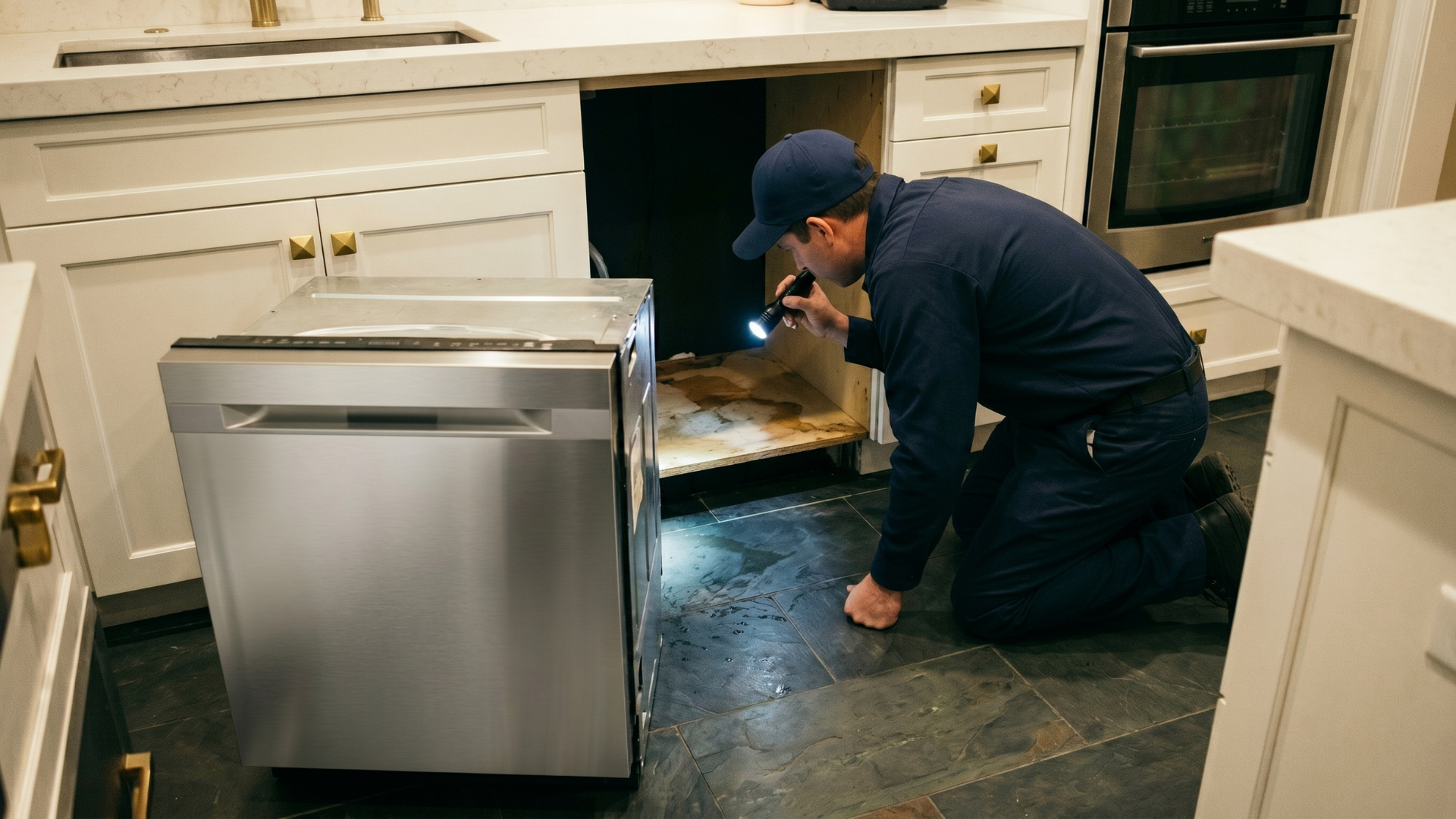
- Moisture levels in the floor under and around the dishwasher
- Moisture content and mold in the cabinet box
- The wall cavity behind the unit if the water was deep enough
These scopes don’t overlap but they interact. A technician confirming the control board is fine says nothing about whether the insulation is dry. A restoration crew clearing the floor isn’t clearing the appliance. Both evaluations are needed before reinstalling anything.
The Houston Angle: Slab Flood + Miele Built-In = The Worst-Case Combination
Houston sits largely on clay soil, which means homes in low-lying neighborhoods — Meyerland, Bellaire, portions of Memorial and Tanglewood — experience slab flooding: water that enters at grade level, spreads across the ground floor, and sits. Unlike flash flooding that crests quickly, slab flooding holds at a consistent level for hours as drainage systems catch up.
That sustained exposure is exactly what maximizes cavity insulation damage. For a dishwasher with the front kick-plate 3–4 inches off the floor, even moderate slab flooding at 6–8 inches of standing depth reaches the insulation. The combination of Houston’s flood profile, the premium-kitchen density in affected zip codes (77005, 77019, 77024, 77401), and Miele’s construction characteristics makes this scenario a familiar one after any significant rain event.
If you’re in one of these neighborhoods and experienced standing water, have both an appliance technician and a water-damage professional assess the kitchen before running the dishwasher again — regardless of whether it appears to be working.
The Cost Math: Why Remediation Outpaces Replacement
A Miele G 7000 series dishwasher retails between $1,500 and $2,500. Panel-ready installation in a custom kitchen adds another $300–$600. Those are the appliance costs.
The remediation costs are what tip the math:
- Cabinet box replacement — if the surrounding cabinetry has absorbed water and shows mold, it comes out. In a premium kitchen, matching adjacent cabinet runs often means pulling more than just the dishwasher bay.
- Subfloor repair — if the floor under the unit wasn’t sealed, subfloor sections may need replacement before new flooring goes over it.
- Mold remediation — if the dishwasher itself became a mold source, it needs to leave the space before remediation begins, not after.
- Air clearance testing — professional remediation ends with air sampling to confirm the space is clean.
In a Houston premium kitchen, the fully burdened cost of addressing a flooded dishwasher — appliance replacement, cabinetry, flooring, remediation, reinstallation — regularly runs into five figures. The dishwasher is typically the smallest line item.
Understanding that early changes the decision. You’re not deciding whether to fix the dishwasher. You’re deciding how to manage the kitchen restoration, and the appliance is one part of it.
Frequently Asked Questions
Can I run my Miele dishwasher after flooding to clean it out?
No. Running a flooded appliance before inspection is a safety risk — floodwater can compromise wiring, the pump motor, and the control board. Running a cycle also doesn’t address the cavity insulation, which is where the mold risk lives. Have the unit inspected before any power is applied.
How quickly does mold grow inside a dishwasher after a flood?
The EPA’s 24–48 hour window is the outer boundary for prevention, not a comfortable buffer. In a sealed cavity at Houston’s post-storm ambient temperatures, mold can establish within 24 hours. If you’re 48–72 hours out from the event without an inspection, treat it as a remediation scenario, not a prevention scenario.
Does homeowners insurance cover a flooded Miele dishwasher?
Standard homeowners policies cover sudden and accidental water damage — a burst pipe, for example. Storm flood damage generally requires separate flood insurance (NFIP or private). Have your insurance adjuster inspect the kitchen before remediation begins to preserve your claim.
What’s the difference between the appliance inspection and the water-damage inspection?
The appliance technician assesses mechanical and electrical safety. The restoration crew assesses moisture in surrounding materials — cabinet, floor, wall cavity. Both are needed. A working dishwasher reinstalled into a moldy cabinet box creates a long-term air quality problem.
Is a Miele dishwasher ever salvageable after flooding?
If water reached only the kick-plate level and the cavity stayed dry, it may be salvageable after professional inspection. Full submersion — water reaching cavity level — is almost always a total loss, particularly with Category 3 floodwater (storm surge, sewage). When in doubt, err toward replacement.
How do I know if the cabinet around my dishwasher has mold?
Early-stage mold often presents as a musty odor before it’s visible. A restoration professional can assess the cabinet box using moisture meters and surface sampling. Don’t rely on visual inspection alone — mold behind a toe kick or in a cabinet cavity can be invisible until it’s extensive.
When a flood reaches your kitchen, the appliances you see are not the whole story. The insulation inside your Miele, the subfloor underneath it, the cabinet box surrounding it — these are where the long-term damage lives. Getting both an appliance technician and a water-damage restoration professional into your kitchen within 24–48 hours of a flood event is the decision that controls whether you’re managing a straightforward appliance replacement or a full kitchen remediation.
We’re here when you need a qualified set of eyes on your appliances. Schedule a service or call us at (281) 758-9978 — we assess first, so you know exactly what you’re dealing with before any work begins.
Sources
- EPA — A Brief Guide to Mold, Moisture, and Your Home — load-bearing: 24–48 hour mold-prevention window cited throughout
- EPA — Mold Cleanup in Your Home — porous materials that become moldy may need to be discarded
- NC State Cooperative Extension — How to Salvage Flood-Damaged Appliances — explicit guidance that flooded appliances with internal insulation should be replaced
Related Reads from Uptown
- Common Miele Problems in the Houston/Dallas Climate — covers the broader range of issues Miele owners face in Houston and Dallas, including how climate conditions accelerate specific failure modes
- Why Your Miele Dishwasher Won’t Drain in Dallas — and What to Do About It — if your post-flood inspection reveals a drain issue, this is the next read
- Miele Washer and Dryer Repair in Houston and Dallas: The 20-Year Machine Most Technicians Have Never Fixed — same Miele engineering principles apply to washers; flood damage to laundry rooms follows a parallel logic
- When to Repair vs. Replace Your Luxury Refrigerator: A Cost-Benefit Analysis — the repair-vs.-replace framework applies equally to high-end refrigerators that take on flood damage