





Most wine cellars get exactly one service call in their working life: the one after they fail. The industry’s shorthand for this — “run to failure” — is how approximately four out of five residential cellars in Houston and Dallas are operated, regardless of the value of the collection they protect. Owners do not neglect their cellars intentionally. They are simply never shown the maintenance schedule that separates a cellar that lasts 20 years from one that fails at year seven.
The schedule exists. It is documented in manufacturer service manuals, embedded in commercial service contracts, and followed rigorously by the small minority of collectors who treat their cellar equipment the way they treat their HVAC system. What follows is that schedule, translated for serious Texas collectors who want their next cooling unit failure to be the result of end-of-life wear, not accumulated neglect.
Why Texas Makes This Schedule Non-Negotiable
The preventive maintenance frequencies that apply in a California or New England cellar do not apply in Texas. Three environmental factors compress the service calendar substantially. Summer ambient conditions in Houston and Dallas regularly exceed the 90°F thresholds at which most self-contained cooling units derate. Gulf Coast humidity loads every cellar’s condensate drainage system harder than manufacturers’ design assumptions. And Texas municipal water carries mineral content that accelerates scale buildup in any humidification system faster than in softer-water regions.
The schedule below reflects Texas-adjusted intervals, not generic manufacturer defaults.
Monthly: The Owner’s Five-Minute Walk-Through
The monthly check is what separates a cellar owner from a cellar steward. It is not a maintenance procedure. It is a situational awareness routine that catches most developing problems in the two-to-four-week window before they become service calls.
Four observations, taking less than five minutes:
Controller reading versus an independent thermometer in the collection zone. A discrepancy of more than 2°F — or a gap that is growing month over month — is the leading indicator of either sensor drift or a developing cooling performance issue.
Audible condition. A healthy cellar cooling unit is barely audible at the cellar door. New rattles, a compressor that sounds different, or fan bearing noise that wasn’t there last month are all early warnings worth noting with a dated phone recording.
Door seal. A dollar bill placed in the closed cellar door should require firm resistance to pull out. A bill that slides easily indicates a seal that needs replacement — often a $150 part that, if left unaddressed, forces the compressor into extended duty cycles and shortens its lifespan by years.
Humidity reading. A cellar whose humidity has drifted outside the 60–70% band over the course of a month is communicating something: the humidification system is failing, the door seal is leaking, or the cooling unit’s condensate management has changed.
Quarterly: The Condenser Clean
Every three months in Texas, and every six months in more temperate climates, the condenser coils require inspection and cleaning. This is the single most important preventive action a cellar owner can take, and it is the one most frequently skipped.
CellarPro publishes explicit guidance on condenser cleaning, noting that airborne dust and lint clog the gaps between condenser fins over time, impeding heat transfer and eventually forcing the unit to run at higher temperatures that damage internal components. Wine Guardian’s own maintenance documentation specifies fan, condenser, and evaporator cleaning as routine preventive tasks that most owners are qualified to perform.
For Texas cellars specifically, the three-month interval matters. A condenser that is 30% occluded with lint and dust forces the compressor to work harder to reject heat. In a summer where the cooling unit is already running near its rated capacity against 96°F ambient conditions, a dirty condenser is what turns “running near capacity” into “running at capacity continuously” — and that is the duty cycle that kills compressors.
The quarterly clean is a 20-minute task: remove the filter if equipped, vacuum the coils with a brush attachment, wash the filter in warm soapy water if aluminum, and reinstall. No refrigeration system access is required. No EPA certification. No service call.
Semi-Annual: The Drain and the Humidifier
Twice a year, two systems that owners cannot see require attention.
The condensate drain line, typically a small-diameter tube running from the evaporator to an exterior drain, develops biological growth — algae, mold, and in some configurations, insect ingress. A clogged drain backs up condensate, which eventually either floods the cellar or triggers the unit’s safety shutoff, killing cooling entirely. The semi-annual clean involves disconnecting the drain line, flushing with a dilute bleach solution, and confirming free flow.
The humidification system — whether an integrated mister, an external Aprilaire, or a passive water reservoir — requires descaling. Texas water’s mineral content precipitates into scale on any surface that holds standing water, and scale on a humidifier’s atomizing element reduces output while forcing the unit to work longer to maintain setpoint. Semi-annual descaling, using manufacturer-specified solutions, restores output and prevents the gradual humidity drift that most owners never notice.
Annual: The Professional Service Call
Once a year, a factory-trained technician should inspect the entire system. This is the service call that owners of run-to-failure cellars never make, and the one that turns a cellar into a stewarded asset rather than a depreciating appliance.
The annual call covers the items that require EPA Section 608 certification or specialized training: refrigerant charge verification, compressor amp-draw measurement against nameplate specifications, thermostatic expansion valve superheat check, electrical connection torquing, and calibration verification against a traceable reference. On a split system, the line-set insulation is inspected for compression damage. On a self-contained unit, airflow patterns are verified with a velometer.
The annual service produces a document that, on a cellar that is functioning correctly, looks boring. That is the point. The value of the annual service is not in what it catches in a given year; it is in the trend data the service record builds over five, seven, twelve years of operation. A compressor whose amp draw rises 8% over three consecutive years is telling you something. A thermostat that requires recalibration every year is telling you something else. The annual record is how you learn which one your system is doing.
Uptown’s wine cellar service framework builds the annual inspection around the brand-specific requirements of CellarPro, WhisperKool, EuroCave, Breezaire, and Wine Guardian systems — each of which has different critical inspection points and different parts-supply considerations.
Every Three to Five Years: The Capital Cycle
Every three to five years, depending on system age and runtime, major wear components approach end of life. Contactors, capacitors, blower motor bearings, and humidifier solenoids all have predictable service lives in the 3-to-7-year range. A preventive replacement cycle — swapping these components before they fail on the hottest day of July — is the difference between a scheduled $400 part replacement and an emergency weekend call with a collection at stake.
For collectors whose cellar failure in Texas summer conditions would trigger an expensive loss curve, the capital-cycle replacement of wear components is a risk management expense, not a maintenance cost.
What the Schedule Prevents
A cellar operated to the schedule above lasts 15 to 20 years before the cooling unit needs replacement. A cellar operated on run-to-failure lasts 7 to 10 years, with one to three emergency service calls before the final failure and a commensurate risk of collection damage during each one.
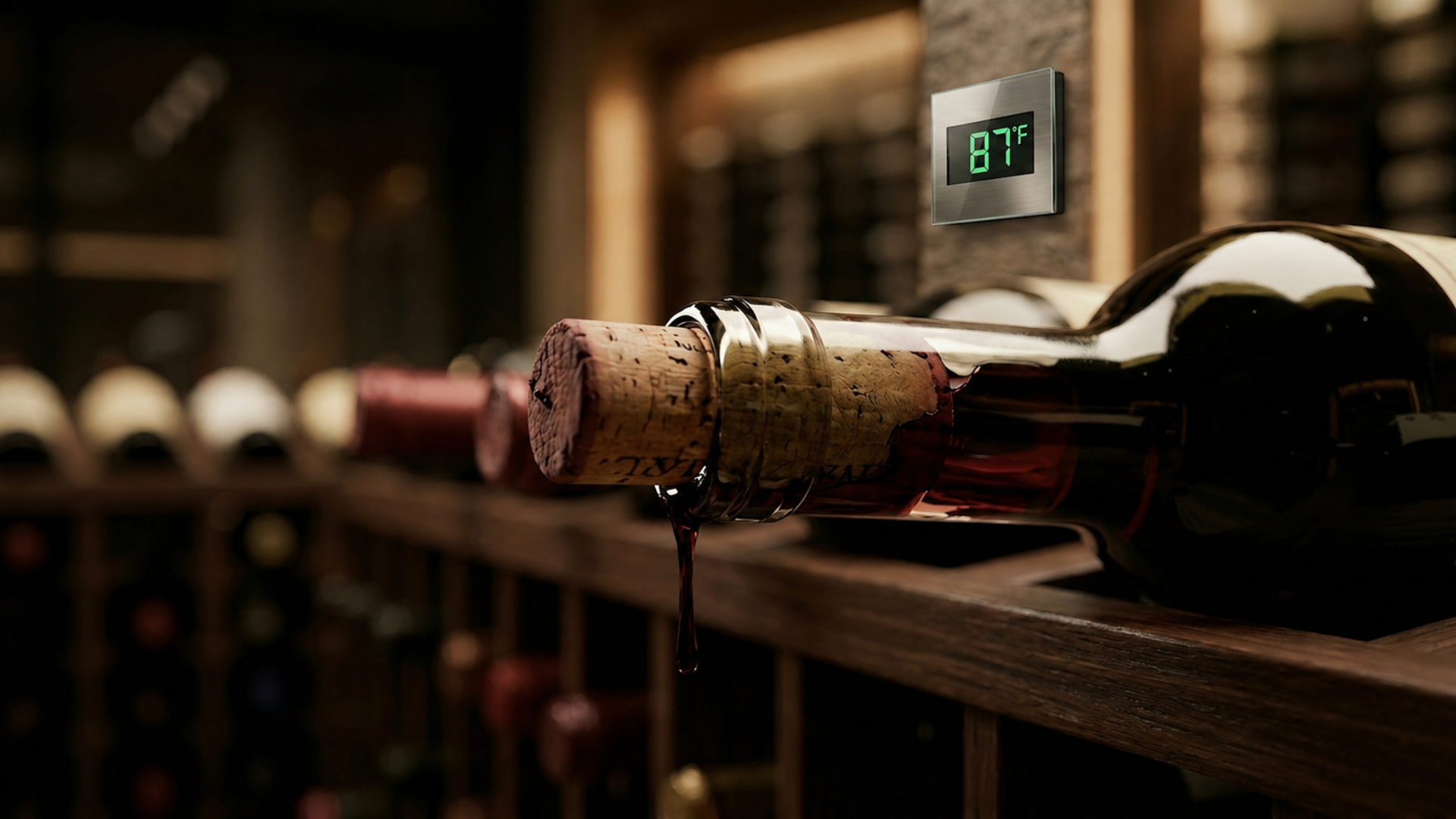
The financial math is not close. A preventive schedule — owner-handled monthly observation and quarterly condenser cleaning, professional service semi-annually and annually — costs a fraction of a single emergency service call, and a negligible fraction of the collection damage a mid-summer compressor failure produces when the cellar reads 82°F before anyone notices.
The early warning signs of cellar failure are readable when someone is reading them. The maintenance schedule is what trains an owner to read it.
The Framework
Monthly: owner’s five-minute walk-through. Quarterly: condenser clean. Semi-annual: drain and humidifier service. Annual: professional factory-trained inspection. Every three to five years: wear-component preventive replacement.
The schedule is not optional for serious collectors. It is the difference between a cellar that quietly protects a collection for two decades and one that fails loudly at year eight with the inventory still inside. For collections that took decades and significant investment to build, the schedule is the cheapest protection available — and the one most owners learn about only after the cellar has already told them they needed it.