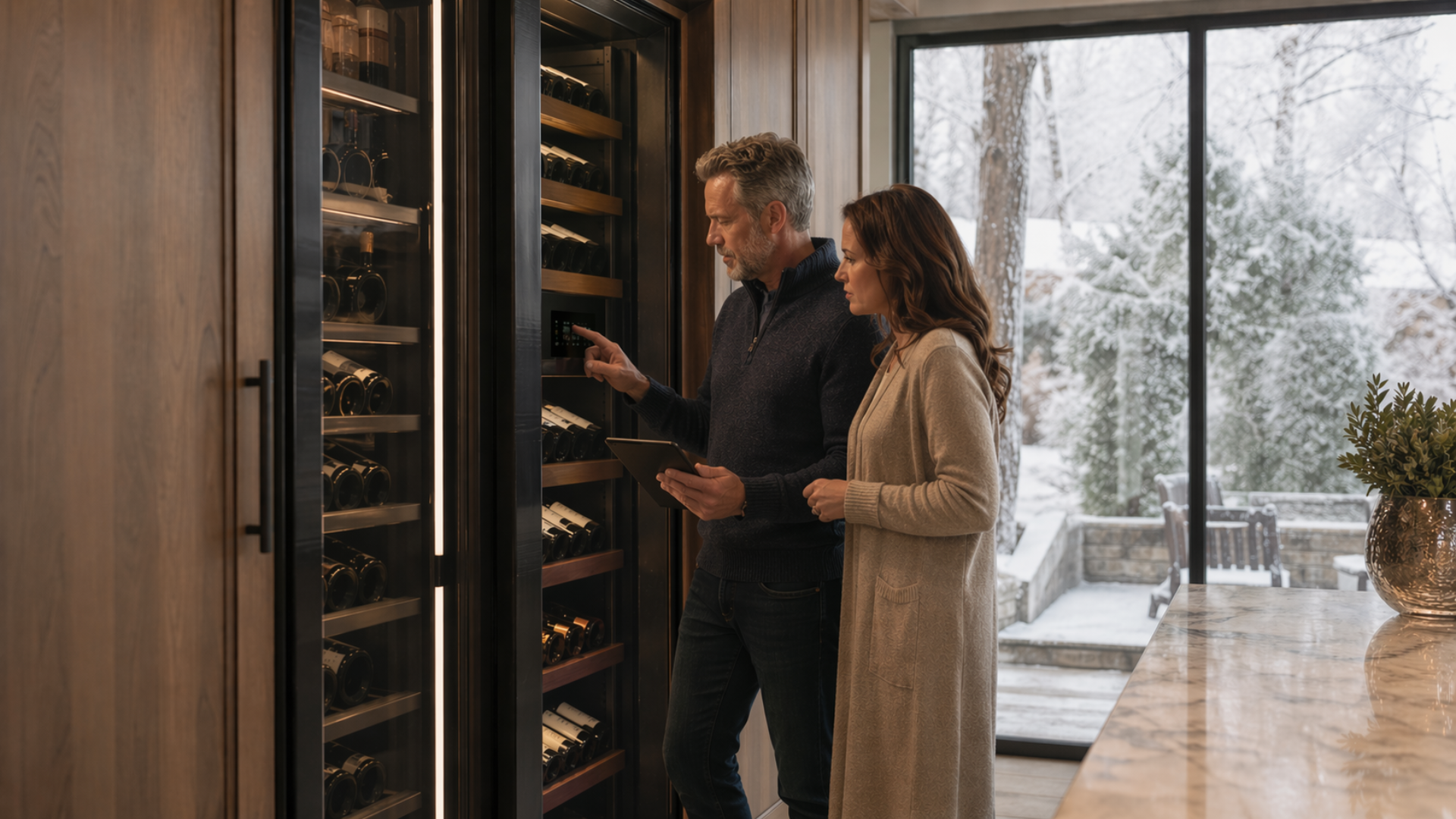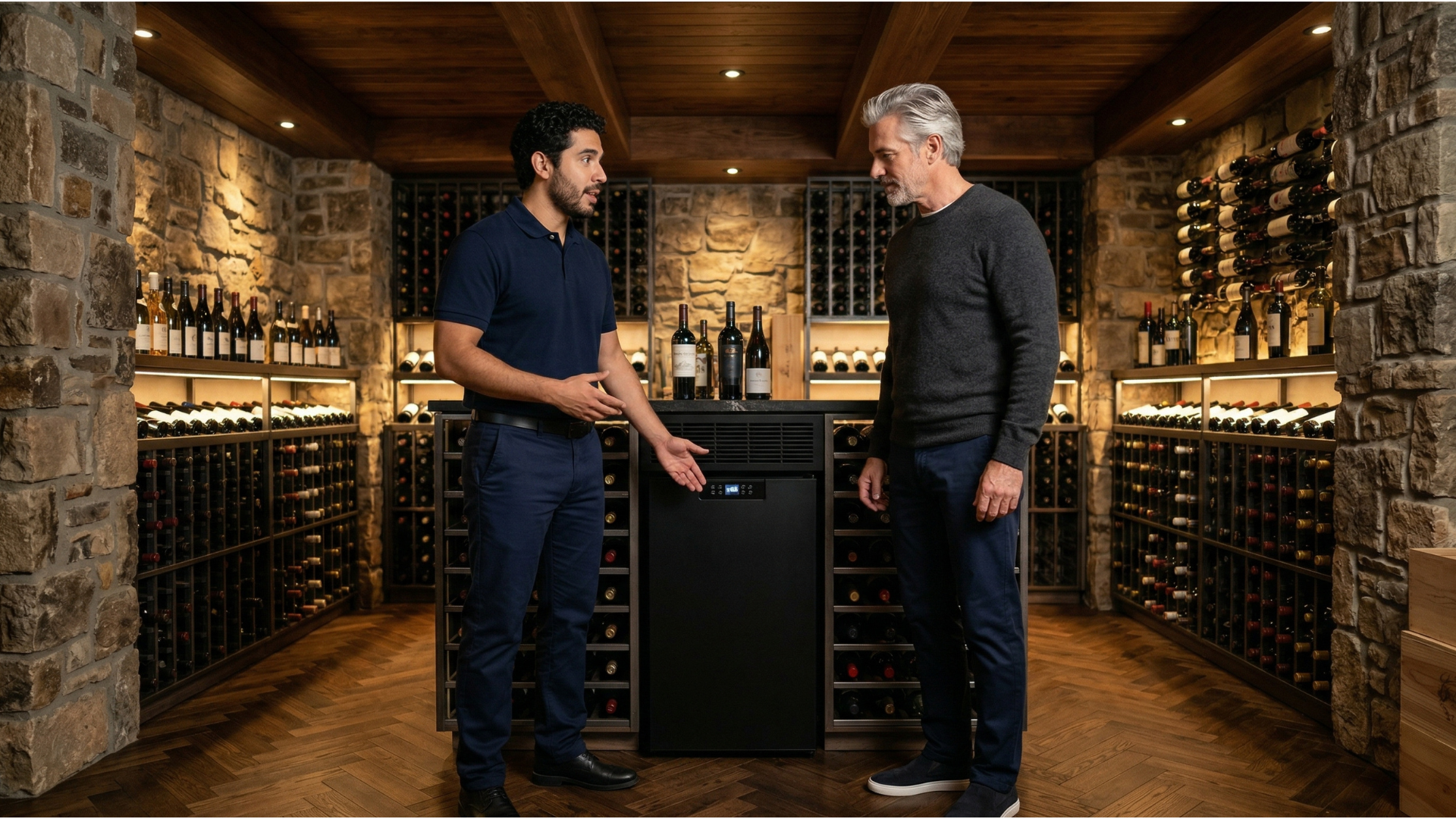





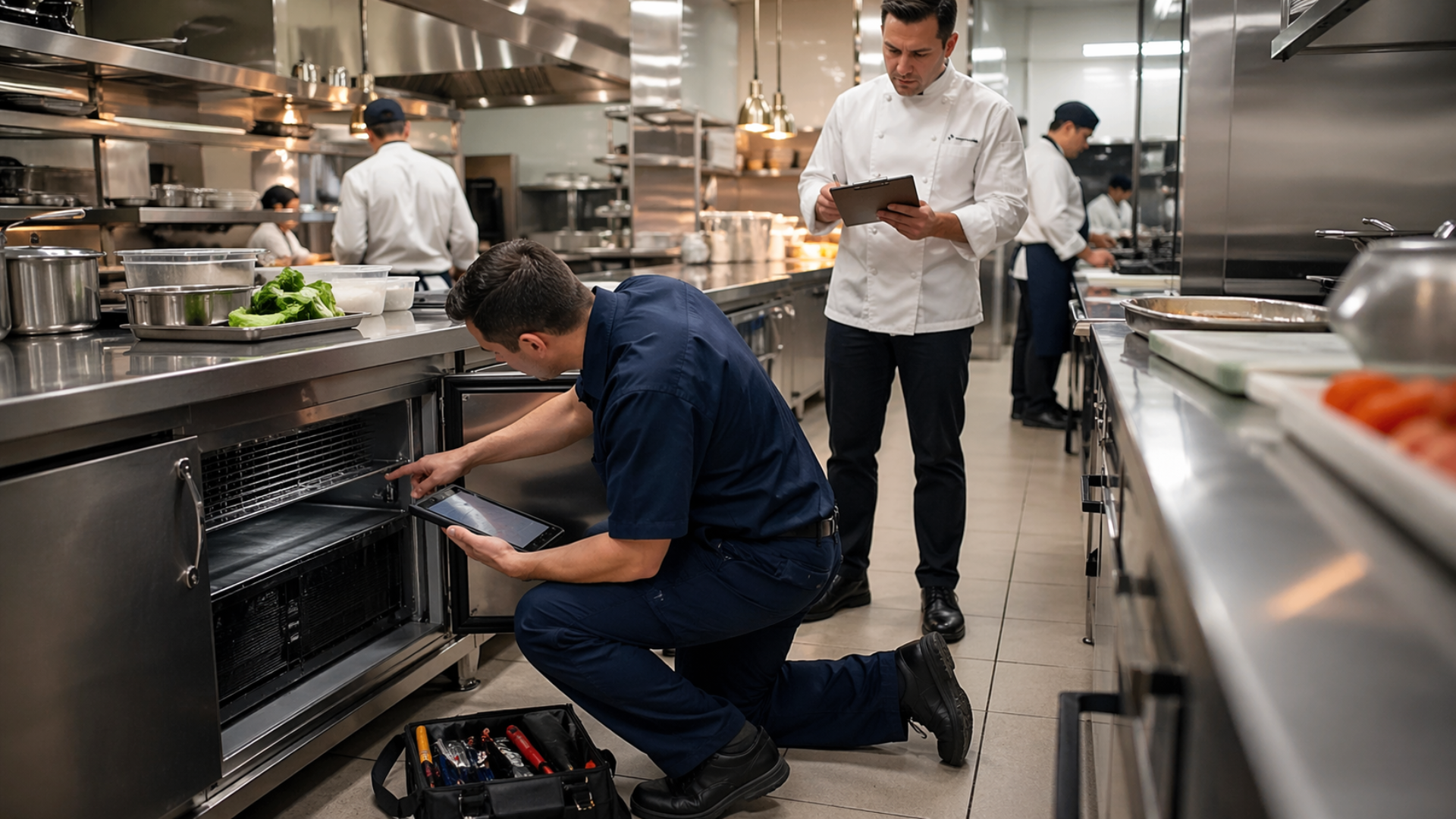
The walk-in cooler alarm starts beeping at 10:47 a.m. on a Friday. Lunch service opens at 11:30. The manager calls the usual service company — the one the previous GM hired three years ago — and gets a voicemail promising a callback. By noon, the cooler is reading 52°F. By 2:00 p.m., it’s 58°F. By the time a technician arrives Monday morning, the restaurant has thrown out $8,400 of inventory, canceled a Saturday wedding rehearsal dinner, and been visited by a health inspector who walked the kitchen unannounced.
None of that was the cooler’s fault. The compressor was a $600 part and a three-hour repair. Every other cost downstream — the food, the canceled service, the regulatory exposure — was the cost of response time. For any Houston restaurant operating on 5 to 10% EBITDA margins, the single most important vendor decision in the commercial kitchen is not which equipment to buy. It is how fast help arrives when it fails.
The Regulatory Clock Is Six Hours
Texas restaurants operate under the Texas Food Establishment Rules (25 TAC Chapter 228), which adopt the FDA Food Code as the operational standard. The rule that matters in a refrigeration failure is specific and unforgiving: time/temperature control for safety (TCS) foods must be held at 41°F or below. When refrigeration fails and the temperature rises, the regulatory clock begins immediately.
The inspector’s framework: TCS food held between 41°F and 70°F for more than four hours must be discarded. Food held above 70°F for more than two hours must be discarded. In a typical Houston walk-in cooler failure during a July afternoon, the interior temperature passes 41°F within 90 minutes of compressor shutdown, and 70°F within four to six hours. The math of the regulation means that a Friday afternoon failure, if not addressed within roughly six hours, converts the entire contents of a cooler into waste — not because the food is visibly spoiled, but because TFER requires its disposal.
This is why the service-call window matters so much in restaurant equipment. The equipment failure is bounded. The regulatory consequence of the failure is bounded. The time between them is the only variable that a service provider changes.
The Equipment Most Likely to Fail on the Worst Day
Restaurant equipment does not fail randomly. Research from quick-service restaurant operations shows that three of the top six equipment breakdowns involve refrigeration systems, and unplanned equipment failures can cost restaurants up to 11% of revenue when downtime, spoilage, and recovery costs are compounded.
Four categories of equipment produce the overwhelming majority of emergency calls in Houston commercial kitchens:
Walk-in coolers and freezers, which operate continuously against Houston’s 96°F summer ambient and 75-80% humidity, are the category where small maintenance lapses compound fastest. A condenser that has not been cleaned for a year carries a 30-40% performance derating into July. The operational realities of walk-in cooler failure in Houston — including the load Texas climate places on Copeland scroll compressors, Heatcraft evaporators, and the Bohn condensing units that dominate this market — determine whether the equipment is a 12-year asset or a 7-year liability.
Commercial ice machines — Scotsman, Hoshizaki, Manitowoc, and Follett dominate the Texas hospitality market — fail in predictable patterns driven by municipal water quality. Scale buildup on evaporator plates reduces ice output by 15-30% over 18 months of operation without descaling. A bar operating on half its normal ice output cannot serve at full capacity, and the failure cascades into service speed and customer satisfaction before it produces a service call. Scotsman and Hoshizaki service under factory-qualified technicians is structurally different from residential refrigeration work — the duty cycles, the municipal water profiles, and the parts supply chains are all separate markets.
Commercial reach-ins and prep tables are the hidden failure category. Line cooks open prep tables hundreds of times per shift. The door gaskets fail first, the door hinges fail next, and when the compressor finally fails on the hottest Saturday of July, the equipment has actually been failing slowly for 18 months through a door-seal leak that forced it into continuous duty.
Range hood ventilation and gas cooking equipment round out the category. Hood fire-suppression systems have quarterly inspection requirements under NFPA 96, and a hood shutdown due to grease accumulation is a code-enforcement event that stops service until cleared.
Why Emergency Response Time Defines the Relationship
A residential Sub-Zero failure is uncomfortable. A restaurant walk-in failure is existential. The difference is the rate at which costs accumulate.
Residential refrigeration: the owner loses some groceries. Service can be scheduled for next Tuesday. The cost of waiting 72 hours is the inconvenience. Commercial refrigeration in a high-volume restaurant: the operator loses inventory at roughly $2,000 per hour for a moderately stocked walk-in, plus gross margin on canceled reservations, plus labor costs for idle staff, plus the regulatory exposure described above. The cost of waiting 72 hours compounds into 10-15% of monthly revenue in many documented cases.
The service provider’s response framework is therefore the single largest operational variable in commercial kitchen equipment management. “Emergency service” is not a marketing claim in this category — it is a specific, measurable SLA that includes phone-answer time, technician dispatch, on-site arrival, parts availability, and first-visit repair rate. A provider whose structure cannot answer at 10:47 a.m. Friday call with a technician on-site by 2:00 p.m. is, functionally, not available for restaurant service.
The Maintenance Contract Question
The operators who avoid the Friday-afternoon cascade are almost always on maintenance contracts, not on run-to-failure. The economics are straightforward: quarterly preventive inspections on walk-in coolers, semi-annual descaling on ice machines, and annual deep service on prep tables cost less than one emergency event per year, and they catch 70-80% of the failures that would otherwise produce the emergency.
A formal maintenance contract structure adapts naturally from property management to commercial kitchens — in both cases, the operator is trading a small, predictable expense for the avoidance of large, unpredictable ones. For restaurants specifically, the contract also produces documentation that health inspectors value during annual audits: dated service records, temperature log reviews, and filter/descaling verification are all items that reduce regulatory friction, independent of whether they prevent any specific failure.
What to Ask Before the Emergency
The service provider relationship must be established before the Friday afternoon call. Three specific questions surface whether a provider is structured for restaurant service:
Who answers the phone at 10:00 p.m. on a Saturday, and what is their authority to dispatch a technician? If the answer is “a call center that takes a message,” the provider is not structured for commercial work.
What is the parts inventory for Copeland scroll compressors, Heatcraft evaporator fan motors, Scotsman/Hoshizaki descaling assemblies, and walk-in cooler door gaskets? A provider who stocks common wear parts catches most first-visit repairs; a provider who orders them per call turns a three-hour emergency into a three-week exposure.
What is the on-site response time commitment during peak service hours? Not the “we’ll try to get there” answer — the contractual SLA. Providers who cannot put a number in writing do not have the operational structure to honor one under load.
The framework for evaluating any appliance service provider applies with particular weight to restaurant work, because the cost of getting the evaluation wrong is measured in discarded inventory and canceled service, not in personal inconvenience.
The Working Framework for Restaurant Operators
Commercial kitchen equipment runs on tighter tolerances and harder duty cycles than anything in a residential kitchen. The failures are not worse engineering problems; they are identical engineering problems operating in a context where the clock runs faster, and the regulatory consequences arrive sooner.
The operational response that protects the business has three components. A maintenance contract that catches predictable failures before they become emergencies. A service provider whose structure — phone, parts, technician dispatch — can deliver on-site response within hours, not days. And an internal protocol for the moment the alarm sounds: who calls the service company, who documents temperature readings, who notifies front-of-house that certain menu items are coming off, and who decides which inventory to move and which to discard. The regulatory clock does not wait for any of those decisions to be made in real time. Every restaurant that has survived one of these events already had the answers written down.
Uptown services commercial refrigeration, ice machines, range hoods, and cooking equipment across Houston and Dallas with the response-time structure the category requires. For operators whose current service relationship was defined by proximity or price rather than by the specific question of Friday-afternoon response, the evaluation is worth running before the alarm starts beeping rather than after.