




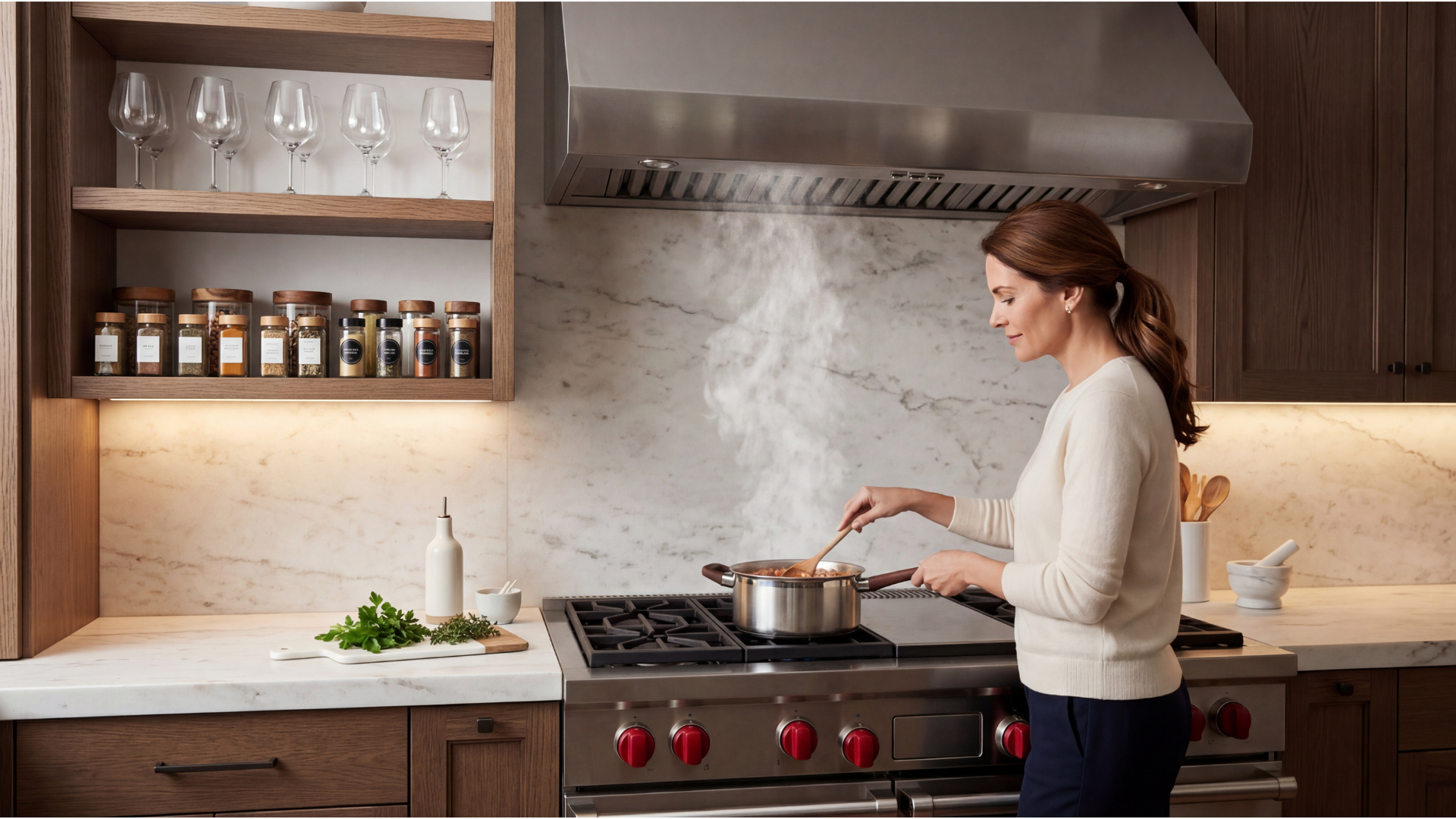
A Wolf 48″ dual-fuel range outputs up to 135,000 BTU across its burners. The ventilation standard for ranges at that heat level is 100 CFM per 10,000 BTU — meaning adequate capture requires 900 to 1,200+ CFM. Most residential hoods installed above these ranges move 400 to 600 CFM.
The consequence isn’t just lingering cooking odors. Under-ventilated kitchens accumulate grease aerosols on cabinetry, accelerate moisture infiltration into adjacent Sub-Zero refrigerator seals, and generate indoor air quality readings that rival outdoor pollution on high-BTU cooking days. When these symptoms appear, the range typically gets the service call. The hood is rarely examined.
What the code requires — and what most kitchens ignore
Texas cities individually adopt IRC and IMC building standards. IRC Section M1503.6 requires that any exhaust system exceeding 400 CFM must be provided with makeup air at a rate approximately equal to the exhaust rate — provided there’s atmospherically vented combustion equipment in the home (gas water heaters, fireplaces).
This threshold matters because just 10 Pascals of negative pressure — the equivalent of a gentle 9 mph breeze — is sufficient to cause backdrafting of gas water heaters and fireplaces, potentially drawing carbon monoxide into living spaces. A high-output hood running without a makeup air system depressurizes the home every time it operates.
Makeup air systems with preheaters run $3,000–$5,000 installed. Most luxury kitchen renovations omit them entirely, either because the contractor wasn’t aware of the threshold or because the owner chose the hood based on aesthetics rather than CFM output. The result is a system that can’t legally or safely run at full capacity.
The grease fire calculus
NFPA data consistently identifies cooking as the leading cause of reported home fires. The ignition threshold is lower than most people expect: 1/8 inch of grease accumulation can ignite at temperatures as low as 375°F — well within the range of any cooking oil at normal sauté temperature.
An undersized or failing hood doesn’t just reduce capture efficiency — it deposits grease faster on interior duct surfaces, building toward ignition conditions with every use. Flexible ductwork (which Sub-Zero and Wolf explicitly prohibit in their ventilation specifications) compounds the problem by trapping grease at bends rather than allowing it to exhaust cleanly.
The Sub-Zero Wolf ventilation guide specifies: maximum equivalent duct length of 50 feet, 8- or 10-inch round rigid metal ducting, and a minimum of 15 inches of straight duct between elbows. Deviations from these specs don’t just reduce performance — they’re documented as contributing factors in insurance claim denials after ventilation-related fire damage.
The indoor air quality argument
EPA data shows gas stoves produce 1.5 to 4 times higher indoor NO₂ concentrations than electric stoves. A May 2024 Stanford study found gas and propane stoves account for approximately 25% of average total indoor and outdoor NO₂ exposure for regular cooks — exceeding 50% for heavy users. A 2013 meta-analysis found that children in homes with gas stoves have a 42% higher risk of current asthma, comparable to exposure from living with a smoker.
Adequate ventilation doesn’t eliminate these emissions — but it reduces peak concentrations significantly. For households with children or anyone with respiratory conditions, the hood isn’t a kitchen accessory; it’s the primary mitigation system for daily combustion byproducts.
Where Vent-A-Hood fits in the Dallas market
Vent-A-Hood, headquartered in Richardson, Texas, since 1933, is the oldest residential range hood manufacturer in America and holds approximately 70% of the high-end residential ventilation market. Their patented Magic Lung® centrifugal blower captures grease through centrifugal force rather than conventional filters — which creates a meaningful fire safety advantage. Because the system separates grease from air mechanically before either can enter the ductwork, it removes the grease-laden filter as a potential ignition point.
For Dallas service companies, Vent-A-Hood’s Richardson headquarters is a significant parts access advantage — domestic manufacturing and a local distribution point means lead times that European luxury hood brands can’t match.
The diagnostic that’s usually skipped
Ventilation failures mimic appliance failures often enough that the hood should be on the diagnostic checklist for any high-BTU range complaint. Specific symptoms that point to ventilation rather than the range:
Grease deposits visible on cabinet faces above the cooking surface indicate the hood isn’t capturing at the cooking plane — either because CFM is insufficient, the hood is mounted too high (optimal height is 30–36 inches from countertop), or the hood doesn’t extend at least 3 inches beyond the cooking surface on all sides.
Fan noise that increases over time is usually a motor bearing issue or grease accumulation on the blower wheel — both maintenance items, not appliance failures.
A cooking odor that clears slowly after cooking ends, but the range itself is functioning normally, almost always indicates a CFM shortfall relative to BTU output.
For Wolf and Sub-Zero owners, the service plans page covers ventilation system maintenance alongside appliance service — addressing the full kitchen system rather than individual components in isolation. Given how frequently ventilation problems are misrouted to appliance service calls, evaluating both together tends to resolve symptoms that repeat after single-system repairs.
The range hood is the most underspecified component in most luxury kitchens. For rooms built around $15,000–$18,000 Wolf ranges with six-figure cabinetry packages, it’s also the most consequential item to get wrong.
Uptown Appliance Repair serves Dallas (Highland Park, Preston Hollow, University Park) and Houston (River Oaks, Memorial, The Woodlands). Same-day emergency service available. Call (281) 758-9978.