




Dallas average highs swing from 77°F in April to 97°F by July — a 20-degree jump in roughly ten weeks. For a wine cellar holding steady at 55°F, that shift transforms a manageable 22°F temperature differential into a punishing 42°F gap that nearly doubles the cooling system’s workload.
A system that hums along in spring may collapse under that load by midsummer. And by then, every hour of failure accelerates the chemical degradation already underway inside your bottles.
The Arrhenius problem: heat doesn’t damage wine gradually — it compounds
Most collectors understand that heat is bad for wine. Fewer understand how bad, or how fast.
The Arrhenius equation — the same thermodynamic principle used in pharmaceutical stability testing and semiconductor reliability — quantifies the relationship between temperature and chemical reaction rates. Applied to wine, the math is stark: for every 10°C (18°F) increase in storage temperature, the rate of chemical aging roughly doubles.
At 73°F, wine ages somewhere between 2 and 8 times faster than at 55°F, depending on the specific reaction pathway. At 91°F — a temperature a failed cellar in Dallas can reach within 48 hours during summer — aging accelerates by a factor of 4 to 56. One month at that temperature can inflict the equivalent of years of aging on sensitive vintages.
Research published in the Australian Journal of Grape and Wine Research confirmed that elevated storage temperatures produce measurable changes in color, aroma compounds, and SO₂ levels — changes that are irreversible once they occur. White wines brown faster. Volatile compounds that create desirable floral and fruity aromas degrade within days at extreme temperatures. Red wines lose anthocyanins at rates that increase logarithmically with heat.
This is why April matters. The audit isn’t maintenance — it’s stress-testing before the stress arrives.
What the differential reveals: half-load vs. full-load diagnostics
A wine cellar cooling system operating against a 22°F differential in April runs at roughly half its summer capacity. Marginal components — a compressor drawing slightly elevated amps, a condenser coil with 60% airflow restriction, a slow refrigerant leak — can still maintain the setpoint at that load. The system appears fine.
By July, that same system faces a 42°F differential and runs near-continuously. The marginal compressor overheats. The restricted condenser can no longer reject enough heat. The slow leak has dropped the refrigerant charge below the threshold for effective cooling. Failure cascades.
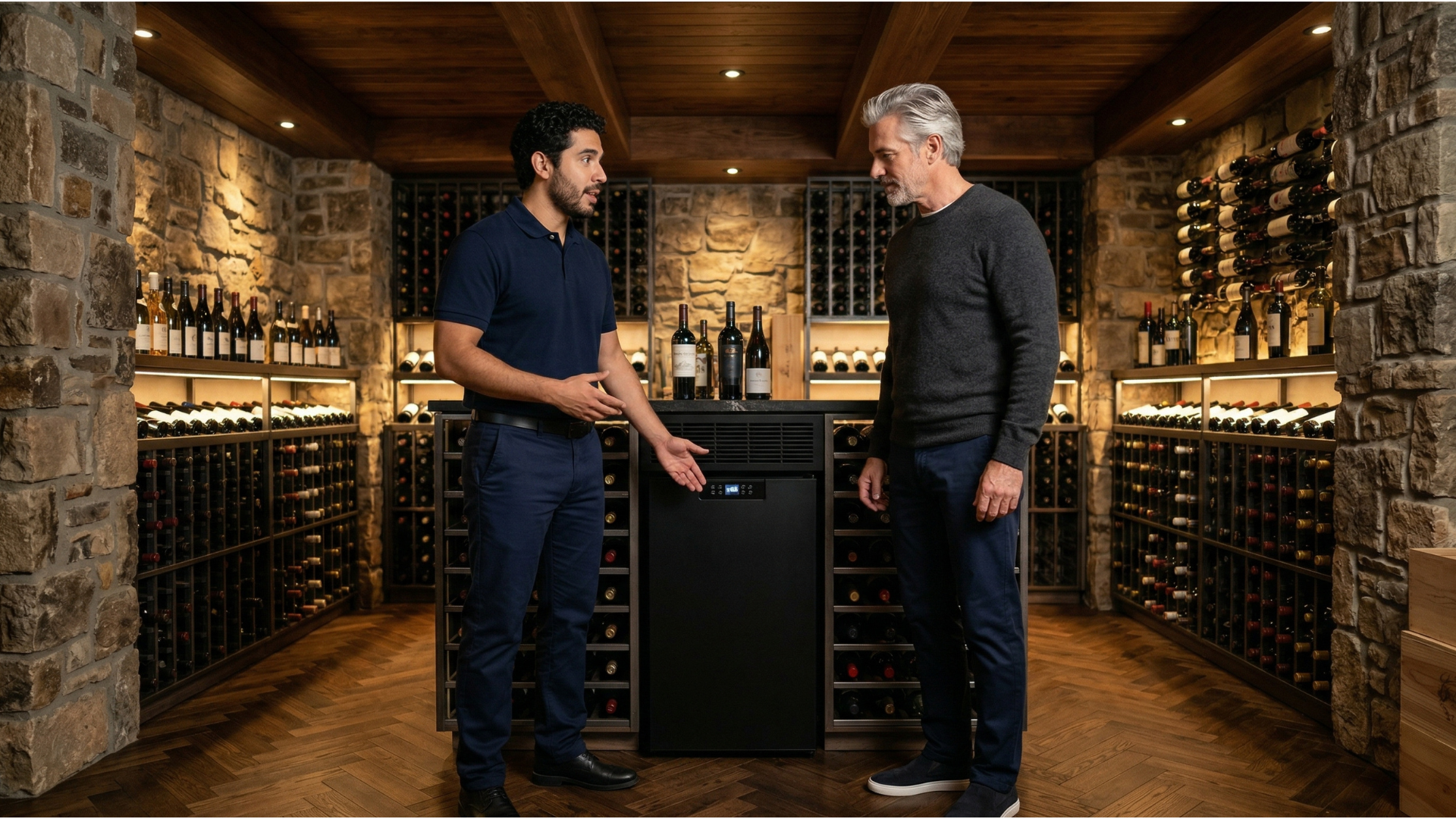
The April audit catches these issues precisely because the system isn’t yet in crisis. Technicians can measure compressor amp draw against manufacturer specifications, check refrigerant pressures with manifold gauges, and identify the gap between current performance and rated capacity — a gap that only becomes visible under controlled conditions.
Five components that fail differently in Texas heat
Compressor health
Elevated amp draw exceeding rated load amps by more than 10% signals impending failure. Short-cycling — compressor engaging more than 8 times per hour — indicates the system is struggling to maintain pressure differentials. Both conditions worsen exponentially as ambient temperatures climb. In April, a technician can catch a compressor trending toward failure. In July, that same compressor may already be seized.
Condenser coil condition
Dirty condensers are the single most preventable cause of wine cellar cooling failure. In Dallas neighborhoods like Highland Park and Preston Hollow, where mature landscaping surrounds most estates, condenser coils accumulate pollen, cottonwood seeds, and debris from spring growth. Properties near dryer vents face additional lint buildup. The coils need cleaning every three to six months — and the pre-summer window is the most consequential.
Refrigerant charge
The air temperature delta between entering and exiting the cooling unit should measure 12–15°F. Below that range suggests low refrigerant — often from slow leaks at joints and fittings that may lose only ounces per month. An April pressure check catches losses early, before the system compensates by running longer cycles that stress every other component.
Door seals and insulation
Wine cellars require R-15 to R-20 wall insulation and R-19 to R-40 ceiling insulation to maintain efficient operation. Degraded door seals — testable with the dollar-bill method (if the bill slides out easily, the seal has lost magnetic retention) — allow conditioned air to escape and humid exterior air to infiltrate. In Dallas’s climate, where the city logs 108 days at or above 90°F annually, even minor seal failures compound cooling costs and shorten system lifespan.
Condensate drainage
Drain lines clog with mold, algae, and insects over fall and winter. When the system ramps up for summer and produces significantly more condensate, blocked drains overflow — causing water damage, mold growth, and humidity spikes that threaten cork integrity. A 30-second drain inspection in April prevents a potential collection emergency in August.
The humidity dimension most collectors overlook
Temperature dominates wine storage conversations, but humidity is equally destructive — and harder to monitor without instrumentation.
The ideal range sits between 60% and 70% relative humidity. Below 55%, corks begin measurable shrinkage within four to six months. A UC Davis study tracking 12,000 bottles over seven years found a 3.8x higher rate of premature oxidation when humidity dropped below 50% compared to the 60–70% range.
Dallas runs drier than Houston for most of the year and can sustain humidity below 50% for weeks without collectors noticing — particularly in homes where HVAC systems aggressively dehumidify interior air. A pre-summer audit that includes hygrometer calibration and humidity system testing catches drift before corks start drying.
Monitoring technology worth the investment
WiFi-enabled sensors have made continuous cellar monitoring accessible at negligible cost relative to collection value. Systems like the SensorPush HT1 ($50–70 for the sensor, $100 for the gateway) deliver ±0.3°C accuracy with no monthly subscription fees. For whole-cellar coverage, Govee WiFi sensor packs run $40–60 for a six-unit set.
A $200 monitoring system protecting a $200,000 collection represents less than 0.1% of collection value — less than a single year of specialized wine insurance premiums. The data these sensors generate also creates a documented temperature and humidity record that supports insurance claims if equipment failure does occur.
Preventive economics: the cost gap between planned and emergency service
Industry data consistently shows that unplanned maintenance costs three to nine times more than scheduled service. For wine cellar cooling systems specifically, the gap between a preventive visit and an emergency compressor replacement illustrates the math clearly.
Preventive maintenance programs reduce emergency calls by approximately 60% and extend equipment lifespan by five to ten years. A well-maintained system operates 15–20 years; a neglected unit in Texas heat may fail within seven to ten.
The April audit is the single most cost-effective intervention point in the annual maintenance cycle. It falls after winter dormancy (when low-demand operation masks developing issues) and before summer stress (when failures become urgent and service schedules fill).
What the audit produces
A thorough pre-summer inspection by factory-certified technicians covers EuroCave, CellarPro, WhisperKool, Breezaire, and Wine Guardian systems — and should deliver three outputs:
A current performance baseline: compressor amp draw, refrigerant pressures, temperature delta, humidity readings, and seal integrity — all measured against manufacturer specifications.
A risk assessment: which components are trending toward failure and at what timeline, so repairs can be scheduled proactively rather than reactively.
A maintenance record: documented service history that supports warranty claims, insurance documentation, and resale provenance for investment-grade collections.
For Highland Park, University Park, and Preston Hollow collectors managing five- and six-figure collections, this documentation alone justifies the service visit. It transforms a maintenance appointment into a verifiable asset protection record.
Dallas: (214) 761-8300 | Houston: (281) 758-9978