




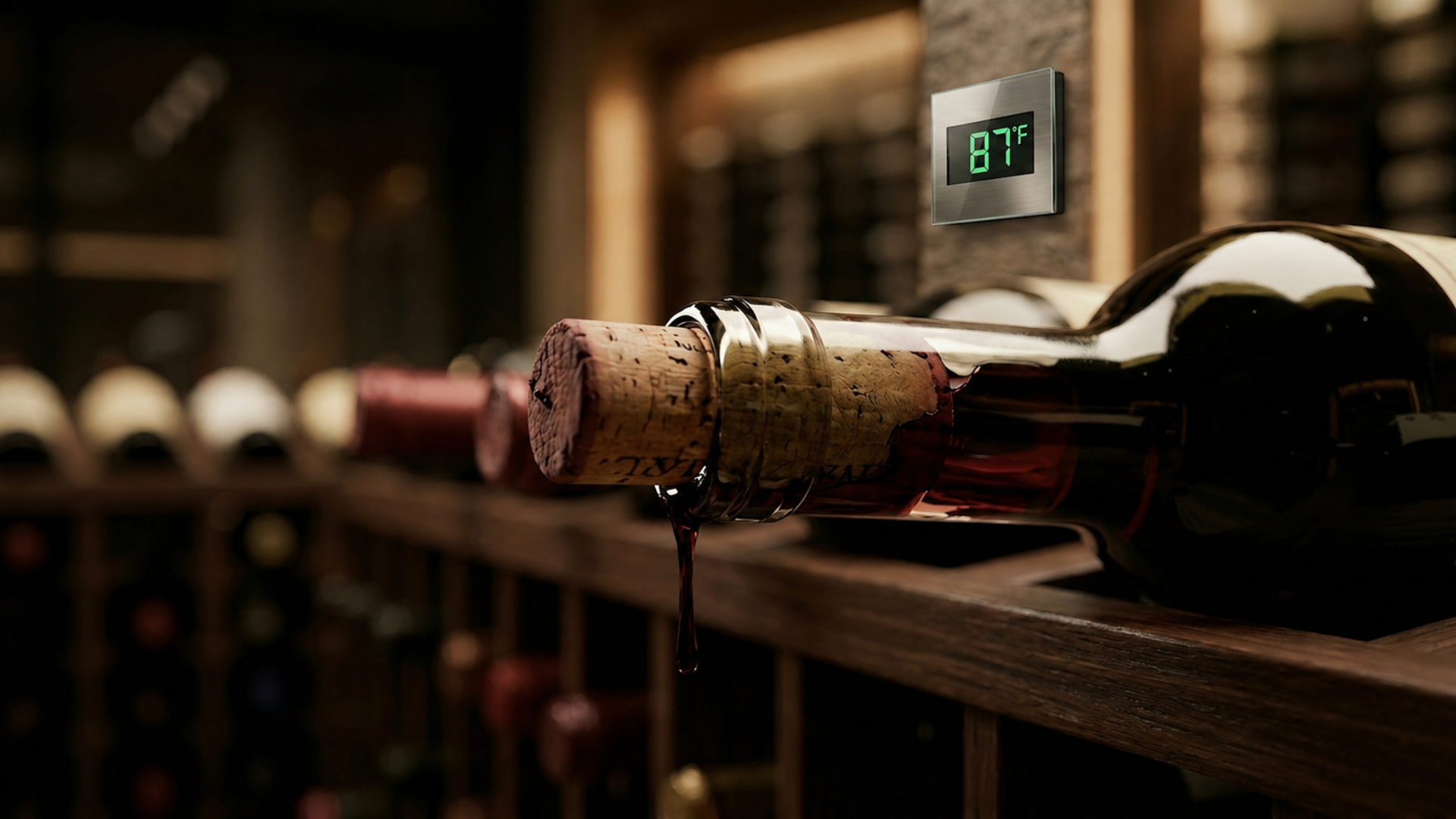
The cooling system failed at 2 p.m. on a Tuesday in July. The cellar was reading 55°F when it failed. The collector was out of town and the cellar’s remote monitoring had stopped pushing notifications six weeks earlier — a lapsed app subscription nobody noticed. By Thursday evening the cellar was at 87°F. The collection, conservatively valued at $180,000, had aged at an accelerated rate equivalent to three to five years in a well-maintained environment. Several older Burgundies had pushed corks past their retention point and begun seeping.
Every Texas summer produces a version of this story. The cooling failure is the initiating event, but the damage is not instantaneous — it compounds along a curve that serious collectors should understand before they ever encounter it. What the next 48 hours actually cost is governed by physics that is unforgiving in one direction and reversible in the other, and the decisions that matter happen within the first six hours.
Hour Zero: The Failure
A wine cellar cooling system fails in one of three ways: a compressor seizure (sudden, no warning), a refrigerant leak (gradual, often announced by warm cellar air days before full failure), or a control-board fault (random, often presenting as a cooling system that runs but doesn’t cool). Texas summer failures concentrate in the first two categories, and the compressor failures concentrate in July and August when ambient conditions force extended duty cycles.
At hour zero, the cellar is at setpoint. The cellar’s insulation — assuming R-15 to R-20 walls and proper vapor barrier placement — is the only thing standing between the collection and ambient conditions.
Hours One to Six: The Insulation Phase
A properly insulated cellar rises in temperature at approximately 1 to 2°F per hour during Texas summer conditions. The cellar’s R-value, the outdoor ambient, and the solar load on exterior walls all modify this rate, but the band is narrow.
At hour six, a cellar that started at 55°F is reading 61 to 67°F. This is the phase where wine damage is reversible with no material loss — corks have not dried, labels have not molded, pressure inside the bottles has not exceeded containment — and it is also the phase where a service call can restore the cellar to setpoint before any compromise occurs.
This is the window that matters. Every hour past six adds a permanent change to the collection.
Hours Six to Twelve: The Acceleration Phase
Between hours six and twelve, a cellar without cooling passes through the 68 to 75°F range. The chemistry changes here.
Dr. Alexander Pandell’s published work on wine temperature and aging, drawing on Arrhenius kinetics applied to the specific reactions that govern wine development, establishes what wine chemists already knew quantitatively: reaction rates roughly double for every 10°C increase in temperature. Depending on the specific reaction, wine at 73°F ages 2.1 to 8 times faster than wine at 55°F. Wine Spectator’s editorial position echoes the chemistry — sustained temperatures above 70°F age wine “more quickly than is usually desirable.”
At hour twelve, a cellar that has been passively losing temperature since failure is reading 72 to 78°F. A 2015 study published in the Australian Journal of Grape and Wine Research (Scrimgeour et al.) documented the specific ways elevated storage temperature degrades wine composition — browning reactions, sulfur dioxide decline, and anthocyanin degradation all accelerate along Arrhenius curves that compound exposure-time with temperature. The 12-hour window does not produce weeks of damage in one burst, but it initiates the chemistry that continues compounding for every hour the temperature remains elevated.
Hours Twelve to Twenty-Four: The Chemistry-Is-Moving Phase
Between hours twelve and twenty-four, a typical Texas cellar reaches 78 to 85°F. At 85°F, aging rates push toward the upper end of the Arrhenius band and continue climbing.
What matters at this phase is not the instantaneous temperature but the integrated exposure — the sum of elevated temperature multiplied by elapsed time. A collection that spends 24 hours averaging 78°F accumulates aging equivalent to several weeks at 55°F.
Sulfur dioxide, the preservative that protects wine from premature oxidation, declines at about 1.2 times the normal rate across this range. This is the chemical marker that makes “heat-damaged” a category rather than an event — the wine isn’t ruined, but its ability to protect itself against future oxidation is diminished, and that diminishment is cumulative. The warning signs that precede a major cellar loss — including the behavioral and chemical markers a cellar displays before catastrophic failure — are the diagnostic framework that separates recoverable events from total losses.
Hours Twenty-Four to Forty-Eight: The Consequence Phase
By hours twenty-four to thirty-six, most Texas summer cellars without cooling have reached ambient — 80 to 95°F, depending on the building envelope. At 91°F, Pandell’s calculations show aging accelerating 4.1 to 56.1 times normal: one month at 91°F equals four months to eighteen years of aging at 55°F, depending on the specific chemical reaction.
This is the phase where cork integrity becomes the failing variable, not chemistry. As internal bottle pressure rises with temperature, older corks — particularly in Burgundies, older Bordeaux, and any bottle with 15+ years of age — push past their retention point. Seepage is the visible signal; the invisible signal is accelerated oxidation through a compromised seal that continues even after the cellar is restored.
The insurance context at this phase is worth naming. Standard homeowners insurance covers wine collections at $1,000 to $2,500 total — the same limit applied to kitchen goods, regardless of the collection’s actual value. Mechanical breakdown of cooling equipment and “gradual temperature change” are both commonly excluded. A collector relying on homeowners coverage for a wine-collection loss is typically recovering less than 1% of actual damages.
The Decision Framework: What to Do in the First Six Hours
The collection is protected if the cooling system is restored before hour six. After that, damage is cumulative and partially irreversible. Three actions change outcomes during the critical window.
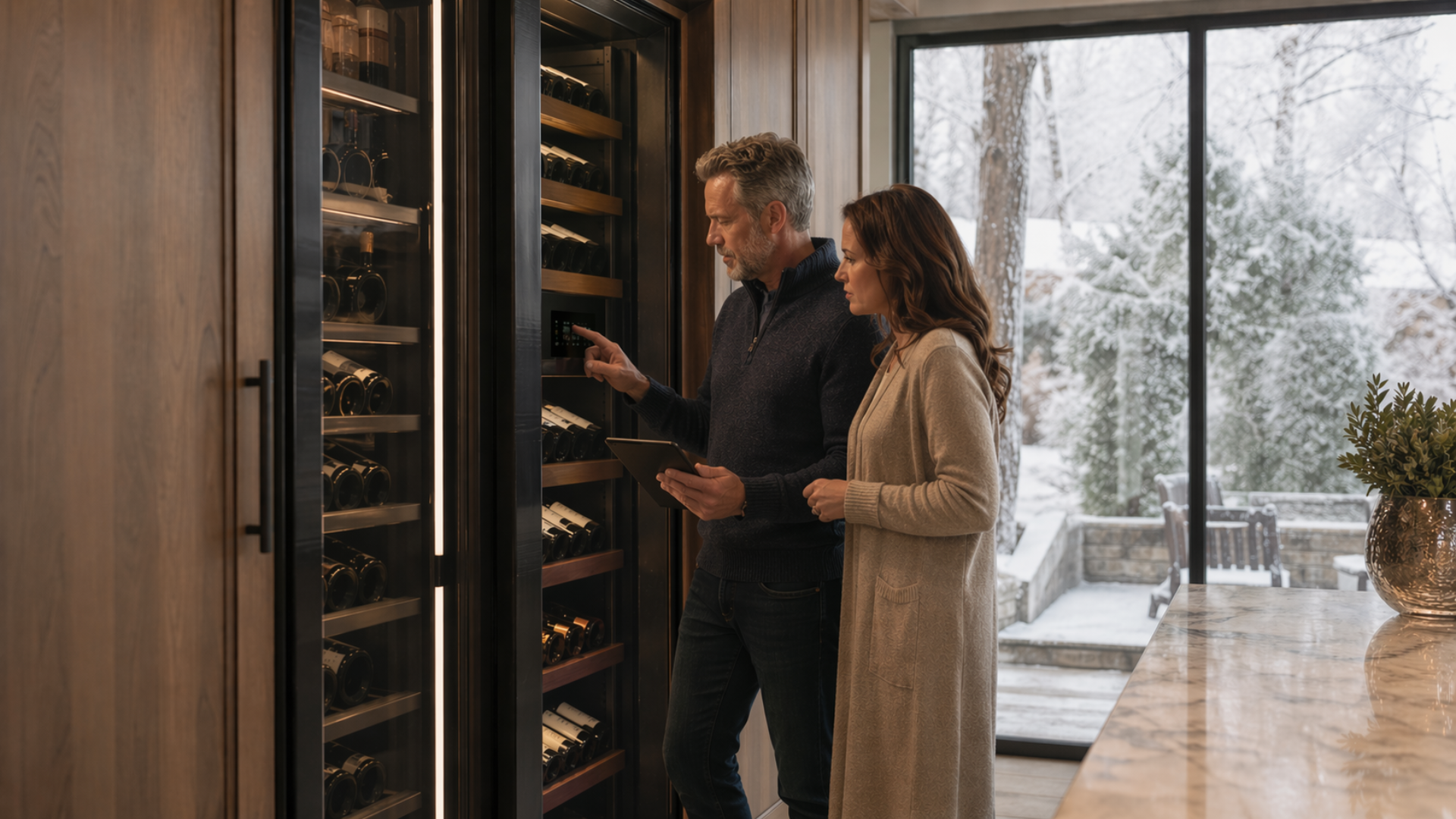
First: recognize the failure. A cellar that rises from 55°F to 58°F without resetting is not “drifting” — it is a cooling system that is not cycling. Remote monitoring (SensorPush, Govee, or integrated systems from Wine Guardian) is the cheapest collection insurance available; sub-$100 sensor coverage for a six-figure collection is asymmetrical risk management.
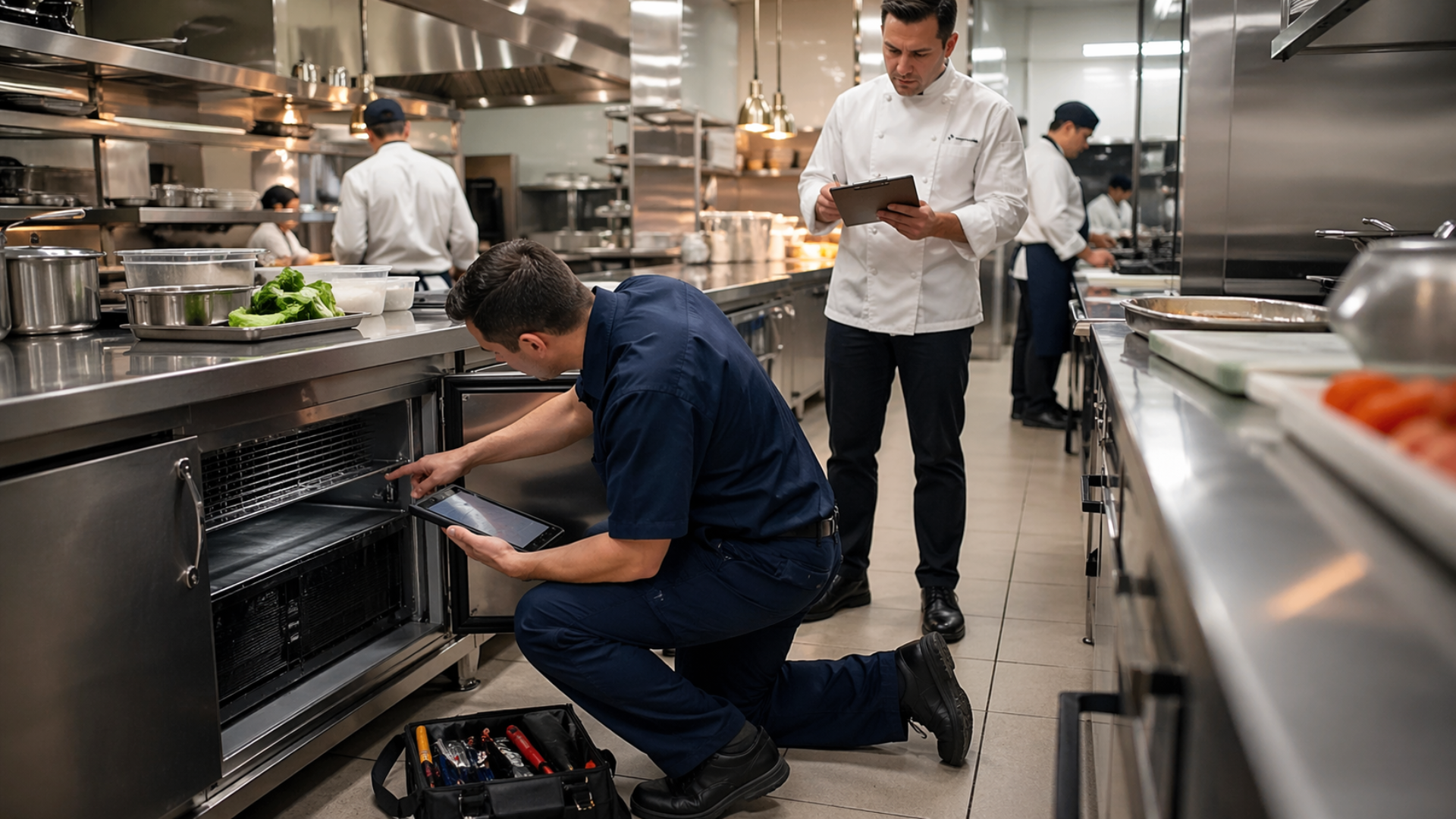
Second: contact emergency service within hours, not days. Wine cellar service is fundamentally different from kitchen refrigerator service, and generalists are not the answer. A factory-certified technician qualified on CellarPro, EuroCave, WhisperKool, Breezaire, or Wine Guardian systems is the only reliable restoration path.
Third: if the service cannot arrive before hour six, temporary mitigation buys time. A portable air conditioning unit running in the cellar is ugly but functional. Relocating the highest-value bottles to a commercial wine storage facility (Vault & Vino in Montrose, UOVO Wine Houston, or Big Tex Storage for Dallas) removes the irreplaceable inventory from the damage curve entirely.
What the 48 Hours Actually Cost
The financial loss from a 48-hour Texas summer wine cellar failure depends on collection composition, but the pattern is consistent. Younger wines (under five years) often survive with minor oxidative damage. Older collectibles — Burgundies 15+ years old, older Bordeaux, aged Italian wines — suffer disproportionately because their cork integrity is already marginal.
For a collection worth $100,000, a typical 48-hour Texas summer failure produces 5 to 15% value loss at resale — $5,000 to $15,000 — plus the aging acceleration that costs the collector time on wines that still have holding potential. For a $500,000+ collection with significant aged inventory, the range widens substantially. The variable that matters most is not collection size. It is how many hours elapsed between failure and restoration.
The cooling system will fail eventually. The collection’s exposure depends on whether the response time is measured in hours or in days. Texas summers do not give collectors the latter.