




Miele tests every washing machine for 10,000 hours across 5,000 wash cycles, simulating 20 years of household use before a single unit reaches a showroom floor. No other manufacturer subjects its laundry appliances to that standard. The result is a machine that, at $1,999 for the W1 washer and up to $1,899 for the T1 heat-pump dryer, costs two to three times what a conventional washer-dryer set runs and lasts roughly three times as long.
This creates a problem that Miele owners in Houston and Dallas discover only when something finally goes wrong. The average appliance repair technician has fixed hundreds of Samsung and LG washers. He has probably serviced a few dozen Bosch units. But a Miele W1 with a TwinDos dosing fault or a honeycomb drum bearing issue? He may have seen one, maybe two, in his entire career. The machine’s greatest selling point — it almost never breaks — becomes its greatest repair vulnerability when it does.
What Makes Miele Laundry Engineering Different
Miele builds washers and dryers the way it has since the company’s founding in 1899: with components that other manufacturers consider excessive. Cast-iron counterweights, where competitors use concrete. A stainless steel outer drum, where others use plastic. Enameled front panels that Miele claims are scratch-proof and corrosion-proof. These are not marketing choices. They are engineering decisions that explain why a Miele washing machine spins at 1,600 RPM — extracting more moisture than any residential competitor — without shaking itself apart over two decades of use.
The proprietary systems compound the complexity. TwinDos is a two-phase automatic detergent dispensing system that stores three months of UltraPhase 1 (cleaning) and UltraPhase 2 (stain removal) inside the machine, adjusting the ratio and timing based on fabric color, water hardness, load weight, and soil level. It dispenses UltraPhase 1 at cycle start and introduces UltraPhase 2 roughly 30 minutes later. When this system clogs, miscalibrates, or develops a sensor fault, the machine displays a maintenance prompt that most technicians have never encountered and cannot clear without Miele-specific diagnostic access.
The patented honeycomb drum uses hexagonal dimples that create a thin water film between drum and fabric, reducing wear during the wash cycle and protecting delicate textiles. CapDosing adds another layer: pre-measured capsules for six specialized detergent formulations (sport, down, outdoor, wool, silk, and proofing agent) that release at calculated points during the cycle. Every one of these systems has its own failure mode, its own error messaging, and its own repair protocol.
The Failures That Actually Happen
Miele washers rarely fail catastrophically. They degrade gradually, and the warning signs are specific enough that a trained technician can catch them months before they become expensive.
Bearing wear in the honeycomb drum announces itself through a progressive increase in vibration and noise during spin cycles. In a conventional washer, this is a straightforward bearing replacement. In a Miele, the stainless steel outer drum and cast-iron counterweight assembly require a precise disassembly sequence. Technicians accustomed to plastic tub machines can damage the drum seal or misalign the counterweights, creating a vibration problem worse than the original fault. In River Oaks and Highland Park homes where Miele units often sit on upper floors or in closets adjacent to living spaces, even minor vibration transfer becomes a structural concern that standard leveling cannot resolve.
TwinDos faults are the most common service call on newer W1 models. The system’s dispensing tubes can develop residue buildup that throws off the calibrated dosing volumes. When UltraPhase 2 (the bleach-based stain treatment) dispenses at the wrong concentration or timing, it can damage colored fabrics in a single wash. The machine will prompt TwinDos maintenance, but clearing that prompt requires navigating Miele’s proprietary menu structure and running a compartment-specific cleaning protocol — not simply wiping the detergent tray.
The T1 heat-pump dryers present a different challenge. They run on standard 120-volt outlets rather than the 240-volt connections most dryers require, making them installable almost anywhere but also making them unfamiliar to electricians and technicians trained on conventional dryer platforms. The heat pump itself — the component that enables ventless operation and eliminates the need for external ductwork — fails differently than a traditional heating element. It does not simply stop producing heat. It loses efficiency incrementally, extending cycle times by minutes per load until the homeowner notices shirts taking 90 minutes instead of 60.
Why Houston and Dallas Add Complexity
Texas-specific conditions interact with Miele engineering in ways that do not apply to conventional machines. Houston’s expansive clay soils cause seasonal foundation movement that can shift a Miele washer out of level by fractions of an inch — enough to trigger vibration sensors in a machine engineered to tolerances most washers do not measure. A technician who does not understand that the vibration fault originated from foundation settling, not mechanical wear, will replace shock absorbers ($120–$280) that did not need replacing.
Dallas’s hard water accelerates mineral buildup in the TwinDos dispensing system and affects the heat pump dryer’s moisture sensors, causing inaccurate drying cycle termination. These are maintenance issues in theory but diagnostic puzzles in practice for technicians without Miele-specific calibration tools.
The Uptown Approach
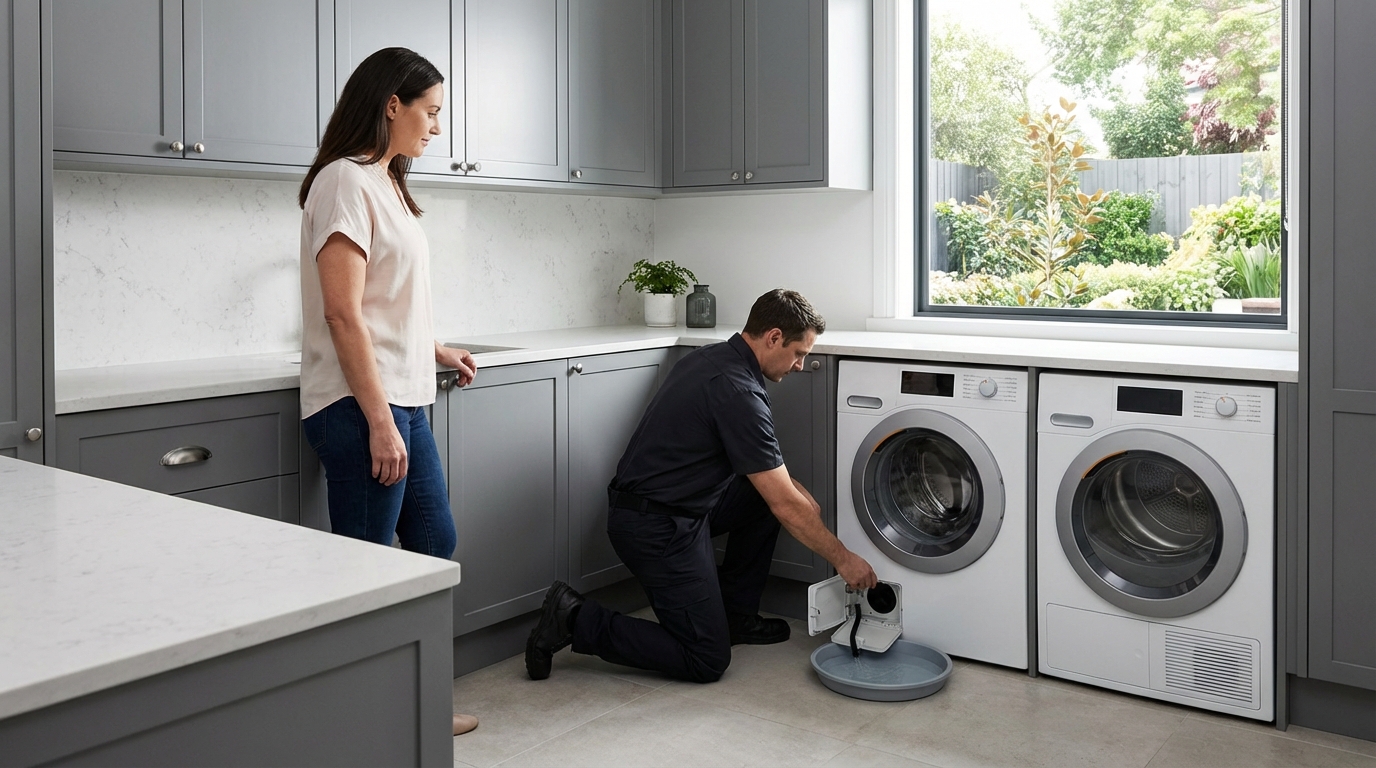
Uptown Appliance Repair maintains factory-certified Miele technicians who carry the diagnostic software and brand-specific training that general appliance repair providers lack. This is not a volume business. Miele laundry sets represent a fraction of the installed appliance base in any market. But for the homeowners in Memorial Villages, West University, University Park, and Preston Hollow who own them, the technician’s familiarity with the platform determines whether a $200 service call resolves the problem or a $1,200 series of misdiagnoses precedes the actual repair.
Our technicians understand the TwinDos calibration process, the honeycomb drum disassembly sequence, and the heat pump efficiency diagnostics that separate a Miele service call from a generic washer-dryer repair. Every repair uses genuine OEM components sourced from Miele, and every repair carries a 2-year warranty on parts and labor — more than double the industry standard.
For a machine designed to last 20 years, a 2-year warranty is not generous. It is proportional.
Schedule your Miele service: (281) 758-9978 (Houston) or (214) 761-8300 (Dallas).