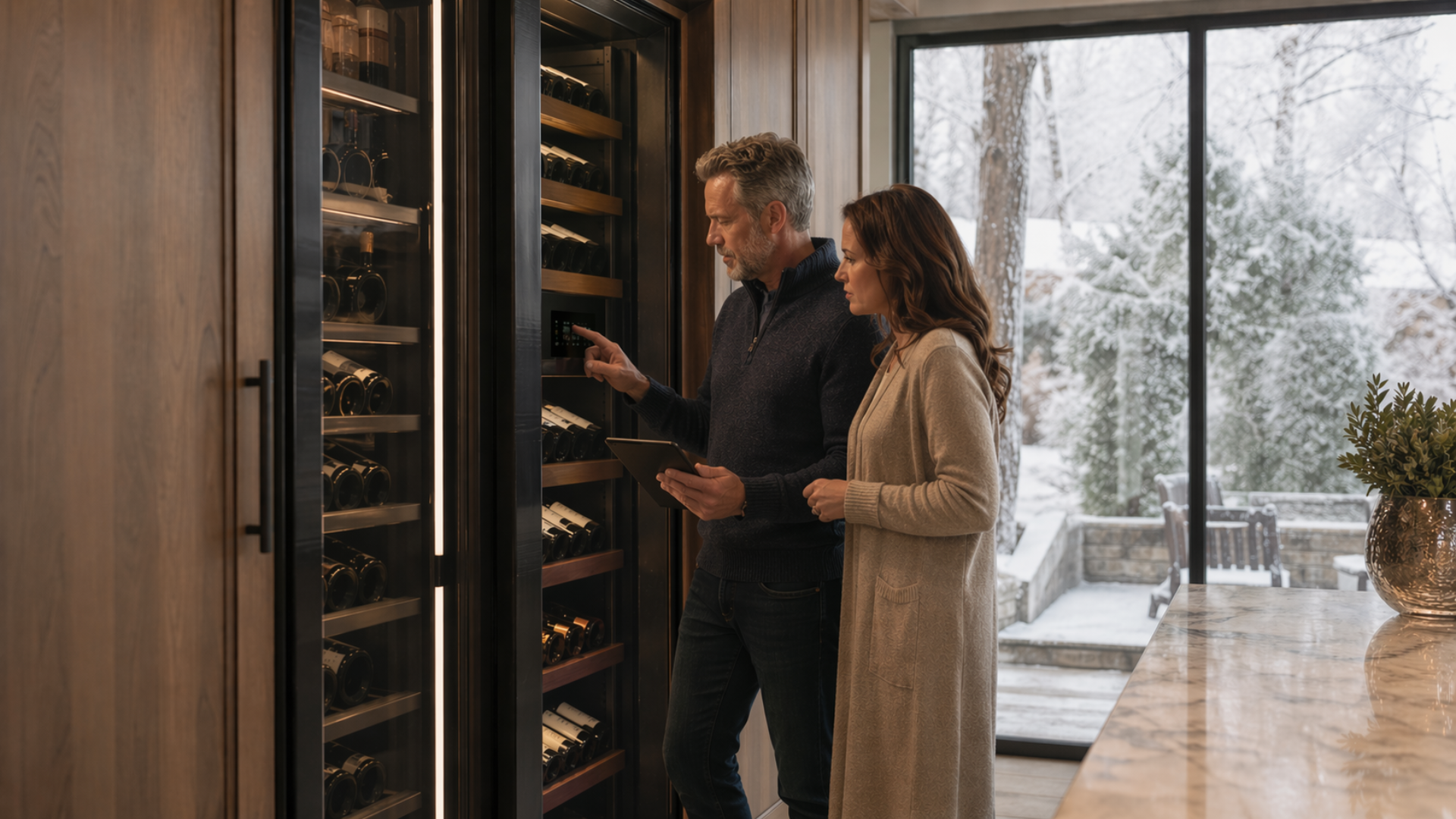





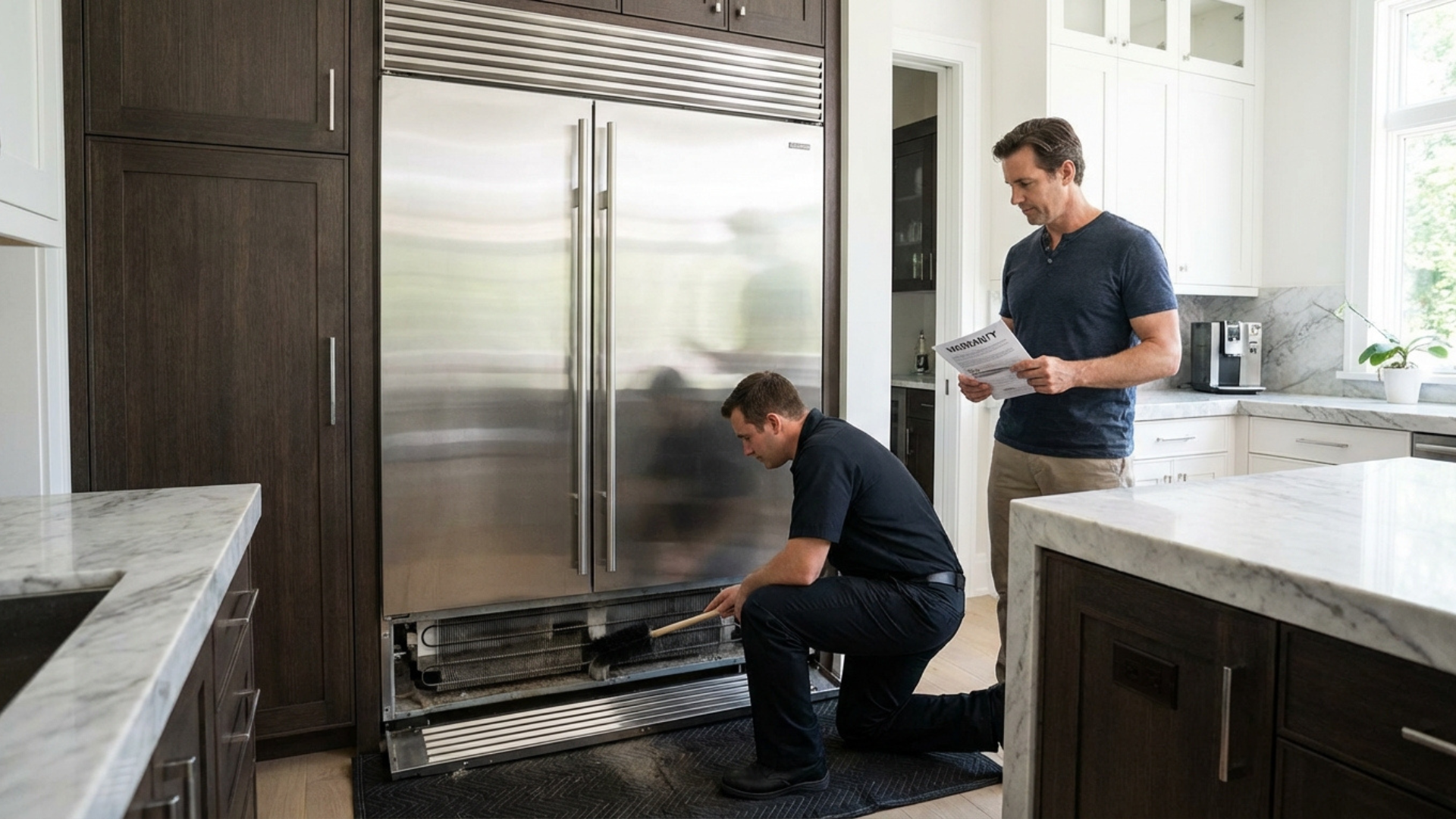
Sub-Zero offers one of the most generous warranty structures in the appliance industry. Two years of full coverage on parts and labor. Five years on the sealed refrigeration system. Twelve years on the compressor, condenser, evaporator, and connecting tubing. For a refrigerator that costs $10,000 to $25,000 and is engineered to last two decades, that level of protection is not a marketing gesture. It is a substantial financial commitment from the manufacturer.
Most Sub-Zero owners in Highland Park and River Oaks know they have a warranty. Very few know how it actually works — and the single requirement that runs through every tier of coverage is the one most likely to be violated by a perfectly reasonable decision.
The Requirement Nobody Reads
Every level of Sub-Zero’s residential warranty contains the same condition: all service must be performed by Sub-Zero Factory Certified Service. Not “recommended.” Required. The two-year full warranty, the five-year sealed system warranty, and the twelve-year limited warranty all specify this. If an uncertified technician touches the unit during the warranty period, Sub-Zero has grounds to deny coverage — not because the technician was incompetent, but because the warranty terms were not met.
This matters because the most natural thing a homeowner does when a refrigerator stops cooling is search for a local appliance repair company. Dallas and Houston have dozens. Many are skilled. Some have worked on Sub-Zero units for years. But unless they hold current factory certification from Sub-Zero — a designation that requires manufacturer-specific training, ongoing education, and access to proprietary diagnostic tools — their work falls outside the warranty terms.
The distinction is not academic. A compressor replacement on a Sub-Zero runs $1,200 to $2,000 in parts and labor. Under the five-year sealed system warranty, the repair costs the homeowner nothing. Under the twelve-year limited warranty, Sub-Zero covers the compressor itself while the owner pays labor. But if the previous service call — even a routine one — was performed by an uncertified company, the manufacturer has a basis to question the entire claim. The savings difference between a covered and an uncovered sealed system repair can exceed $1,500 on a single visit.
What the Warranty Actually Covers
The confusion around Sub-Zero warranty claims often starts with owners not understanding which tier applies to their situation. The structure is straightforward once you see it laid out, but Sub-Zero does not make it especially easy to find.
Years one and two provide full coverage. Every component, all labor, no cost to the owner — provided the unit was installed for normal residential use and all service is performed by factory-certified technicians. If a factory-certified installer handled the original installation, this tier extends to three full years. That additional year of complete coverage is Sub-Zero’s incentive for professional installation, and it applies automatically when the installer’s certification is on file.
Years two through five cover the sealed refrigeration system: compressor, condenser, evaporator, filter-drier, and all connecting tubing. Parts and labor are fully covered. These are the most expensive components in the unit — the parts whose failure turns a service call into a four-figure event. This tier protects against the catastrophic failures that would otherwise make a Sub-Zero repair rival the cost of a mid-range replacement refrigerator.
Years five through twelve continue coverage on those same sealed system components, but with a critical shift: Sub-Zero covers the parts, while the owner is responsible for labor. This is still significant protection. A replacement compressor alone can cost $600 to $800 before installation. But the labor exclusion means the owner pays for the technician’s time — and that technician must still be factory-certified for the parts coverage to apply.
Everything outside the sealed system — thermostats, control boards, fans, ice makers, door gaskets, sensors — is covered only during the first two years (or three with certified installation). After that window closes, these components become the owner’s responsibility regardless of who performs the service.
The Maintenance Requirement That Isn’t Written as a Requirement
Sub-Zero’s warranty documents do not contain a clause that explicitly states “failure to clean condenser coils voids your warranty.” But the warranty does exclude coverage for damage caused by “accident, misuse, abuse, or negligence.” That final word — negligence — creates a gray area that becomes very clear when a compressor fails, and the condenser coils are caked in dust.
Sub-Zero’s own maintenance documentation is unambiguous: clean the condenser coils every six to twelve months. The manufacturer states directly that failure to do so “could result in temperature loss or mechanical failure or damage.” When a technician arrives for a warranty claim and finds coils that clearly have not been cleaned in years, the manufacturer has a straightforward argument that the failure resulted from neglect rather than a defect in materials or workmanship.
This is not hypothetical. Dirty condenser coils are the leading cause of Sub-Zero cooling failures. The coils sit behind the grille at the top of most built-in models, out of sight and out of mind. In Highland Park homes with pets, or open-concept kitchens in Memorial, where cooking generates airborne grease, coils can accumulate enough debris in six months to measurably reduce cooling efficiency. The compressor compensates by running longer and harder. Over time, that overwork becomes the failure that the homeowner assumes the warranty will cover — and it might not, if maintenance records do not exist.
The practical protection here is documentation. A scheduled maintenance program that includes condenser cleaning creates a paper trail proving the owner fulfilled their maintenance obligations. When a warranty claim arises, that documentation shifts the conversation from “was this neglect?” to “this failure occurred despite proper maintenance” — a much stronger position.
The Three Decisions That Actually Matter
The original article framed warranty protection as avoiding five mistakes. In practice, Sub-Zero warranty outcomes hinge on three decisions, and all three happen before anything goes wrong.
Who installed the unit. Factory-certified installation adds a full year of complete coverage — extending the period where every component is protected at no cost. For a $15,000 appliance, that third year of coverage represents thousands of dollars in potential protection. General contractors can physically install a Sub-Zero, but only a certified installer triggers the extended warranty.
Who you call first. The repair company you contact when the unit displays an error code or runs warm determines whether the warranty applies. This decision is often made under pressure — at 10 p.m. when the temperature display reads 50°F and $800 in groceries is at risk. Having a factory-certified service provider identified in advance, before anything fails, prevents the panicked search that leads to uncertified service.
Whether maintenance is documented. Not whether it was done — whether it can be proven. A homeowner who vacuums their own condenser coils every six months has fulfilled the maintenance obligation. But without service records from a certified technician, they have no third-party documentation if a warranty dispute arises. The cleaning itself prevents failures. The documentation prevents claim denials.
What Happens After Year Twelve
Sub-Zero’s warranty coverage ends at twelve years. For the remaining eight-plus years of the unit’s expected lifespan, every repair is the owner’s responsibility. This is where the choice of service provider shifts from a warranty consideration to a quality-of-repair consideration.
Uptown Appliance Repair’s 2-year warranty on all parts and labor exists specifically for this phase — and for the many Sub-Zero units in Preston Hollow, University Park, and River Oaks that are already past their manufacturer warranty period. Where the industry standard offers 90 days of coverage on a repair, Uptown’s warranty provides 24 months. On a sealed system repair that costs $1,500, that extended protection eliminates the risk of paying twice for the same failure.
The warranty also applies to units still under manufacturer coverage. Uptown’s factory-certified technicians perform all work within Sub-Zero’s warranty requirements, preserving the manufacturer’s coverage while adding Uptown’s own protection on top of it. The two warranties do not conflict — they layer.
The Simplest Protection Available
Sub-Zero built a warranty structure that protects owners for over a decade on the components most likely to generate large repair bills. The coverage is real, the terms are specific, and the single most common reason claims are complicated is not dramatic misuse or unauthorized modification. It is the ordinary, understandable decision to call the nearest available repair company instead of confirming factory certification first.
That one decision — made in a moment of urgency — can forfeit years of coverage on components worth thousands of dollars. The simplest way to prevent it is to make the decision now, while everything is working.
(281) 758-9978 (Houston) · (214) 761-8300 (Dallas)