




TL;DR: Houston hurricanes and Dallas derechos both knock out power for days, but they stress your kitchen appliances in very different ways. Houston’s storm profile — multi-day heat-index outages, slab flooding, and sustained CenterPoint grid disruption — tends to produce compressor fatigue and water intrusion damage. Dallas’s profile — explosive morning derecho winds, hail strikes, and fast-moving lightning surges through the Oncor grid — hits control boards and inverter modules harder. The repair strategy that works in Houston isn’t always the one you need in Dallas.
Houston hurricane damage to premium kitchen appliances typically results from prolonged power outages (averaging 5–8 days under CenterPoint Energy grid restoration timelines), heat-index stress on compressors, and slab-level flooding. Dallas derecho damage — as confirmed during the May 28, 2024 North Texas Derecho — comes primarily from rapid voltage fluctuation at restoration, hail/wind intrusion through kitchen penetrations, and lightning-driven power surges to Oncor service lines. Understanding which profile matches your city tells you which components to inspect first and when to call for a professional assessment.
Two Cities, Two Very Different Storms
Texas has two major metros that both sit squarely inside North America’s severe-weather corridor — and each one has a dominant storm type that shapes how premium kitchens take damage.
Houston faces the Gulf. Every June through November, the National Hurricane Center publishes its Atlantic storm track maps, and Houston-Galveston appears on nearly every one of them. The risk isn’t just wind speed or rain totals — it’s the multi-day, grid-wide power disruption that follows when a major storm makes landfall inland and moves slowly across Harris County. Houston’s grid operator, CenterPoint Energy, manages over 2.6 million customer connections. When even a fraction of that distribution network fails, restoration takes days — sometimes more than a week.
Dallas faces the plains. The Dallas-Fort Worth metro sits at the intersection of the central Texas severe-weather corridor, where supercell thunderstorms, mesoscale convective systems, and derechos form with little warning. A derecho — a widespread, long-lived windstorm tied to rapidly moving thunderstorm lines — can cross the entire DFW metro in two hours and leave Oncor’s 4-million-customer network in fragments. Unlike hurricanes, derechos arrive without the multi-day lead time of a named storm. They move fast. The damage profile is front-loaded and short: intense surge, rapid outage, and aggressive hail — then restoration within a few days.
Both cities now have recent, documented major events that illustrate these differences clearly. Hurricane Beryl in July 2024. The May 28, 2024 North Texas Derecho. If your kitchen holds Sub-Zero, Wolf, Miele, Thermador, or similar premium equipment, what happened in those two events tells you a great deal about what’s at risk in your home right now.
What Beryl Taught Houston About Premium Appliances
Hurricane Beryl made landfall near Matagorda Bay on July 8, 2024, as a Category 1 hurricane and moved directly across Harris County through the heart of the Houston metro. By the time CenterPoint’s damage tally was complete, nearly 3 million customers had lost power — essentially the entire service territory. Eight days after landfall, approximately 226,000 customers were still without electricity.
For a homeowner with a builder-grade refrigerator, a week-long outage means a lost freezer full of food and a restart button. For a homeowner with a Sub-Zero column refrigerator, a $9,000 built-in wine column, and a Wolf dual-fuel range, Beryl was something else entirely.
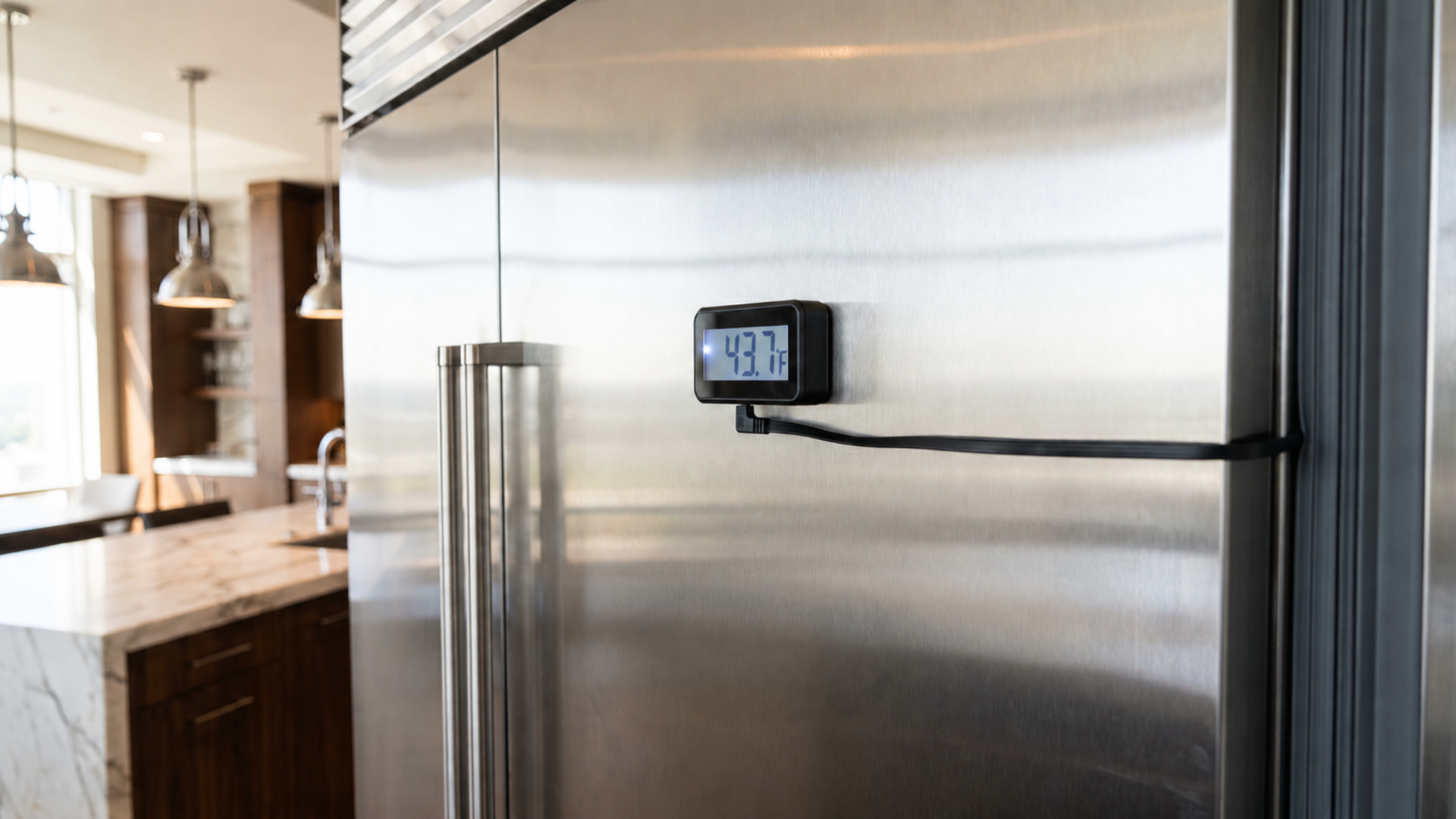
The sustained outage problem. Sub-Zero’s food storage guidance draws a hard line: a refrigerator section is unsafe above 42°F, and an empty unit can cross that threshold in roughly three hours without power. A freezer is unsafe above 20°F — though a full freezer holds that threshold for 20-plus hours. After Beryl, with heat indexes near 106°F and no power for eight-plus days, many Houston homeowners found their Sub-Zero units running on home generators for extended stretches — a setup the manufacturer explicitly cautions against.
According to Sub-Zero’s generator guidance, their products require a minimum 2,800-watt generator delivering 115/125V AC at 60Hz, with a continuous minimum of 104V. A dual-compressor unit draws close to 24 amps at startup. Running a Sub-Zero on an undersized generator — or on a generator with dirty power output — for eight consecutive days puts the compressor and inverter board under stress they weren’t designed for. That’s the failure mode that showed up in Houston service calls in the weeks after Beryl: compressors short-cycling, inverter boards with burned capacitors, and control boards that had locked into fault states.
Heat-index stress on refrigeration systems. Houston’s climate adds a layer that Dallas rarely faces. When ambient temperatures stay in the mid-90s for a week, your Sub-Zero column — even when running — works harder than it’s designed for. The condenser fan cycles more frequently, the compressor rests less, and the sealed system accumulates heat stress. When power finally returned after Beryl, we saw refrigerators that technically “worked” but were already running abnormally warm — compressors that had been stressed past their design point over a week of heat-load combat.
Slab flooding and water intrusion. Houston’s low elevation and clay soil make slab flooding a uniquely local risk. Beryl dropped inches of rain on neighborhoods already saturated from earlier 2024 storm events. Meyerland, Bellaire, and Friendswood — all zip codes with significant concentrations of premium kitchens — experienced water intrusion that reached the kick-plate height on built-in refrigerators and island dishwashers. When flood water contacts the insulation cavity of a Sub-Zero built-in refrigerator, the insulation absorbs moisture. NC State Cooperative Extension research confirms that submerged refrigerators and freezers should typically be replaced rather than repaired, because water-saturated insulation cannot be dried adequately to restore food safety and thermal efficiency.
FEMA is unambiguous on this point: never restore electrical power to a flooded appliance without a qualified electrician’s inspection. For gas appliances like Wolf ranges, FEMA’s guidance on home repairs also notes that furnaces, water heaters, refrigerators, and stoves may be covered under disaster assistance — but dishwashers are not. That distinction matters for any Houston homeowner navigating a post-flood insurance claim.
What the Dallas Derecho of 2024 Revealed About DFW Kitchens
The May 28, 2024 North Texas Derecho hit the Dallas-Fort Worth metro in the early morning hours and moved through the region at highway speed. Oncor described it as “the worst day ever experienced in the Dallas-Fort Worth metro” in their 100-plus years of operation. Peak outages reached nearly 400,000 customers, and the storm’s effects were still being felt five or more days after the event.
But if Beryl was a slow, sustained battering, the DFW derecho was a punch. And punches to the grid produce a specific kind of appliance damage.
The power restoration surge. When Oncor crews restore transmission lines after a large derecho, power doesn’t come back gradually — it comes back in blocks, as switching stations reconnect sections of the distribution grid. That reconnection event produces a voltage spike on the line that’s different from the more gradual restoration that CenterPoint managed (imperfectly) after Beryl. Control boards in premium appliances — the circuit boards that govern temperature regulation, display functions, and self-diagnostic systems in Sub-Zero, Miele, and Thermador units — are particularly vulnerable to these short, sharp voltage spikes.
The Insurance Information Institute’s 2024 Texas data shows that Texas led the nation in lightning loss claims with 4,369 claims at an average of $38,558 per claim. That’s the dollar story. The mechanism story: a lightning-triggered surge through the distribution grid — or a direct strike to a neighborhood transformer — can send a transient voltage spike through a home’s wiring in microseconds. Control board capacitors that aren’t designed to absorb that kind of spike simply fail. We’ve seen this in Viking induction cooktops (the induction generator board is particularly surge-sensitive), Miele dishwasher control modules, and Thermador steam oven boiler controllers.
Hail intrusion and wind damage. Dallas’s storm profile includes hail in a way that Houston’s hurricanes rarely do. Hail stones one inch or larger struck Texas 878 times in 2024, according to the Insurance Information Institute. During the DFW derecho, wind gusts reached 90–120 mph in portions of the metroplex. That combination — large hail plus extreme wind — penetrates kitchen ventilation systems, damages outdoor condenser units for built-in wine cellars and refrigeration drawers, and occasionally punches through soffit panels that protect refrigerant lines in custom installations. The damage mode is physical intrusion, not just electrical.
The five-day DFW restoration window. After the May 2024 derecho, Dallas City Hall’s emergency management office confirmed a multi-day restoration effort compounded by follow-on storm waves. While five days is substantially shorter than Beryl’s eight-day tail in Houston, it’s still long enough to lose a freezer and stress a compressor. The difference is the thermal environment: Dallas in late May runs warmer than Houston in early July, but without the 106°F heat index that made Beryl’s outage period so punishing. A five-day DFW outage is serious. An eight-day Houston outage in July heat is a different category of stress on sealed refrigeration systems.
The Four Damage Modes, Side by Side
Here’s how the two storm profiles map to specific failure modes in premium kitchens. This is the comparison that determines your post-storm inspection priority.
| Damage mode | Houston hurricane profile | Dallas derecho profile | What fails first |
|---|---|---|---|
| Sustained power outage | 5–8+ days; Beryl averaged 8 days for last 226K customers | 3–5 days; DFW derecho peaked at 5 days for late restores | Compressor fatigue (both); food spoilage (both); generator-stress damage (Houston more likely) |
| Power restoration surge | Gradual multi-phase restoration; CenterPoint sectionalized over days | Rapid block restoration; Oncor reconnects large sections at once; sharper voltage events | Control boards, inverter boards, induction generator boards (Dallas more acute) |
| Water / flood intrusion | Slab flooding common in Meyerland, Bellaire, Friendswood, Memorial; rain totals 8–20 inches | Rare slab flooding; wind-driven rain penetration through vents and soffits | Built-in refrigerator insulation, dishwasher cavities (Houston); ventilation systems, outdoor condensers (Dallas) |
| Hail / wind / debris | Winds to 80+ mph; minimal hail in most Houston events | Hail to 5 inches reported; winds 90–120 mph; debris projectile risk | Exterior condenser units, glass panel inserts, skylight kitchen penetrations (Dallas dominant) |
| Lightning surge | Less common as direct cause; more common as grid-wide transient | Direct-strike risk higher; 4,369 Texas lightning claims in 2024 (Triple-I) | Viking induction boards, Miele control modules, Thermador boiler controllers (Dallas dominant) |
Sustained Outage: The Damage No One Sees Coming
Of the four damage modes, sustained outage is the one that gets underestimated in both cities — and for different reasons.
In Houston, homeowners often focus on the visible: water on the floor, wind damage to the structure. The compressor that’s been stress-cycling on a neighbor’s undersized generator for eight days in 95°F heat doesn’t announce itself. It may cool normally the day power returns. Then, three to six weeks later, it stops cooling entirely — and by then, the connection to Beryl isn’t obvious anymore.
The failure pattern we see most often in Sub-Zero units after a prolonged Houston outage: the compressor continues to run but stops pulling down temperature effectively. The unit reads 45°F when set to 38°F. Humidity inside the cabinet rises. That’s a compressor that has lost capacity — not a complete failure, but a degraded one. At that point, a factory-certified technician needs to evaluate the sealed system. Sometimes the answer is a compressor replacement. Sometimes it’s a refrigerant recharge. Sometimes the unit is worth repairing. Sometimes it isn’t.
In Dallas, the sustained outage risk is different — it’s not the duration alone, but the bookend events. The DFW derecho arrived with a surge (power went out in a voltage spike as the storm hit lines), and it restored with another surge (Oncor’s block reconnection). The compressor saw a spike coming in, five days of nothing, and a spike going out. The capacitors in the inverter board are doing two jobs: protecting against the surge and managing the startup current. After taking hits at both ends of a five-day outage, capacitors that were already aging can fail on the next power cycle.
This is why a post-storm inspection — even when your appliances appear to be working normally — is worth scheduling in both metros. The failure may already have happened at the component level. The appliance just hasn’t told you yet.
Water Intrusion: Houston’s Most Distinctive Damage Mode
No other damage mode separates the two cities as clearly as water intrusion. Houston’s geography — low elevation, clay soil with minimal drainage, proximity to Galveston Bay and Brays Bayou — means that significant rain events translate directly into residential flooding, particularly in established premium neighborhoods where the drainage infrastructure predates modern storm-surge modeling.
When flood water reaches the kick-plate of a built-in Sub-Zero refrigerator — typically about four to six inches off the floor — it enters the lower mechanical bay where the condenser coils, the compressor, and the control board connections all live. That’s the scenario where the NC State Cooperative Extension’s guidance applies most directly: submerged refrigerators and freezers should generally be replaced, not repaired, because insulation that has absorbed floodwater cannot be adequately dried, and mold can establish in a foam insulation cavity within 72 hours under Texas humidity conditions.
For Wolf ranges, floodwater under the burner deck doesn’t necessarily mean the range is a write-off — but it does mean every gas connection, igniter harness, and control wiring run needs to be inspected before the range is used again. FEMA is explicit: do not restore power to any appliance that has been flooded without an electrician’s sign-off first. For gas appliances, that same caution extends to gas connections.
Dallas homeowners face water intrusion of a different kind: wind-driven rain through ridge vents, soffit panels, and kitchen skylight frames. DFW’s derecho-force winds at 90–120 mph can push water through gaps that would be watertight in any ordinary rainstorm. The failure mode here is moisture in the control electronics of overhead appliances — microwave-drawer units, ventilation hood controls, and integrated combination ovens — rather than the slab-level flooding that defines Houston’s profile.
Power Surge and Lightning: Dallas’s Dominant Threat
The numbers tell the story. Texas led the nation in 2024 with 4,369 lightning loss insurance claims, averaging $38,558 per claim. The DFW metro sits in a lightning-dense corridor where supercell thunderstorms develop frequently during spring and summer months. The NWS Fort Worth office issues severe thunderstorm watches for the DFW metro multiple times per season, and each one brings lightning-surge risk.
The mechanism for control board damage from lightning is well established. A lightning strike to a nearby transformer or to the distribution line serving a neighborhood sends a transient voltage spike — sometimes thousands of volts for a fraction of a millisecond — through the home’s electrical system. Modern premium appliances use electronic control boards with sensitive capacitors, microprocessors, and relay circuits. These components are rated to operate within a specific voltage range. A microsecond spike well outside that range can depolarize capacitors, fry relay contacts, or corrupt firmware stored in non-volatile memory.
Here’s what that means in practice:
- A Sub-Zero integrated refrigerator loses its control board. The compressor still works. The unit just won’t respond to temperature commands or display readings. Control board replacement is the repair path.
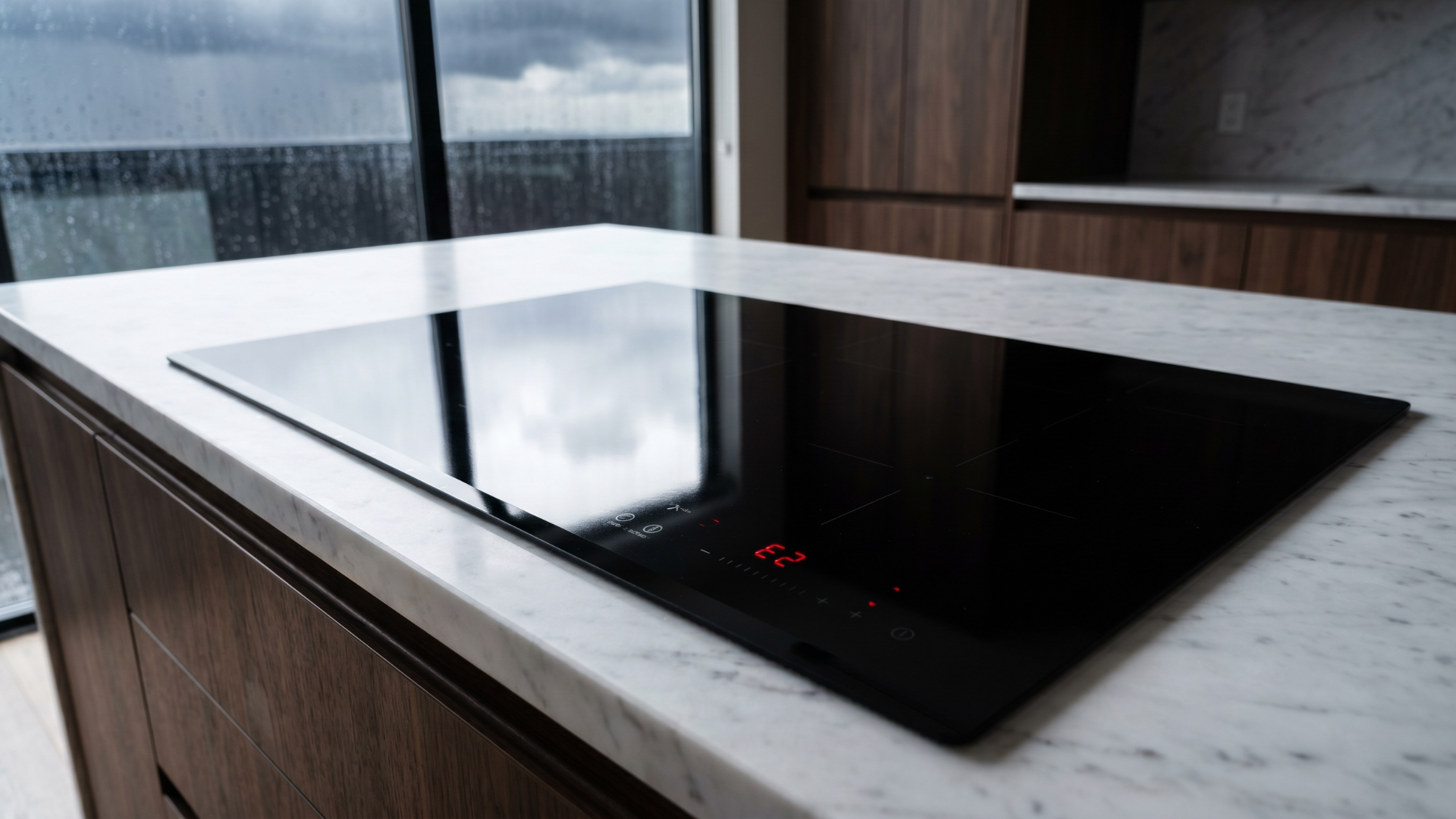
- A Viking induction cooktop shows a fault code and won’t power zones on. The induction generator board — which is the most expensive single component in an induction cooktop — has taken a voltage hit. Repair is possible but component cost is substantial.
- A Miele dishwasher shows error codes and won’t fill or drain. The Aqua-Stop module, which controls water intake, has a control board component that’s reliably surge-sensitive.
- A Thermador steam oven won’t generate steam. The boiler pump module is run by a dedicated control circuit that sits between the home’s wiring and the heating element. Surge damage to that circuit typically requires the boiler pump assembly to be replaced.
None of these are hypothetical — they’re the specific failure patterns we diagnose after Dallas storm events. The good news: most of them are reparable with OEM parts. The key is not delaying the diagnosis, because a damaged control board that’s left running in a marginal state can sometimes cause secondary damage to components it controls.
The Surge Protector Paradox: What Sub-Zero Actually Says
Here’s the thing about surge protectors that surprises most homeowners in both cities.
Sub-Zero’s own guidance warns that “a surge protector, AFCI, or GFCI may prevent power being restored to the unit” after an outage. In other words: the device you installed to protect your Sub-Zero from a surge might be the reason your Sub-Zero won’t restart when power comes back.
This is especially relevant in the Dallas context, where restoration surges tend to be sharper (faster block reconnection by Oncor) and where homeowners often install surge strips as a protective measure after a storm season. If your Sub-Zero went dark during the DFW derecho and still won’t power on after Oncor restored your block — before you call for a service appointment, check whether there’s a surge strip between the wall and the unit. Unplug it directly. Then try the unit on the raw outlet.
The manufacturer’s recommended approach, for both Houston and Dallas homeowners, is to shut the refrigerator off at the circuit breaker during an outage rather than running it on an improperly sized generator or through a surge strip. Sub-Zero’s food storage guidance confirms that a fully stocked, closed freezer can maintain safe temperature for 20-plus hours — which covers the initial outage period in most events without needing generator power at all.
Insurance: What’s Covered Differs by Damage Type
Houston and Dallas homeowners often find that the insurance conversation after a storm depends heavily on the damage mode — and that the distinctions matter.
Power surge damage — lightning or restoration-surge control board failures — is typically covered under standard homeowners’ policies as an electrical event. Document everything: the date the storm occurred, the date power was restored, the date the appliance stopped functioning, and the specific error codes or symptoms. A written diagnosis from a certified technician is more useful to an adjuster than a self-assessment.
Flood damage is a different policy lane entirely. Standard homeowners’ policies don’t cover flood damage — that requires a separate National Flood Insurance Program (NFIP) policy or a private flood endorsement. This is one of the most consistent gaps we see in Houston premium-home kitchens: the homeowner has excellent property insurance, but the slab flood that destroyed a $15,000 built-in refrigerator falls under a coverage category they didn’t purchase.
Food spoilage is the most immediately visible loss after any outage event. Texas homeowners’ policies typically cover up to $500 for spoiled food after a power outage — a figure that barely covers two weeks of groceries in a premium household, let alone the contents of a $9,000 Sub-Zero wine column.
If you’re navigating an insurance claim for appliance damage in either city, the documentation sequence that supports the cleanest outcome is: photograph everything before moving or cleaning up, document the storm date and outage duration with a utility company notification (your CenterPoint or Oncor outage confirmation email is sufficient), get a written assessment from a certified appliance technician, and submit the technician’s report with your claim.
Your Post-Storm Inspection Checklist (for Both Cities)
Whether you’re in Houston recovering from a hurricane or in Dallas after a derecho, the inspection logic follows the same sequence — though the priorities differ slightly by storm profile.
Within 24 hours of power restoration:
- Don’t rush to plug everything in at once. Stagger appliance restarts to avoid stacking startup loads.
- Check for visible water intrusion at the kick-plate of any built-in appliance. If you see water marks, don’t power on until inspected.
- Verify that your Sub-Zero or built-in refrigerator is plugged directly into the wall — not through a surge strip or UPS device.
- Note any error codes showing on control panels before you try a reset. Photograph them.
- Check your circuit breaker panel for any tripped breakers before restoring power to appliances.
Within 48–72 hours:
- Monitor refrigerator temperatures actively for the first 24 hours after restart. A unit that reads 45°F when set to 38°F has a problem — even if it’s cooling at all.
- Run your dishwasher on a short cycle and watch for proper fill, wash, and drain sequences.
- Cycle your range through each burner or cooking zone and observe for hesitation, error codes, or unusual behavior.
- If your steam oven, warming drawer, or speed oven shows any abnormality, schedule an assessment before using it for food prep.
Houston-specific additions:
- If you experienced any water intrusion, don’t assume the kick-plate is the limit. Have a technician inspect the lower mechanical bay of any built-in refrigerator that was near flood level.
- If you ran your Sub-Zero on a generator for more than 48 hours, schedule a compressor health check — even if the unit appears to be cooling normally.
Dallas-specific additions:
- If the power restoration was abrupt (lights jumped on rather than gradually brightening), check all electronic control panels for error codes.
- For induction cooktops, test each zone before assuming all zones are functional — individual zone boards can fail while others survive.
- If your wolf range uses an electronic ignition system (rather than a standing pilot), test each igniter individually after a lightning event.
A Note on What “Factory-Certified” Actually Means Here
Both Houston and Dallas homeowners sometimes ask whether any qualified technician can handle post-storm diagnostics on premium appliances. The honest answer: yes and no.
For obvious mechanical failures — a compressor that’s clearly seized, a burner that simply won’t light — the diagnostic path is relatively direct and a competent technician can identify the issue. But post-storm damage to premium appliances often shows up as subtle or intermittent symptoms: a refrigerator that cools to 41°F instead of 38°F, an oven that takes 15% longer to reach setpoint, a dishwasher that runs but doesn’t clean as effectively. Those symptoms require familiarity with factory specifications — the baseline parameters that define what “working correctly” means for a Sub-Zero 700 series versus a 600 series.
Factory certification for Sub-Zero, Wolf, Miele, Thermador, Bosch, Viking, Gaggenau, and Dacor means a technician has been trained on the manufacturer’s own specifications, diagnostic protocols, and approved repair procedures. It also means access to genuine OEM parts — not aftermarket equivalents. For a $12,000 Sub-Zero built-in, the difference between an OEM inverter board and an aftermarket substitute is significant: fit, firmware compatibility, and warranty coverage all hinge on it.
FAQ
Does my Houston homeowners insurance cover power-surge appliance damage after a hurricane?
Generally, yes — electrical damage from a power surge event is typically covered under the personal property section of a standard homeowners’ policy. The key is documentation: the storm date, the power restoration date, the date your appliance failed, and a written diagnosis from a certified technician. Surge damage that occurs at the moment of power restoration (not during the outage itself) is still an insured electrical event. Check your policy’s deductible, because it often exceeds the cost of control board replacement on its own.
Should Dallas owners worry about Beryl-style multi-day outages?
The May 28, 2024 North Texas Derecho confirmed that DFW can experience five-day outage events — shorter than Beryl’s eight-day tail, but still long enough to lose food and stress refrigeration systems. The more realistic daily risk in Dallas isn’t hurricane-duration outages; it’s the repeated two-to-four-hour outages that each bring their own small surge at restoration. Those accumulate across appliance components over time.
My Wolf range ignites normally but the clock and display aren’t working after the DFW storm. Is that a surge symptom?
Yes — this is a classic split-damage pattern from a power surge. The gas delivery system (burner, igniter, valve) is electromechanical and more resistant to voltage spikes. The display and control functions run on a circuit board that’s more sensitive. You can continue using the range carefully — if the burners light and flame is stable — but schedule an assessment. Operating a range without functional control electronics means you’re bypassing safety monitoring features.
Is it safe to run my Sub-Zero on a generator during a Houston hurricane outage?
For short periods (a few hours), a properly sized generator can help you manage the immediate food safety window. Sub-Zero requires a minimum 2,800-watt generator with 115/125V AC, 60Hz, and a minimum continuous 104V. Their guidance is clear that their products are not designed for long-term generator operation. For extended outages, the manufacturer’s recommendation is to turn the unit off at the circuit breaker and use ice for food safety rather than risk damage from sustained generator-supplied power.
After the Dallas derecho, my Sub-Zero is running but my food seems warmer than usual. What’s happening?
This is the symptom we see most often after surge-related inverter board stress. The inverter board manages the variable-speed compressor — if it’s partially damaged, the compressor may still run but not modulate efficiently. The unit cools, but not to setpoint. It often gets worse over the following two to four weeks as the damaged component degrades further. Schedule an assessment; this is diagnosable and typically reparable before it becomes a full compressor failure.
Do flood-damaged Houston appliances always need to be replaced?
Not always — but submerged ones usually do. The rule of thumb from NC State Cooperative Extension is that refrigerators and freezers with water in the insulation cavity should be replaced, because the insulation absorbs moisture that cannot be adequately dried to restore food safety. Appliances that experienced splash or spray — without direct water in the insulation or mechanical bay — may be restorable. The answer depends on water depth and contact time, which is exactly what a technician’s inspection assesses.
What’s the single most important thing to do before power returns after either storm?
If you know power restoration is imminent, turn your premium refrigerators and dishwashers off at the circuit breaker before power comes back. When Oncor or CenterPoint restores service, the first moments of reconnection carry the highest surge risk. Starting with appliances off — then powering them back on in a controlled sequence, one at a time — is the simplest protection that requires no special equipment. It costs nothing and takes thirty seconds.
We’re Here When the Storm Passes
If your Sub-Zero, Wolf, Miele, Thermador, or other premium appliance is behaving strangely after a Houston hurricane or a Dallas storm event, the right next step is an assessment by someone who knows the manufacturer’s specifications. Not a guess, not a wait-and-see. An actual diagnosis.
We serve both Houston and Dallas, we’re factory-certified for every brand in your kitchen, and we use genuine OEM parts exclusively. We’d rather catch a $400 control board issue before it becomes a $4,000 compressor replacement.
Give us a call at (281) 758-9978 or schedule a service appointment online. We’re a call away.
Related reading from Uptown Appliance Repair:
- How Texas Weather Affects Your High-End Appliances
- Two Climates, Two Failure Profiles: Outdoor Kitchen Appliance Care in Houston and Dallas
- When Your $18,000 Sub-Zero Stops Cooling in Memorial Park
Sources
- Sub-Zero Food Storage Without Power — factory guidance on safe temperature thresholds and outage protocols for Sub-Zero refrigerators and freezers
- Sub-Zero Generator Considerations — manufacturer specifications for generator sizing, voltage requirements, and long-term generator cautions
- National Hurricane Center — Atlantic Storm Track Data — NHC official storm track maps and historical hurricane landfall records for the Houston-Galveston region
- NHC Tropical Cyclone Reports (Beryl) — official post-storm reports including Hurricane Beryl’s Harris County impact and outage data
- Texas Tribune — Texans Still Without Power After Beryl (July 15, 2024) — reporting on 226,000 customers still without power eight days after Beryl landfall
- Urbint — Power Outage Report: May 28, 2024 Texas Derecho — detailed outage analysis for the DFW derecho event; source for “worst day ever” Oncor characterization and restoration timelines
- Insurance Information Institute — Texas Home Insurance Market (2024) — lightning claim volume (4,369 claims), average payout ($38,558), and hail-strike counts for Texas 2024
- NC State Cooperative Extension — How to Salvage Flood-Damaged Appliances — guidance on when flooded refrigerators should be replaced vs. repaired; insulation moisture absorption findings
- FEMA — Flood Systems Inspections: Electrical Equipment — federal guidance prohibiting power restoration to flooded appliances without electrician inspection
- FEMA — What Home Repairs Are Covered — disaster assistance coverage distinctions (refrigerators and stoves covered; dishwashers not covered)
- Dallas City Hall — May 2024 Severe Weather Emergency Management — official city documentation of the multi-day DFW restoration effort following the derecho
- NWS Fort Worth — National Weather Service office covering DFW; source for severe thunderstorm watch frequency and lightning-surge risk data for the Dallas corridor
- CenterPoint Energy — Houston-area grid operator managing 2.6M+ customer connections; referenced for post-Beryl restoration timeline and grid disruption scale
- Oncor — DFW-area grid operator managing 4M+ customer connections; referenced for derecho restoration surge pattern and block reconnection behavior
Related Reads from Uptown
- How Texas Weather Affects Your High-End Appliances — the foundational guide to year-round Texas climate stress on premium appliances; read this alongside the storm comparison for full seasonal context
- Texas Power Grid Issues: Protecting Your Appliances During Outages — a deep-dive on ERCOT grid vulnerability and surge-protection strategies; directly complements the grid-stress analysis in this article
- Two Climates, Two Failure Profiles: Outdoor Kitchen Appliance Care in Houston and Dallas — applies the same Houston-vs-Dallas comparative framework to outdoor kitchens; the structural companion piece to this article
- Hurricane Season Appliance Prep: Protecting Wine Cellars from Power Outages — Houston-specific pre-storm preparation checklist for Sub-Zero wine columns and built-in refrigeration drawers
- Texas Freeze and Your Luxury Appliances: Lessons from Winter Storm Preparedness — the winter counterpart to this storm-profile guide; same premium-appliance audience, opposite seasonal threat
- When Your $18,000 Sub-Zero Stops Cooling in Memorial Park — a Houston-specific case study on compressor fatigue diagnosis after an extended power outage