




A $100,000 outdoor kitchen in Preston Hollow faces different threats than the same kitchen in River Oaks. Dallas destroys equipment through extreme heat, hail, and UV degradation. Houston destroys it through humidity, salt-air corrosion, and hurricane power cycles. Understanding which failure profile applies to your home is the starting point for protecting an investment that most homeowners have significantly underinsured.
What Dallas does to outdoor appliances
Dallas holds a 113°F all-time temperature record and logged 40 consecutive days above 100°F in 2011. For outdoor kitchen equipment, the consequences follow a predictable pattern.
Compressor overwork is the defining Houston problem, but Dallas heat accelerates it too. Outdoor refrigerators from brands like Perlick and True — rated for indoor installation at $2,500–$6,000+ — typically last 15–20 years inside. In continuous Texas heat, that lifespan compresses to 8–10 years. The compressor runs near-continuously instead of cycling, degrading components years ahead of schedule.
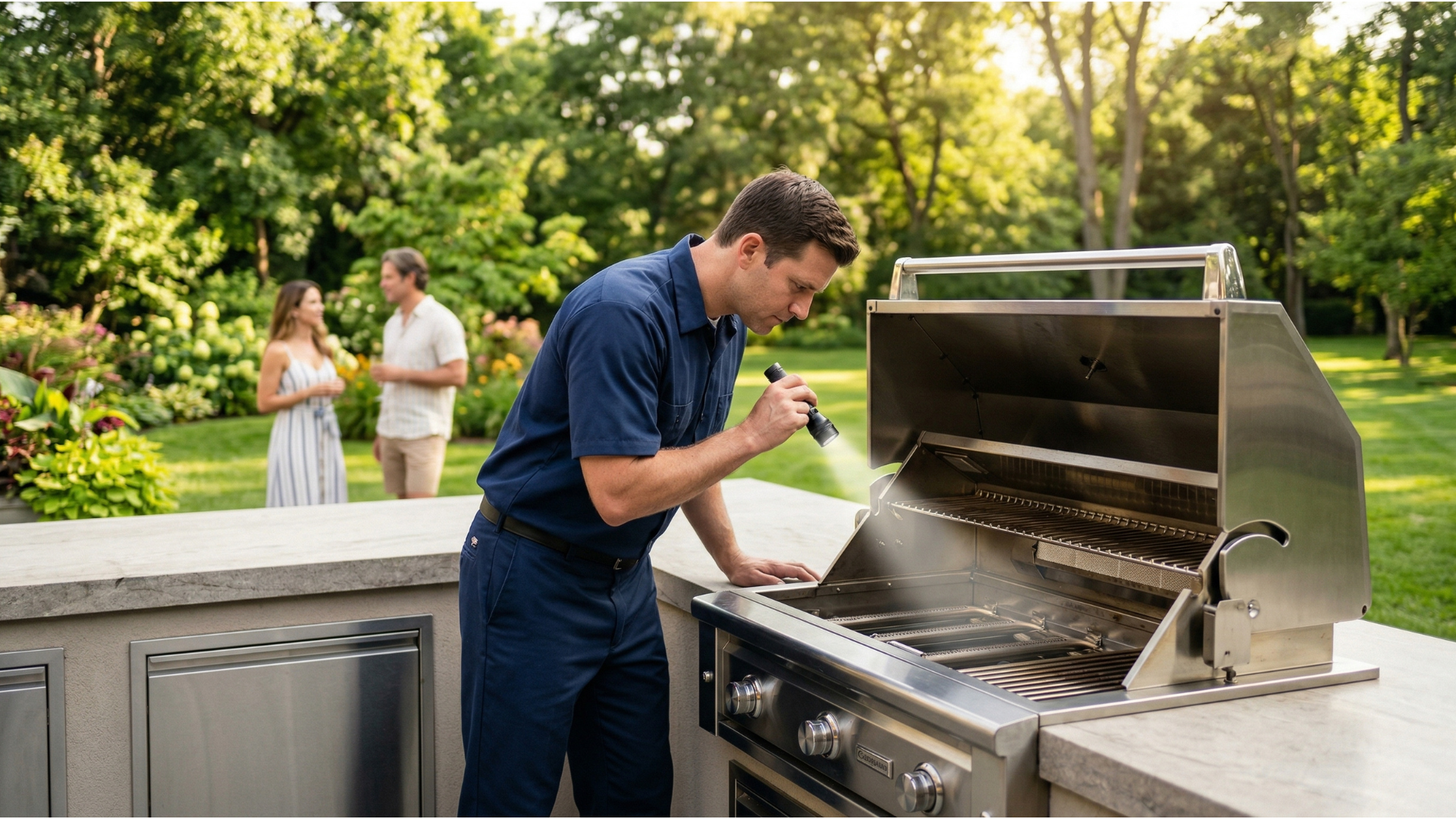
Insect infiltration is the most common seasonal service call in both markets. Wasps and mud daubers nest inside burner venturi tubes during periods when grills sit unused. The mercaptan odorant added to natural gas and propane actively attracts them. When gas flows past a nest, the resulting backflow can create flashback fires near control valves — a hazard that looks like a burner malfunction but is actually an obstruction problem. Clearing venturi tubes before spring and fall startup is a maintenance step most owners skip entirely.
Hail damage is a Dallas-specific variable. The Dallas–Fort Worth metro sits in Hail Alley, the corridor running from Texas through Oklahoma with the highest frequency of large hail in the country. Control panels, glass components, and the tempered windows on enclosed grill hoods are all vulnerable. Damage here usually isn’t dramatic — it’s the micro-fractures in seals and gaskets that allow moisture intrusion over the following months.
Grease fire risk compounds with deferred cleaning. NFPA data identifies cooking as the leading cause of home fires — and a grease accumulation of just 1/8 inch can ignite at temperatures as low as 375°F, well within normal cooking range. Outdoor grills accumulate grease faster than indoor ranges because they’re often used at higher heat and cleaned less frequently.
What Houston does to outdoor appliances
Houston sits roughly 50 miles from the Gulf Coast. Average relative humidity runs 74–90% year-round. That combination — heat plus persistent moisture plus salt air — creates a corrosion environment that standard outdoor kitchen equipment isn’t designed to handle.
Control board corrosion is the #1 Houston-specific repair. Moisture and salt ions migrate into printed circuit boards, creating conductive pathways that short or degrade digital controls. A Viking grill that reads E2 or fails to ignite electronically in Houston is frequently a corroded control board, not a failed igniter. The same repair on a Dallas unit usually has a different root cause.
Stainless steel grade matters more in Houston than anywhere else in Texas. Most outdoor kitchen equipment ships with Grade 304 stainless — the industry standard, and adequate for most environments. In Houston’s coastal proximity, chloride ions from salt air initiate pitting corrosion on 304 SS at the microscopic level, eventually producing the rust spots and structural degradation that owners assume are cosmetic. Grade 316 (marine-grade) stainless, which adds molybdenum to resist chloride attack, costs 20–40% more but is the only grade that holds up long-term in Southeast Texas. Kalamazoo offers 316 SS as a standard option across its $12,500–$22,000+ grill line. Blaze offers a marine-grade line at lower price points. For Houston homeowners, the stainless specification on the original purchase matters as much as the brand name.
Hurricane power cycling creates a separate failure mode. When power cuts and restores — sometimes multiple times in a single storm event, as Houston saw during both Winter Storm Uri (2021) and Hurricane Beryl (2024) — voltage irregularities during restoration can damage sensitive electronics and compressor start capacitors. Surge protection on outdoor kitchen circuits is standard practice indoors and almost entirely absent outdoors.
The insurance gap most owners don’t realize exists
Standard Texas HO-3 policies cover outdoor kitchens under “other structures” at 10% of dwelling coverage — a $2 million home gets $200,000 in other structures coverage, which sounds adequate until you read the exclusions. Fire, wind, and hail are generally covered. Gradual wear, corrosion, UV degradation, and compressor failure are explicitly excluded as maintenance and wear issues — which describes the vast majority of actual outdoor kitchen repair needs.
Flood damage requires a separate policy, and only approximately 14% of Texas homeowners carry flood insurance. For Houston properties in low-lying areas, that gap is particularly significant.
The practical implication: document your outdoor kitchen appliances with photos, serial numbers, and purchase receipts, and confirm what’s actually covered before assuming a claim is viable. For appliances under extended service protection, verify that your coverage terms cover the failure modes specific to your climate rather than generic malfunction.
A pre-season checklist by market
Dallas (spring, before grill season):
- Clear all venturi tubes before first ignition
- Inspect control panel for hail micro-damage from winter storms
- Check burner and grate coatings for UV and heat cycling degradation
- Test outdoor refrigerator compressor cycling under load
Houston (spring, before peak humidity):
- Inspect all control boards for early corrosion discoloration
- Clean condenser coils on outdoor refrigeration units (salt air accelerates fouling)
- Check stainless surfaces for pitting — early-stage treatment prevents structural progression
- Test GFCI and surge protection on all outdoor circuits
- Verify condensate drainage is clear after winter
For brands requiring factory-certified service — Viking, DCS, Lynx, Kalamazoo, Hestan — confirm your provider holds current authorization before booking. General appliance technicians lack access to brand-specific diagnostic tools and OEM parts channels, and outdoor kitchen equipment has enough complexity that a misdiagnosis typically means a second visit and extended downtime.
The outdoor kitchen represents a significant fraction of the total luxury home investment. In Dallas and Houston, protecting it means understanding which climate you’re actually in.
Uptown Appliance Repair serves outdoor kitchen clients across Dallas (Highland Park, Preston Hollow, University Park) and Houston (River Oaks, Memorial, The Woodlands). Same-day emergency service available. Call (281) 758-9978.