




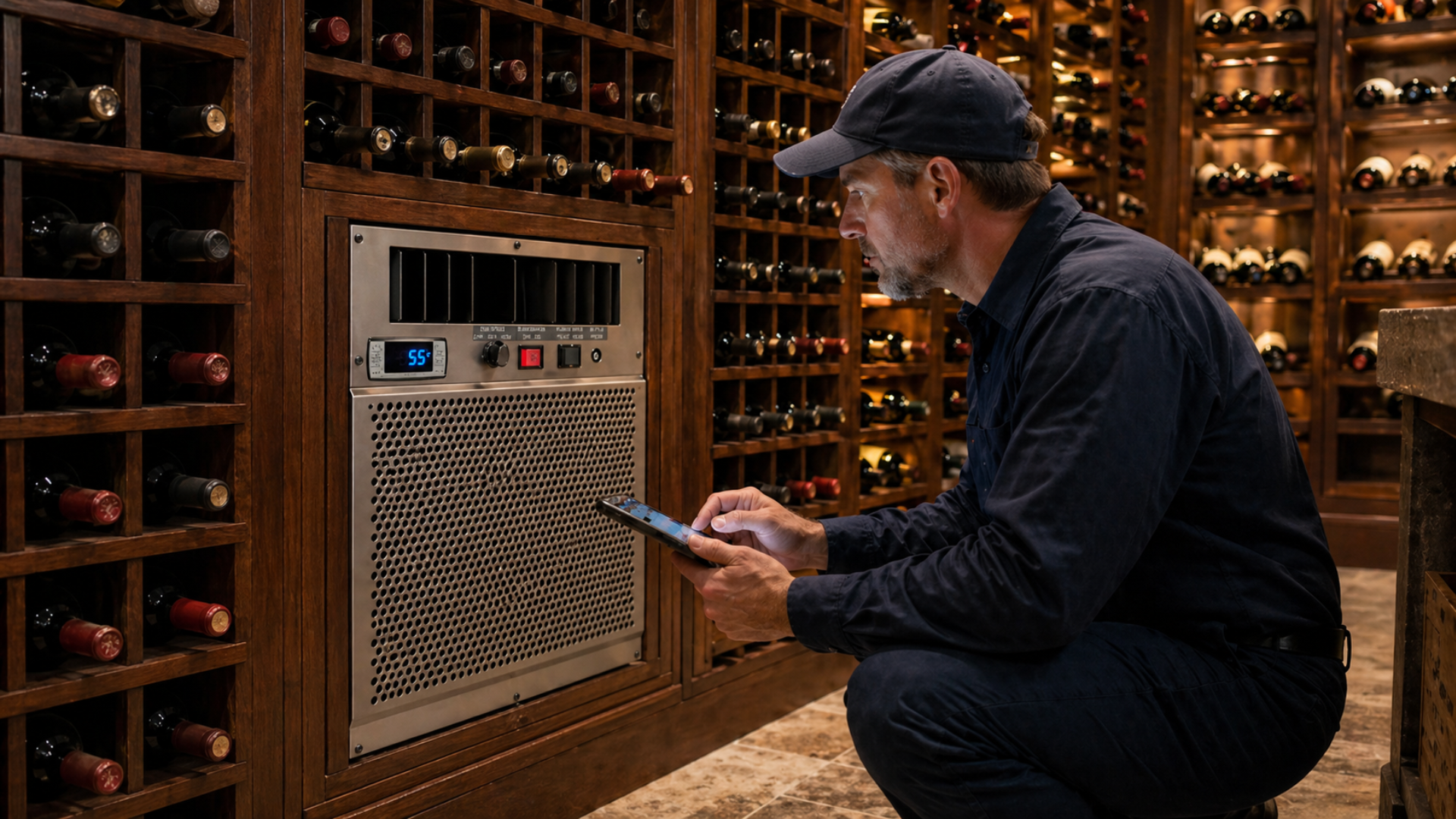
A refrigerator repair technician shows up at a River Oaks home on a Tuesday morning to service what the owner described as a broken refrigerator. The technician is competent. He services 20 refrigerators a week. He pulls the grille, inspects the condenser, reads the error code off the display, and produces a diagnostic in forty minutes. Then he looks at what he is actually servicing — a CellarPro 4200VSi in a 650-bottle wine room — and realizes none of his standard diagnostic sequence applies. The pressure ratios are wrong. The refrigerant isn’t what he expected. The controller language is unfamiliar. He leaves without touching the system.
This is not an unusual story. Wine cellar refrigeration systems and kitchen refrigerators share almost nothing beyond the fact that both use vapor-compression cycles and both keep things cold. The equipment categories diverge at every meaningful engineering decision, and the consequences of ignoring that divergence show up in misdiagnosed service calls, voided warranties, and — in the worst cases — a collection damaged during the learning curve of a technician who should not have been servicing the equipment at all.
The Mission Is Different
A kitchen refrigerator is designed for a specific thermal task: hold a 15-to-25-cubic-foot interior volume at 37°F against repeated door openings that introduce warm room air multiple times per hour. Its duty cycle is intermittent. Its thermal load is dominated by door-opening events, not by continuous wall-transmission loss. The compressor is sized accordingly — typically 1/8 to 1/4 horsepower on residential models — and the refrigerant charge is small enough that the entire system is factory-sealed and hermetically charged, requiring no field refrigerant work for the lifetime of the appliance.
A wine cellar cooling system has a fundamentally different mission. It holds a 200-to-2,000-cubic-foot room at 55°F against a continuous thermal load that never goes away — wall transmission, door seal leakage, heat rejection from lighting, and in Texas, solar gain through any exterior-wall exposure. The duty cycle is continuous, not intermittent. A residential cellar cooling unit in Houston in July runs 70 to 85% of the time, hour after hour, day after day. The compressor is sized for continuous operation against this load, and the refrigerant charge is large enough that most systems are field-serviceable and require EPA-certified handling.
A technician trained on one mission is not trained on the other. The diagnostic sequences are different because the systems are designed around different failure modes.
The Refrigerant Handling Is Different
Kitchen refrigerators on the U.S. market are small appliances under EPA regulation — sealed units with less than five pounds of refrigerant, factory charged, designed to last the system’s service life without ever being opened. Servicing one rarely involves touching the sealed system. When it does — on a Sub-Zero with a compressor failure, for example — the work requires Type I EPA Section 608 certification at minimum and is performed by a small specialist pool of factory-certified technicians.
Wine cellar cooling systems are almost all field-serviceable. Split systems (CellarPro Mini-Split, WhisperKool Platinum Split, Wine Guardian SD series) require field refrigerant charging at installation and periodic refrigerant verification during service. Self-contained units with access valves allow pressure reading and refrigerant adjustment without opening the sealed system. The technician who services a wine cellar needs EPA Section 608 certification at the Type II or Universal level for high-pressure equipment — a requirement that the Section 608 certification small-appliance Type I test does not cover.
A refrigerator technician with Type I certification who opens a wine cellar split system’s refrigerant circuit is, in the most literal sense, operating outside the scope of his certification. The EPA regulation is specific about this distinction, and the manufacturers’ warranty language is downstream of it.
The Load Calculation Is Different
A kitchen refrigerator arrives pre-sized. The manufacturer has done the thermal math. The owner does nothing with BTU calculations or ambient derating curves. The unit either fits the kitchen cavity or it does not; the thermal sizing was decided at engineering.
A wine cellar cooling system is sized for the specific room it serves. A 650-bottle cellar with R-15 walls and R-30 ceiling in a climate-controlled adjacent space requires a dramatically different cooling capacity than the same 650-bottle cellar with R-8 walls and a glass door facing a Houston patio. Manufacturers publish sizing tables — CellarPro, WhisperKool, and Wine Guardian’s cellar cooling calculator all cross ambient temperature, cellar R-value, and target setpoint to produce a BTU-output requirement — but the calculation has to be done at install, not assumed.
The implication for service: a cellar that “isn’t cooling well” may not have a broken cooling unit. It may have an undersized cooling unit for its thermal envelope, or a cellar whose insulation has degraded, or a door seal that has developed a leak that now exceeds the unit’s design margin. A kitchen refrigerator’s failure modes are almost all internal to the appliance. A wine cellar’s failure modes include the room the cooling unit is installed in. A technician who treats the cellar the way he treats a refrigerator will miss half the possible diagnoses.
The Parts Supply Chain Is Different
Sub-Zero, GE, Whirlpool, and the other major residential refrigerator brands operate mature parts distribution networks. Common service parts are available same-day or next-day from regional warehouses. A technician servicing a Sub-Zero refrigerator with a failed evaporator fan motor has a part in his hand within 24 hours in most cases.
Wine cellar cooling equipment operates on a different parts economy. CellarPro parts ship from Petaluma, California. WhisperKool parts ship from the same dealer network that handles their original installations. EuroCave parts ship from France, through Wine Enthusiast as the sole U.S. distributor, with lead times that routinely run one to three weeks on non-stocked components. A technician who doesn’t anticipate this in the initial diagnostic produces an emergency service call that becomes a three-week wait with the collection still exposed to whatever failure mode produced the call in the first place.
This parts asymmetry is why choosing a repair provider with established wine cellar brand coverage matters more in this category than in almost any other. The difference between a provider stocking critical wear parts for CellarPro, WhisperKool, and Wine Guardian and one who has to order them per service call is often two to three weeks of collection exposure.
The Certification Stack Is Different
A kitchen refrigerator service technician needs Type I EPA 608 certification (if they touch sealed systems) and brand-specific training if they want to remain within manufacturer warranty requirements. For premium brands, Sub-Zero and Wolf factory certification is a meaningful credential — but the pathway is one brand family.
A wine cellar service technician needs Type II or Universal EPA 608 certification at minimum — and then brand-specific knowledge across CellarPro, WhisperKool, EuroCave, Breezaire, and Wine Guardian, because the field population is split across all five. A technician certified only on refrigeration appliances and only on Sub-Zero products can be excellent at what he does and still not competent to service a cellar. The certification pathways do not overlap.
The market exposes this gap constantly. Collectors whose kitchen refrigerator technician “also does wine cellars” frequently discover, after the fact, that the technician was operating outside his certified scope and that the repair either didn’t hold or introduced a new problem. The common problems catalog for wine cellar refrigeration is instructive precisely because it documents failures that are unique to cellar systems and not found on residential refrigerators.
What This Means for a Collector
A collection is only as protected as the weakest link in its storage infrastructure, and for most cellars in Houston and Dallas, the weakest link is the service provider, not the equipment. Hiring the first appliance repair company that answers the phone is a gamble that a Section 608 Type II certification, wine cellar brand-specific training, a stocked parts inventory, and an understanding of cellar-envelope thermal load will all be present in a technician who was originally trained on refrigerators.
The pattern that closes the gap is simple. Ask the provider what EPA 608 certification type their technicians hold. Ask which cellar cooling brands they stock parts for. Ask whether their diagnostic sequence starts with the cellar envelope or with the cooling unit. The answers that matter are specific.
Uptown’s wine cellar service is built around this technical stack — Type II and Universal 608 certification, brand coverage across the major cellar manufacturers, parts inventory for the most common wear components, and diagnostic sequences that begin with the thermal envelope because that is where roughly a third of cellar problems actually originate. For a collector whose cellar is holding a six- or seven-figure collection, the specificity of the service provider is not a convenience preference. It is the service layer that determines how long the collection lasts.
A kitchen refrigerator and a wine cellar share a vapor-compression cycle and nothing else that matters. The service response has to reflect that.