




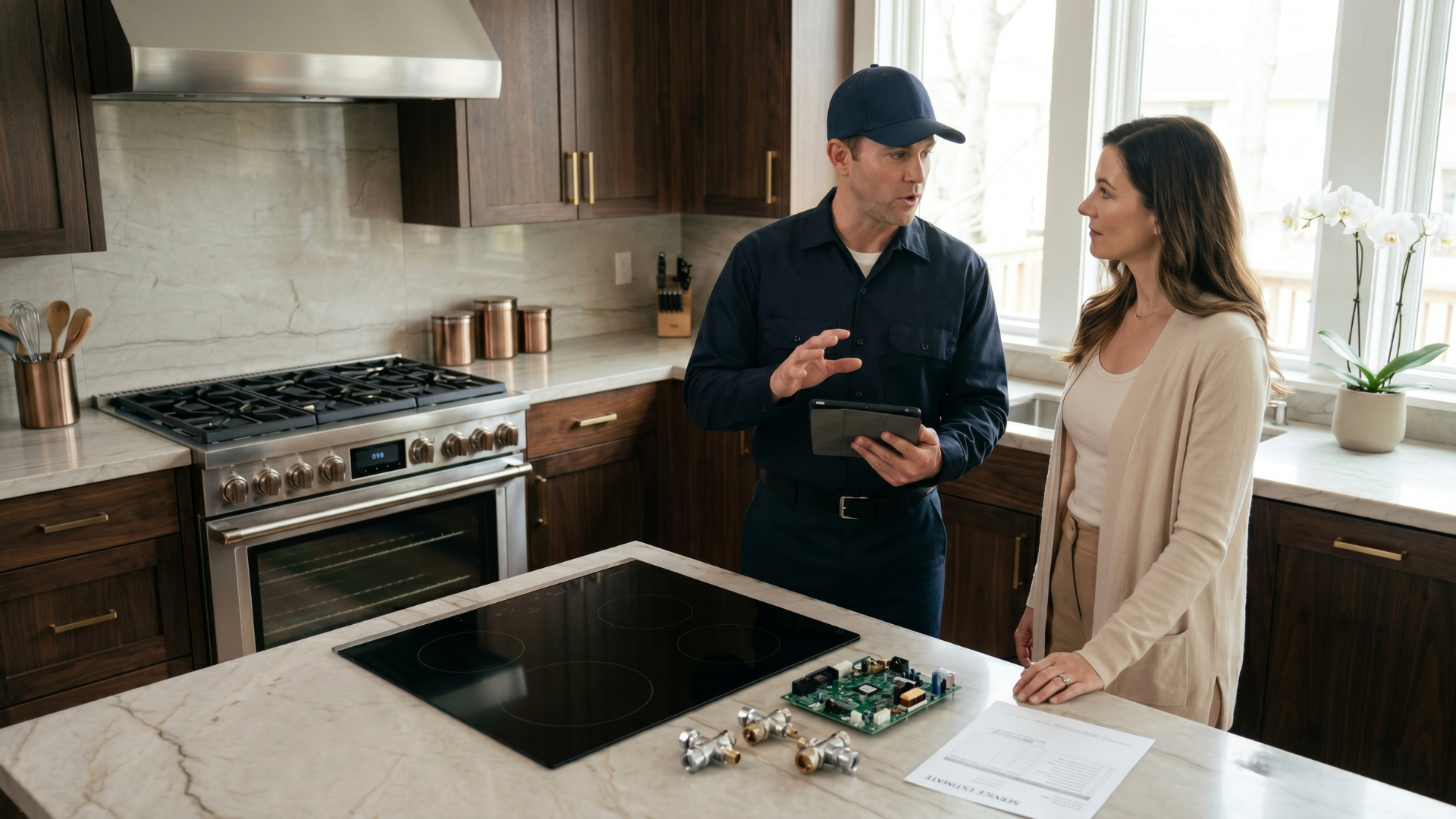
TL;DR: When comparing induction vs. gas range repair costs for a premium Texas kitchen, induction tends to face more frequent first-year service due to complex electronics — control boards, generator boards, and glass surfaces — while gas ranges see igniter, valve, and burner maintenance over time. Long-term ownership cost depends on brand, install complexity, and the specific failure modes each cooking type attracts.
The Range Decision Your Kitchen Designer Won’t Make for You
You’ve narrowed your kitchen remodel to induction or gas. Your designer can tell you which looks better. Your contractor can tell you what the gas line involves. But neither can tell you what that range will cost to maintain over a decade in a Houston or Dallas home — and that matters when you’re looking at a $10,000–$18,000 appliance.
This article doesn’t pick a winner. It gives you the information to pick your own.
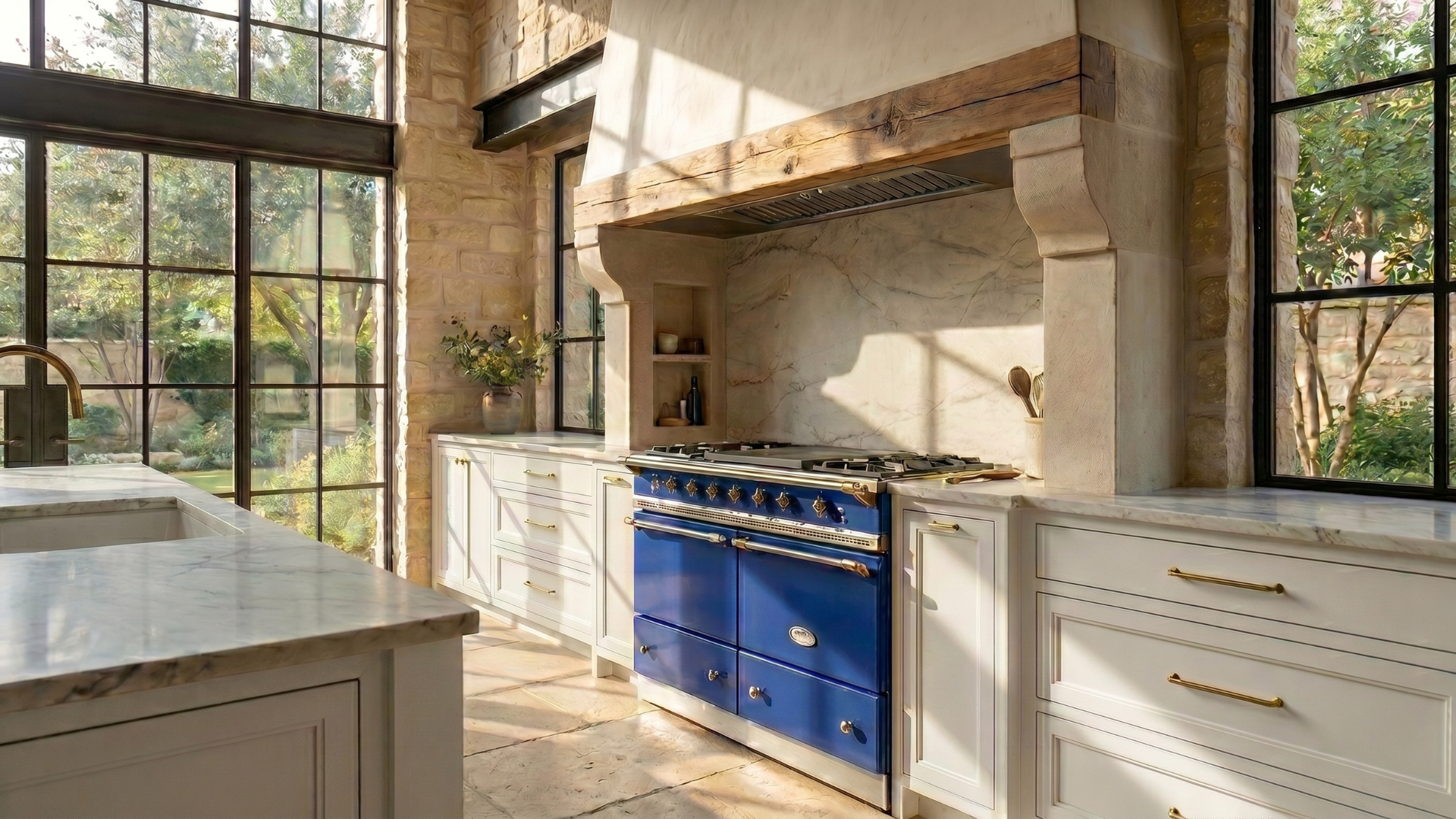
Premium Texas kitchens draw from the same brand tier on both sides: Wolf, Miele, Thermador, Viking, La Cornue, and LaCanche on gas; Wolf, Miele, Thermador, Bosch, Gaggenau, and Viking on induction. Many brands offer both cooking types in the same premium tier. The question is which system fits your household — and what that choice means for your wallet over the next decade.
How These Two Cooking Systems Fail
Understanding the repair profile of each system starts with understanding how they work and, by extension, what breaks.
What breaks on an induction range
An induction cooktop heats by passing an alternating current through a copper coil beneath the ceramic glass surface, creating a magnetic field that generates heat directly in the cookware. The advantages — speed, precision, cool surface — all flow from that electromagnetic system. So do the failure modes.
Generator boards (induction boards): These are the heart of an induction element. When a generator board fails, one or more cooking zones stop responding. Board replacements on premium brands are among the more involved repairs on an induction range — the components are brand-specific and not interchangeable across manufacturers.
Control boards and displays: Induction ranges draw significant power (most run close to 50 amps on a 50-amp circuit), leaving little margin for voltage inconsistency. Breakers trip. Control boards fail. In Texas, where grid events can produce both undervoltage brownouts and sharp restoration spikes, this is a relevant vulnerability. Power-related control board failure is the single most common induction service call, per Yale Appliance’s 2026 induction reliability report based on 33,190 service calls.
Glass cooktop surfaces: The smooth ceramic surface that makes induction cooktops easy to clean is also its most visible vulnerability. A sharp impact from cookware or thermal shock from cold liquid on a hot surface can crack the glass — and premium brand glass panels are not a small-ticket replacement.
The 8.7% number: Yale Appliance recorded an 8.7% first-year service rate across induction ranges — roughly 1 in 11 needing service in year one. For premium brands specifically, that number climbs: Thermador induction ranges ran 13.1% in the same dataset. More features mean more electronics, and more electronics mean more that can go wrong.
What breaks on a gas range
A gas range burns fuel at a burner to produce heat. The elegance of that simplicity shows up in a narrower failure profile — mechanical and combustion components rather than electronics.
Igniters and spark modules: The igniter is the most-serviced component on a gas cooktop. It’s exposed to heat, grease, and moisture every time you cook. A weak spark, a clicking that won’t stop, or a burner that won’t light are all igniter or spark module symptoms. On premium gas ranges, igniters are brand-specific OEM parts — not universal substitutes.
Gas valves: A valve that sticks open (dangerous) or fails to open (frustrating) requires immediate professional attention. This is not a homeowner repair on any gas appliance.
Regulators: The gas pressure regulator manages fuel delivery to every burner. Regulator issues manifest as uneven flame, weak output across all burners, or flame instability. On a Wolf or La Cornue range, a faulty regulator affects the cooking performance the homeowner paid for.
Surface burners and caps: Burner ports clog with cooking residue. Burner caps warp from thermal cycling over years of use. These are maintenance items on any gas range, but premium ranges have precision-machined components where warping or misalignment is more consequential for performance.
The 6.9% number: Gas ranges averaged 6.9% first-year service in the same dataset — lower than induction’s 8.7%. That reflects a simpler mechanical system, not a universally better appliance.
Texas-Specific Factors That Change the Math
The Texas context adds variables that matter for both cooking types.
Induction and the Texas grid
Induction ranges are sensitive to power quality. Voltage inconsistencies — brownouts, sharp power restoration after an outage, or surges — create exactly the conditions that stress control boards and generator boards. Houston experienced a grid event in 2024 that left the majority of CenterPoint’s 2.6 million customers without power, with restoration stretching over multiple days. Dallas saw a comparable event during the May 2024 derecho.
A high-end induction range doesn’t handle a multi-day power interruption the same way a gas range does. When power is restored, a gas range is functionally the same appliance it was before (assuming no surge damage to the ignition electronics). An induction range resumes cooking only when stable power is confirmed — and may need technician attention if restoration power quality damaged a board.
This doesn’t make induction the wrong choice for Texas. It means induction owners in storm-prone Houston neighborhoods should have whole-home surge protection in place and understand their range’s restart requirements before needing that knowledge under pressure.
Gas and new construction
Texas new construction — particularly in North Dallas communities like Frisco and Plano — is increasingly all-electric. Installing a gas range in those homes means adding a gas line where none exists: permitting, line extension, possibly a meter upgrade. That infrastructure cost can add meaningfully to the purchase comparison. In established Houston neighborhoods with existing gas service, a River Oaks or Tanglewood kitchen typically already has what a gas range needs.
The Decision Table
This table is designed for one purpose: helping you match your situation to the right cooking system. It is not a recommendation either way.
| Your situation | Induction makes sense when | Gas makes sense when | |—|—|—| | Cooking style | Precise temperature work, simmer control, fast boiling | Wok cooking, open-flame techniques, char-searing | | Household power | Whole-home surge protection installed; stable grid connection | Grid reliability concerns; existing whole-home generator already sized for gas appliances | | Home type | New construction or all-electric home; no gas infrastructure | Established home with existing gas line; gas infrastructure in place | | Cookware situation | Already own magnetic-base cookware (cast iron, stainless) | Mixed cookware collection including copper, ceramic, or non-magnetic materials | | Kitchen remodel timing | Major renovation; electrical panel upgrade is already in plan | Minor refresh; gas line already terminated at range location | | Noise tolerance | Prefer silent cooking surface | Comfortable with igniter clicking during light; prefer audible confirmation of ignition | | Service access | Factory-certified induction technicians available locally | Factory-certified gas technicians available locally (both are relevant — choose a brand with local service support) |
When dual-fuel is the answer
Dual-fuel ranges pair gas burners with an electric convection oven — Wolf offers this in its full lineup. They address both performance priorities but carry a more complex service profile (gas cooktop components plus electric oven electronics) and still require gas infrastructure. Worth a conversation if the cooking style genuinely demands both.
Lifetime Cost: What to Carry Into the Conversation
There’s no honest way to give you a single 10-year ownership cost number without knowing your brand, your cooking volume, your specific model, and your service history. What we can do is frame the variables.
Purchase price ranges from roughly $5,500–$18,000+ for 30″–36″ premium induction or gas ranges across the Wolf, Miele, Thermador, Viking, and Gaggenau tier. La Cornue and LaCanche French ranges occupy their own pricing category with corresponding parts-lead-time realities.
Installation: Induction requires a dedicated 240V/50-amp circuit if one doesn’t exist; gas requires a properly sized line. Get a quote specific to your home before comparing purchase prices alone.
Energy cost over a decade is genuinely different between the two. The U.S. Department of Energy notes that induction appliances are up to three times more efficient than gas stoves, with induction transferring heat at roughly 85% efficiency versus approximately 32% for gas. Whether that efficiency advantage translates to bill savings depends on your local gas and electricity rates — and Texas electricity rates, particularly in ERCOT markets, can fluctuate significantly. The efficiency advantage is real; the dollar value of that advantage is location-dependent.
Repair costs over time track the failure modes above. Induction board replacements on premium brands carry parts costs that reflect the brand tier. Gas igniter and valve work is generally less expensive at the parts level but requires factory-certified hands for safety and warranty compliance — our Wolf cooktop burner issues diagnostic guide and induction cooktop repair overview give a grounded picture of what service on each system actually involves. OEM parts and brand-specific diagnostic tools matter for both.
Longevity: Wolf designs for 20 years of daily use; Miele makes a similar commitment. A well-maintained premium range doesn’t follow commodity replacement timelines. The 50% rule for appliance repair doesn’t apply to a Wolf or Miele the same way it applies to a builder-grade range — and that distinction matters at year 10.
FAQ
Does induction require special wiring?
Most induction ranges require a dedicated 240V/50-amp circuit. Established Houston or Dallas homes with a prior electric range often already have one; all-gas homes will need an electrician to run it. Confirm the spec for your specific model before purchase — requirements vary by size and brand.
Can I use my existing cookware on induction?
Induction requires a magnetic base — cast iron, enameled cast iron, and most stainless steel work. Aluminum, copper, glass, and most ceramic cookware don’t. If you’re moving from gas with a mixed collection, budget for a cookware audit alongside the range.
How does power outage affect each cooking type?
Gas cooktop burners can be lit manually during an outage — they need electricity to ignite electronically, not to burn. The oven on most modern gas ranges requires power and won’t function. An induction range is fully offline without power. Neither provides a complete kitchen during a multi-day outage without backup power.
What are the most common failures on each type?
Induction: control board and power-related failures are most common in Yale’s 2026 data, followed by generator board failures and glass surface damage from impact. Gas: igniters top the list, followed by spark modules and burner components over time. Gas failures are generally simpler to diagnose — mechanical rather than electronic.
Is dual-fuel worth the added complexity?
Dual-fuel combines gas cooktop and electric oven service profiles. If you specifically want gas response and electric baking precision, the configuration earns its premium. If you can adapt to one surface, a single-fuel range is the simpler long-term proposition.
When you’re ready to talk through what your specific range needs — whether you’re already owning one or evaluating a remodel — we’re a call away. Schedule a service or contact us for an assessment.
Houston: (281) 758-9978 · Dallas: (214) 761-8300
Sources
- Yale Appliance 2026 Induction Range Reliability Report — source for the 8.7% induction first-year service rate vs. 6.9% for gas, based on 33,190 service calls; also the basis for the Thermador 13.1% figure cited in the article.
- U.S. Department of Energy — Making the Switch: Induction Stoves or Cooktops — source for the efficiency comparison: induction at ~85% efficiency vs. gas at ~32%, and the “up to three times more efficient” claim.
- Wolf Appliance — manufacturer reference for the 20-year design lifecycle commitment and dual-fuel range configuration details cited in the article.
Related Reads from Uptown
- Induction Cooktop Repair: Specialized Service for Modern Luxury Kitchens — a deeper look at what induction repair actually involves, from generator board replacement to glass surface diagnosis.
- Wolf Cooktop Burner Issues: From Diagnosis to Repair — the gas-side companion: how Wolf burner failures present, what they cost, and when to call a technician.
- When Your Wolf Cooktop Won’t Ignite: What Texas Homeowners Need to Know — igniter failures are the top gas-range service call; this guide walks you through the symptoms and what to expect from a repair visit.
- The 50% Rule for Appliance Repair — Why It Fails Differently for Every Luxury Appliance — the repair-vs-replace framework that applies differently to a Wolf or Miele than it does to a builder-grade range.
- When to Repair vs. Replace Your Luxury Refrigerator: A Cost-Benefit Analysis — applies the same cost-benefit thinking from this article to refrigeration, useful for homeowners evaluating their full premium kitchen.