





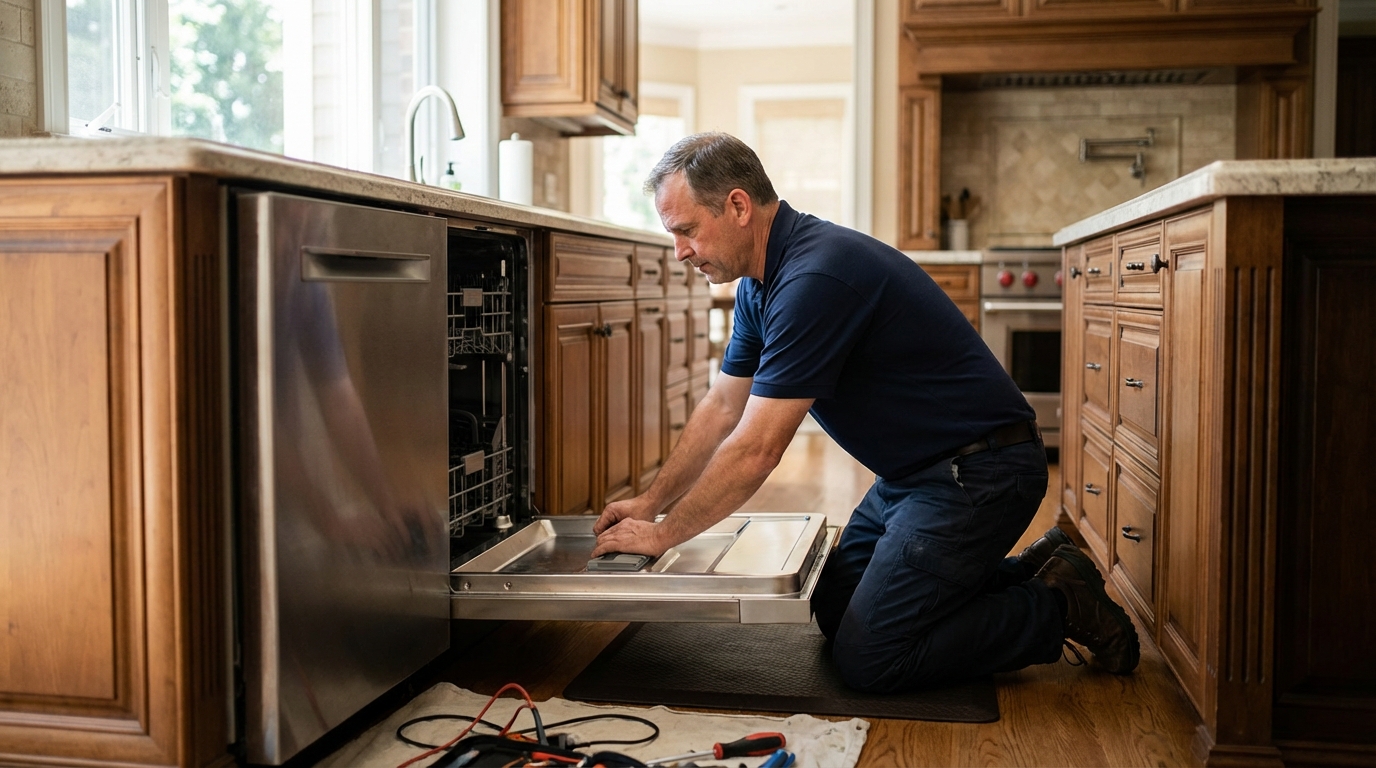
The internet’s favorite appliance advice is simple: if the repair costs more than 50% of a replacement, buy new. For a $600 Whirlpool dishwasher, that math is fine. The threshold is $300. A failed control board hits it. Decision made.
But walk through a Highland Park kitchen with a Wolf 48″ dual fuel range, a Miele panel-ready dishwasher, a Sub-Zero refrigerator column, and a CellarPro cooling system in the adjacent wine cellar — and that single formula is supposed to govern $50,000 or more in equipment that shares almost nothing in common except the roof it sits under.
The 50% rule doesn’t just fail for luxury appliances. It fails in a different way for each type of luxury appliance. And understanding those differences is the only path to decisions that actually protect your investment.
The problem isn’t the math. It’s the assumption behind it.
The 50% rule assumes every appliance is a depreciating commodity with a standard lifespan. Buy it, use it for a decade, replace it when repairs stop making sense. That framework works when the appliance costs $800, lasts ten years, and slides out of a countertop opening that any replacement model will fit.
Luxury appliances violate every one of those assumptions — but they violate them differently depending on the category. A Sub-Zero refrigerator has a different cost structure than a Wolf range, which has a different installation dependency than a Miele dishwasher, which has a completely different risk profile than a wine cellar cooling system. Applying one ratio to all four produces four different kinds of bad advice.
Ranges: where replacement triggers renovation
Wolf designs its ranges to last 20 years, stress-testing every unit under conditions heavier than any home cook will impose. A 48″ Wolf dual fuel range retails for $15,000 to $18,000. The 50% threshold would be $7,500 to $9,000.
No single range repair approaches that number. Igniter replacement, thermostat calibration, convection fan service, control board diagnosis — individually, these are fractions of the threshold. The 50% rule will always say repair, which happens to be the right answer but for the wrong reason. The rule isn’t helping you think; it’s just confirming that replacing an $18,000 appliance is expensive.
What the rule completely misses is installation dependency. A standard freestanding range slides out and a new one slides in. A Wolf 48″ built into custom cabinetry connects to dedicated gas lines, electrical circuits, and ventilation systems sized specifically for that model. Replacement means confirming the new unit’s dimensions match the existing cutout, reconnecting utilities to potentially different specifications, and verifying hood compatibility. If the new model’s depth or height differs by even half an inch — and models do change across generations — you’re looking at cabinetry modifications that can add thousands to the project cost.
A standard range lasts 13 to 15 years. By year ten, replacement is reasonable. A Wolf at year ten is halfway through its designed service life, with individual components that are straightforward to repair and an installation footprint you’d prefer never to disturb.
Dishwashers: the lifespan gap the rule can’t see
Miele tests every dishwasher model to the equivalent of 20 years of average household use — roughly 5,000 wash programs at five cycles per week. A standard dishwasher lasts 10 to 12 years. A Miele is engineered to outlast it by nearly a decade.
Miele dishwashers retail from $1,300 to $3,700, making the 50% threshold $650 to $1,850. Here, unlike with ranges, the threshold is actually reachable. A circulation pump or control board replacement on a high-end Miele model could approach the lower end of that range. So the 50% rule occasionally produces an answer — but it’s still the wrong framework.
The critical variable for dishwashers is integration. Many luxury dishwashers are panel-ready, meaning the visible face is a custom panel matched to your cabinetry. Replacing the dishwasher means either commissioning a new panel — assuming your cabinetmaker still has the matching material — or accepting a visible mismatch in a kitchen designed for seamless uniformity. For a homeowner who spent $150,000 on a kitchen renovation, a visible inconsistency in the cabinet line isn’t a minor detail. It’s the kind of thing you notice every time you walk into the room.
The real question for a Miele dishwasher at year eight isn’t whether the repair costs 50% of a new unit. It’s whether the unit has consumed 40% of its tested lifespan with 60% remaining — and whether the repair restores it to performance that justifies those remaining years.
Refrigeration: the modular exception
Sub-Zero refrigerators are designed to last 20 years or more, using dual compressors and modular architecture that allows individual components to be replaced without disturbing the rest of the system. We’ve written extensively about why the 50% rule breaks down completely for Sub-Zero — the short version is that at $11,000 to $16,000 for a new unit, the 50% threshold sits between $5,500 and $8,000, a number no single repair realistically reaches.
But the refrigeration-specific insight goes beyond cost. Sub-Zero’s modular design means the appliance functions more like a system than a single depreciating asset. A compressor replacement doesn’t reset the clock on the entire unit — it resets the clock on the compressor while every other component continues operating on its own timeline. This is fundamentally different from a standard refrigerator, where a major component failure often signals cascading decline across the whole system.
The repair-or-replace framework for luxury refrigeration should track repair trajectory — isolated failures versus clustered failures — rather than measuring any single repair against a replacement ratio.
Wine cellar cooling: where the rule is irrelevant
Wine cellar cooling systems from CellarPro, WhisperKool, Breezaire, and EuroCave range from $2,000 to over $11,000, depending on capacity and configuration. The 50% rule would set thresholds of $1,000 to $5,500. But applying a standard appliance formula to climate control equipment protecting a wine collection is like using a home insurance calculator to value the art hanging on the walls.
The relevant calculation isn’t equipment cost versus repair cost. It’s equipment repair cost versus collection exposure. A collector with 500 bottles averaging $60 each has $30,000 at risk. A serious collector in River Oaks or Preston Hollow may hold $100,000 to $500,000 in wine that cannot be replaced at any price — allocated vintages, verticals assembled over decades, bottles from producers who no longer exist.
When a wine cellar cooling system develops problems, the question isn’t whether the repair costs half the equipment value. The question is how quickly the system can be restored before temperature deviation begins degrading wine quality. Every hour of inadequate cooling in a Texas summer is a risk to the entire collection. The 50% rule doesn’t account for consequential loss, and in wine storage, consequential loss is the only thing that matters.
What actually works instead of one rule
Each appliance category demands its own decision framework, built around the variables that matter for that specific type of equipment.
For ranges, the deciding factor is installation complexity. If the repair restores a unit that’s firmly within its designed service life, and the alternative is a replacement that may require cabinetry modification, the repair is almost certainly the better investment — regardless of its cost as a percentage of replacement.
For dishwashers, the deciding factor is the remaining engineered lifespan. A Miele at year six with a repairable issue has 14 years of tested capacity ahead of it. The same repair on a standard dishwasher at year six might be reasonable too, but the remaining runway is four years, not fourteen. The math is identical; the context is completely different.
For refrigeration, the deciding factor is failure pattern. Isolated component repairs on a modular system are routine maintenance. Clustered failures across multiple systems in the same unit suggest a different conversation entirely.
For wine cellars, the deciding factor is collection value relative to repair urgency. The equipment is the least expensive element in the equation.
The real function of the rule
The 50% rule exists because most people don’t have a framework for repair decisions, and any framework is better than none. For standard appliances with standard lifespans at standard price points, it works well enough.
But a kitchen with $50,000 in luxury equipment isn’t a standard situation. Each appliance has its own engineering philosophy, its own lifespan profile, its own installation dependencies, and its own risk exposure. The homeowner who chooses a repair partner with category-specific expertise isn’t just getting a better repair. They’re getting a better decision — one informed by the actual variables that determine whether repair or replacement protects the investment.
One formula can’t do that. Four different conversations can