




TL;DR: Houston’s premium neighborhoods carry dramatically different flood risk profiles. Meyerland and Bellaire sit squarely in FEMA’s high-risk Zone AE along Brays Bayou. The Memorial corridor straddles Zone AE and Zone X depending on proximity to Buffalo Bayou’s tributaries. Your flood zone determines how to prepare — and what to inspect first when water recedes from a Sub-Zero, Wolf, or Miele kitchen.
Direct answer: Houston flood zone premium appliance risk comes down to four variables: your FEMA zone designation (Zone AE vs. Zone X), bayou proximity, slab elevation, and whether appliances are built in or portable. Meyerland and Bellaire carry the most consistent Zone AE exposure; Memorial is mixed; Friendswood has its own repeat-flooding pattern. Each zone tier creates a different appliance risk profile.
Why Flood Zone Matters Differently When Your Kitchen Cost $200,000
For most homeowners, “flood zone” is primarily an insurance and mortgage question. For owners of premium integrated kitchens, it’s also a maintenance and repair planning issue.
Water that barely inconveniences a freestanding appliance can permanently end the useful life of a built-in refrigerator column. According to NC State Cooperative Extension’s flood appliance guidance, refrigerators and freezers with wet insulation cannot be salvaged — even when the compressor still runs. The foam holds moisture, creates a mold environment, and compromises thermal performance indefinitely.
Knowing your neighborhood’s flood profile — and what it means for appliance configurations at your specific elevation — is practical preparation that most generic sources don’t provide.
A Plain-English Guide to Flood Zone Designations
FEMA’s Flood Map Service Center uses these zone labels for Houston properties:
Zone AE — the designation that matters most in inner-loop Houston. AE zones carry a 1% annual chance of flooding (the “100-year floodplain”). Zone AE properties typically require flood insurance with a federally backed mortgage. Harris County Zone AE policies average around $1,196 per year. The “E” means base flood elevations are established — your slab elevation relative to the BFE directly affects your premium and your risk.
Zone X (shaded) — 0.2% annual chance (500-year floodplain). Lower statistical risk, but Harvey demonstrated Zone X properties flood too. Harris County NFIP data shows Zone X properties generated 91,679 flood claims averaging $45,000 each. Zone X (unshaded) carries moderate-to-low risk.
Zone AE means engineers have calculated where floodwater reaches in a 100-year storm. Zone X means it probably won’t — but “probably” carries real asterisks in a city built on bayous.
The Four Neighborhoods: Where They Stand
Meyerland — Zone AE’s Most Documented Address
Meyerland (ZIP 77096) sits along Brays Bayou, a 30-mile watershed draining into the Houston Ship Channel. Most of the neighborhood falls in Zone AE.
The flood pattern is primarily bayou overbank flow — when Brays Bayou overtops, water moves outward from the channel rather than up from street drains. This is important for appliance owners: the water rises slowly from the perimeter, giving ground-floor installations the most exposure. Harris County’s flooding history records note a major flood somewhere in the county roughly every two years; Meyerland’s bayou-adjacent position keeps it in that rotation.
Typical appliance exposure: Built-in refrigerator columns, warming drawers at kickplate height, and wine cellars in under-stair configurations. Kitchens within a few blocks of Brays Bayou carry the highest risk of water reaching toe-kick and lower-cabinet zones.
Bellaire — Zone AE With a CRS Discount
Bellaire is an independent city surrounded by Houston, with a flood zone profile that mirrors Meyerland: predominantly Zone AE, with Zone X in higher-elevation areas along Brays Bayou’s southern bank.
One distinction worth knowing: Bellaire participates in FEMA’s Community Rating System (CRS) with a Class 7 rating, earning residents in the Special Flood Hazard Area up to a 15% NFIP premium discount. Harris County as a whole has 19,894 properties with multiple flood insurance losses — 10,546 in Zone AE alone. Bellaire’s Brays Bayou exposure puts many of its properties in this repetitive-loss category.
Typical appliance exposure: Sub-Zero panels at ground level, Wolf range igniters and gas manifolds (both require professional inspection before any attempt to relight after flood exposure), and Miele dishwasher pump housings. Bellaire kitchen renovations are among the highest-value in the metro — a single flood event often triggers six-figure appliance replacement decisions.
The Memorial Corridor — A Mixed Zone Profile
“Memorial” encompasses a large, varied geography. The area generally runs from Shepherd Drive westward through Memorial Park and out toward Katy. Within this corridor, flood zone designations vary considerably:
- Properties adjacent to Buffalo Bayou and tributaries — Rummel Creek, Spring Branch Creek — tend to fall in Zone AE.
- Properties a few blocks removed often sit in Zone X (shaded) or unshaded Zone X.
- Two homes on the same street can carry different zone designations.
The area’s variability was on display during Tropical Storm Imelda (September 2019), which dropped 20–40 inches of rain on a narrow Harris County band in under 48 hours. The Harris County Flood Control District’s Imelda report documented flooding in areas that hadn’t flooded during Harvey — illustrating the limits of zone maps calibrated to historical storm profiles.
Typical appliance exposure: Zone AE Memorial homes near bayou tributaries carry Meyerland-comparable risk for built-in refrigeration. Zone X Memorial homes are more likely to see short-duration street flooding — enough to affect sub-slab appliance components but typically not sustained inundation.
Friendswood — Repeat Flooding on Clear Creek
Friendswood (Galveston County) sits on the Clear Creek watershed, one of the Houston metro’s most persistently flood-prone corridors. Friendswood’s flood pattern is typically slow-rising creek water over 24–48 hours rather than rapid flash flooding. Extended inundation — even at modest depths — is particularly damaging to sub-floor wiring harnesses and pump housings in built-in appliances.
The “Elevated Kitchen” Question: Does a 2-Foot Slab Change the Math?
After Harvey, many Meyerland and Bellaire homeowners elevated their homes — raising slabs by 18 to 36 inches. Elevation helps substantially, but only against storms whose water line stays below the new slab height.
Harris County municipalities updated floodplain regulations after Harvey to require the 500-year flood level rather than the 100-year level as the standard for new slab heights. An elevated home that clears the 100-year flood line may still see first-floor flooding in a 500-year event.
What elevation does protect against: the routine overbank events that account for most of Meyerland and Bellaire’s flooding frequency. A slab elevated 24 inches above Base Flood Elevation clears the water line in most major storms — not all, but most.
For appliance owners in elevated homes: the risk reduction is real, but the planning assumption should stay “this can flood” rather than “this won’t flood,” particularly for lower-cabinet integrated installations and under-counter wine storage.
Pre-Storm Preparation
Steps worth taking before a named storm if you own a premium kitchen in Zone AE:
Document your appliances now, not after. Photograph serial numbers, model numbers, and the full kitchen configuration. Store images in cloud backup, not on a phone that might be in the kitchen. Insurance adjusters and repair technicians both need this information — and it’s much harder to reconstruct after a storm. Preparing before hurricane season is also when you should review your appliance protection plan for wine cellars and refrigeration.
Move what’s movable. Portable wine coolers and countertop appliances can go to a second floor or elevated shelf. Built-in panels can’t move, but their contents can — wine collections, frozen provisions, medications.
Know your gas shutoff. Cut gas to any Wolf range, Thermador cooktop, or built-in grill before confirmed flooding. Compromised gas valves create post-storm hazards independent of the appliance. Know the valve location before hurricane season.
Watch the bayou. The Harris County Flood Warning System provides real-time gauge readings. Brays Bayou data gives Meyerland and Bellaire homeowners a 2–4 hour warning window before typical overbank flow.
Post-Event: What to Inspect First
After water recedes, the sequence matters as much as the action.
Do not restore power until an electrician clears the appliances. FEMA’s guidance on flood-damaged electrical equipment is unambiguous: never restore power to flooded appliances without a professional inspection. This applies even if the water line appears to have been below the electrical components — moisture migrates upward through insulation and wiring before it’s visible.
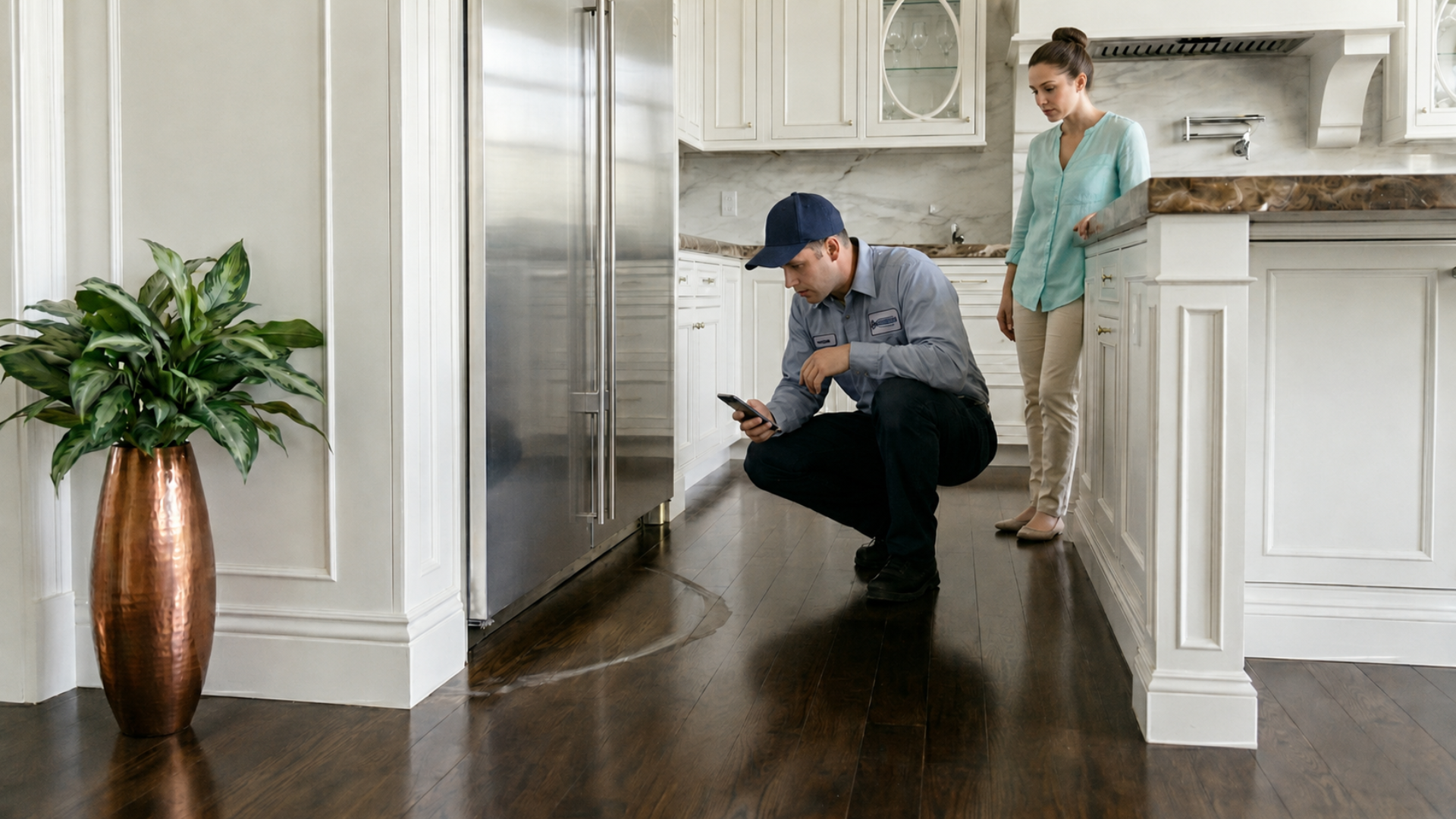
First 24–48 hours: Visual inspection only. Document water line marks on panels, kickplates, and lower cabinets. Don’t open Sub-Zero or integrated refrigerator doors if power has been off — the unit may still be holding safe temperature, and opening disrupts that buffer.
The insulation decision (Sub-Zero and similar integrated refrigerators): If water reached the toe-kick or lower panel of an integrated refrigerator, salvageability depends on water depth and duration. Wet insulation in refrigerators typically cannot be salvaged — this is the call that determines whether you’re facing a repair or a kitchen renovation. Get a professional assessment before making any insurance or replacement decision.
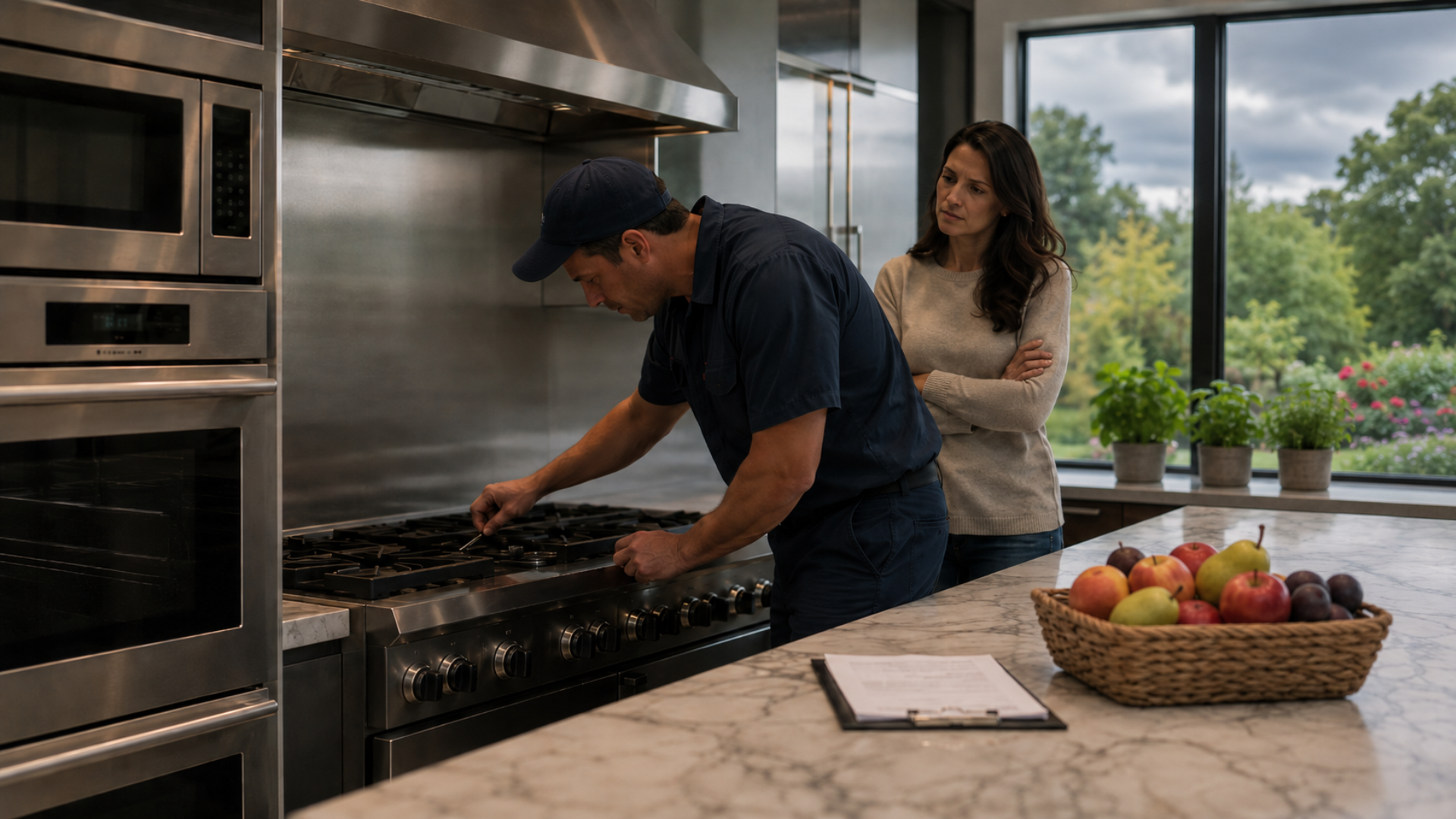
Wolf ranges and gas appliances: Do not relight any gas appliance after flood exposure without a technician inspecting the gas manifold, igniter wiring, and control board. Moisture in a gas valve is a safety issue before it’s an appliance issue. Our Texas power grid article covers related protection principles.
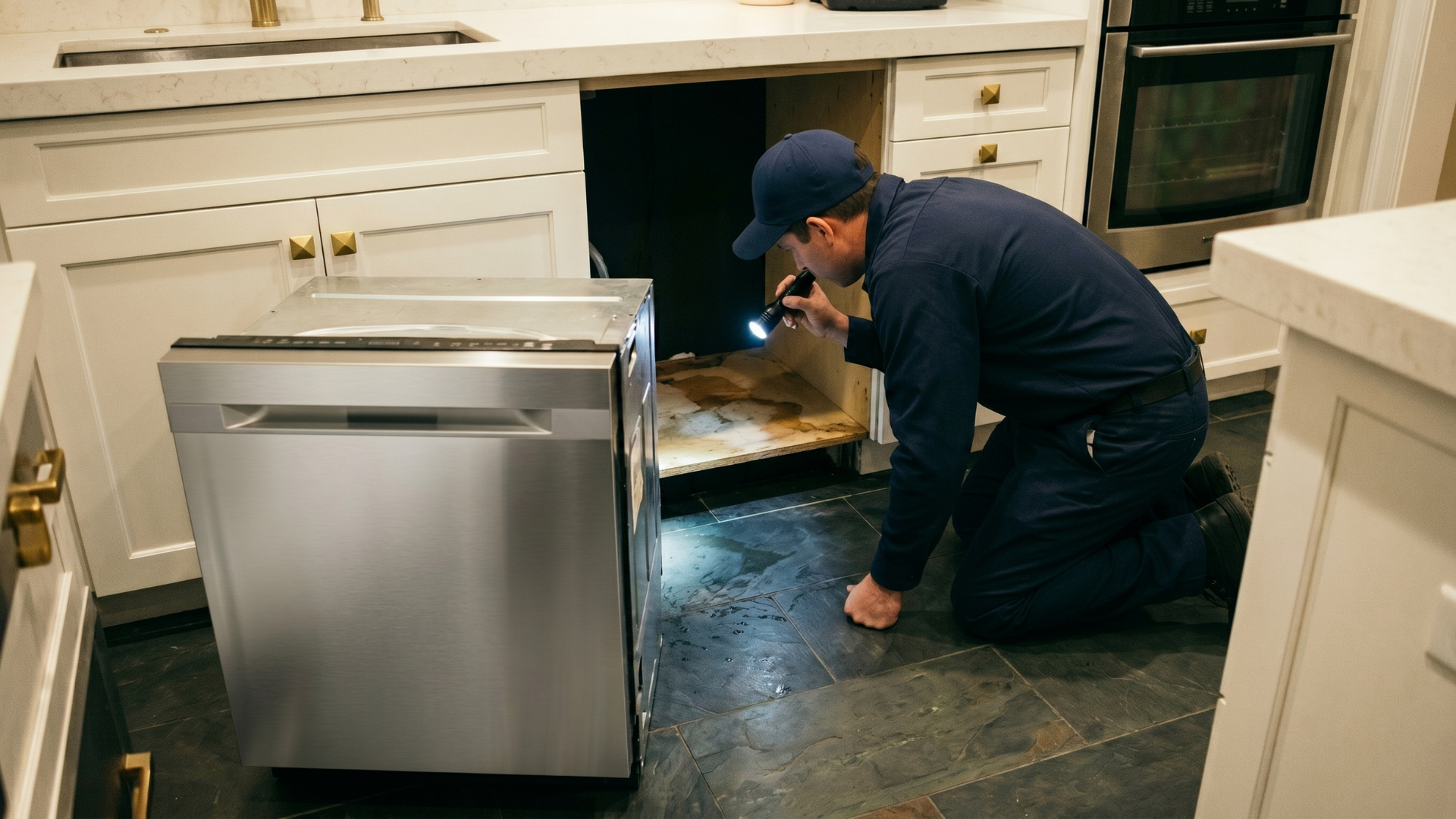
Miele dishwashers: Flood water that enters a dishwasher cavity affects the pump housing, door latch assembly, and control board. Sediment retention causes premature seal failure — often not immediately apparent, but visible within two to three wash cycles.
When to call Uptown: If there’s any question about a premium appliance that experienced flood exposure, our assessment-first model means we diagnose before we recommend — not the reverse.
FAQ
Is Memorial Park in a flood zone?
The area near Buffalo Bayou and its tributaries sits largely in Zone AE. Residential areas further from the waterways often fall in Zone X (shaded) or unshaded Zone X. Zone designation can vary between neighboring streets in Memorial — check your specific address at msc.fema.gov.
Does my Bellaire homeowners insurance cover slab-flood damage to appliances?
Standard homeowners insurance generally does not cover flood damage — that requires a separate policy through FEMA’s NFIP or a private carrier. NFIP covers some appliances (refrigerators, stoves) but coverage for integrated kitchen systems can be complex. Review your specific policy with your insurance agent before hurricane season, not during it.
What’s the difference between Zone AE and Zone X for my appliances?
Zone AE means a 1-in-100 annual chance of flooding from a mapped bayou or creek. Zone X (shaded) is 1-in-500. Zone AE homeowners should plan for potential ground-level flooding and make mitigation decisions accordingly. Zone X homeowners carry statistically lower risk but Harvey demonstrated Zone X flooding across much of the metro — the preparation steps above apply in both zones.
If my Meyerland home was elevated after Harvey, do I still need flood preparation?
Yes. Elevation above Base Flood Elevation reduces risk in most storms but not all — extreme events can exceed both the 100-year and 500-year flood lines. Pre-storm documentation, gas shutoff preparation, and insurance review are worthwhile regardless of slab elevation.
Should I buy flood insurance if I’m in Zone X?
That question belongs to your insurance agent. What we can say: Zone X properties in Harris County have generated tens of thousands of NFIP claims since 1978, averaging around $45,000 per claim.
How do I check my flood zone designation?
Enter your address at FEMA’s Flood Map Service Center. You’ll see your zone, Base Flood Elevation, and FIRM panel. Comparing your BFE to your finished floor elevation shows how much buffer your home has in a 100-year event.
Ready to Talk
We serve Bellaire, Memorial Park, River Oaks, Tanglewood, and the Galleria area — every neighborhood in Houston’s primary flood corridors. If your kitchen took on water or you want a pre-season assessment, we’re a call away: (281) 758-9978.
Sources
- FEMA Flood Map Service Center — official FEMA tool for looking up flood zone designations, Base Flood Elevations, and FIRM panels by address; referenced throughout for Zone AE/X definitions
- Harris County Flood Control District — Brays Bayou Project — HCFCD project page for the Brays Bayou watershed covering Meyerland and Bellaire flood exposure
- Harris County Flood Control District — Harris County’s Flooding History — county-level flooding frequency records cited for Meyerland bayou overbank recurrence pattern
- Harris County Flood Control District — Tropical Storm Imelda Flood Report — official HCFCD post-event report on Imelda (September 2019) documenting flooding in areas not affected by Harvey
- FEMA — Flood Maps and Community Rating System — FEMA source for CRS program details (Bellaire Class 7 rating), NFIP flood claim data, and electrical safety guidance for flood-damaged appliances
- NC State Cooperative Extension — How to Salvage Flood-Damaged Appliances — authoritative guidance on refrigerator insulation salvageability and appliance inspection sequence after flood exposure
Related Reads from Uptown
- Bellaire Appliance Repair: Fast Service for Houston’s Affluent Suburb — Bellaire-specific service context for homeowners in this Zone AE corridor
- Hurricane Season Appliance Prep: Protecting Wine Cellars from Power Outages — pre-storm preparation guide for premium wine storage and refrigeration in flood-prone neighborhoods
- Tanglewood Appliance Repair: Expert Luxury Service for Houston’s Historic Neighborhood — service coverage for one of Houston’s highest-value residential neighborhoods adjacent to the Memorial and Galleria corridors
- River Oaks Appliance Repair: When Luxury Demands Expertise — premium appliance repair in River Oaks, Houston’s most affluent inner-loop neighborhood with mixed flood zone exposure near Buffalo Bayou