




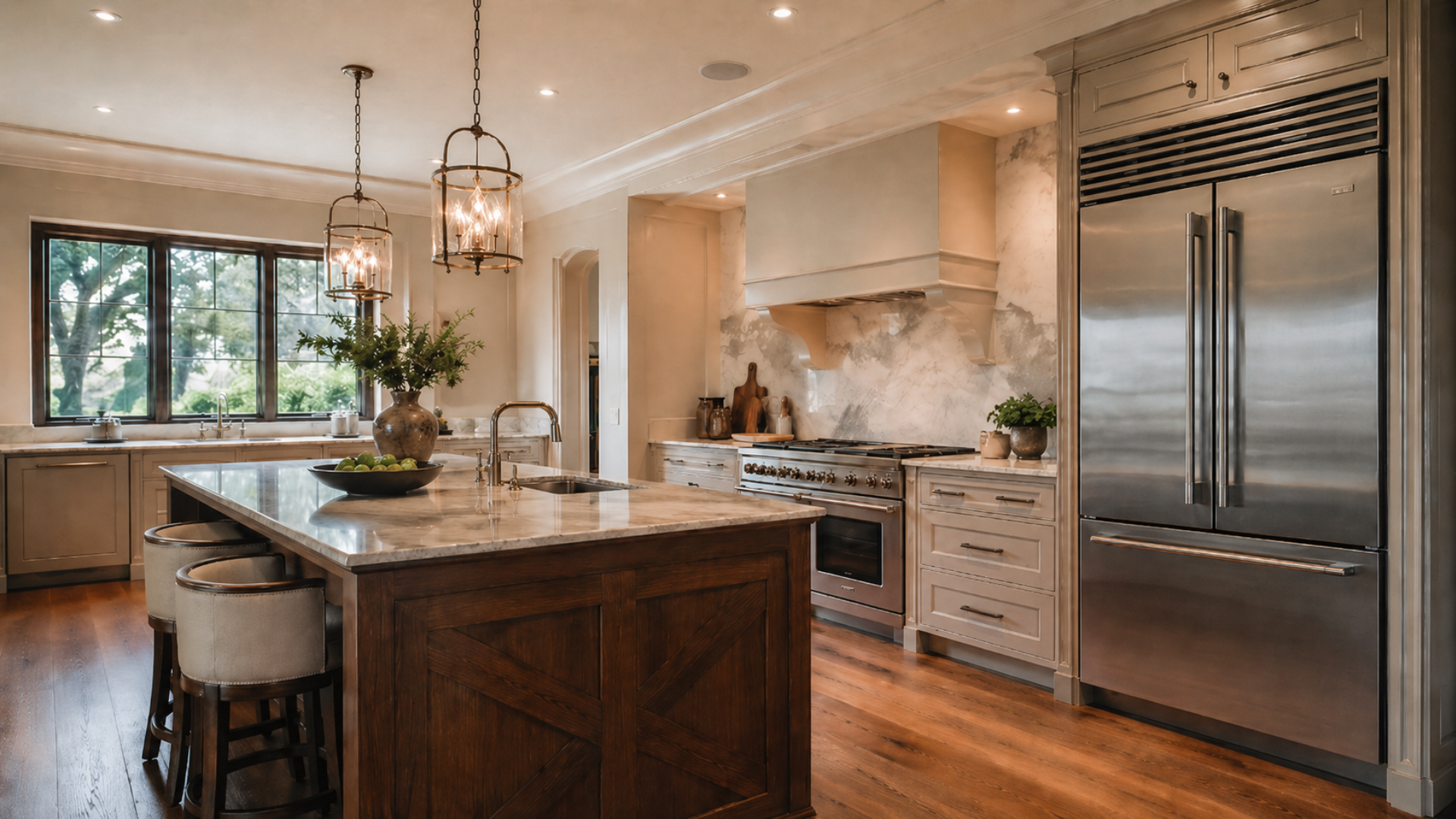
Drive east from Chimney Rock along San Felipe, and in two blocks, you pass three distinct versions of Tanglewood. A 1958 single-story ranch on a half-acre lot, its original copper roof still intact. A 2006 Mediterranean rebuild, now nineteen years old and on its second kitchen remodel. A 2023 modern-farmhouse estate with a Sub-Zero glass-door, a 60-inch Wolf dual-fuel range, and a dedicated wine room. Three houses, three generations of luxury appliances, one appliance-service problem each.
This is the service pattern that makes Tanglewood unlike any other Houston neighborhood. The ZIP codes that cover it are split between working 1970s Viking installations and the most recent Sub-Zero-Wolf-Miele packages. A repair provider has to be fluent in both.
A Neighborhood Built in Three Chapters
Tanglewood opened in 1949 when William Giddings Farrington’s Tanglewood Corporation developed approximately 750 acres of former Houston farmland just outside the 610 Loop. The original homes — predominantly “rambling ranch” style on deep tree-lined streets — were designed around existing oaks, an intentional departure from the grid-like subdivisions of the era. By the 1970s, the original inventory had nearly filled out, and a second wave of construction pushed the neighborhood to its current footprint of approximately 1,200 single-family homes.
The third chapter — the one still underway — began in the 2010s when rising land values made tearing down the original ranch homes economically rational. The Tanglewood Homes Association, founded in 1948, has amended deed restrictions over the decades to accommodate the transition to larger two-story replacements while preserving the neighborhood’s live-oak canopy. Current median sale prices sit near $2.78 million, with lots ranging from 8,000 square feet on the original blocks to more than 40,000 square feet on the estates.
The result is a bimodal housing stock that produces two entirely different appliance repair profiles — often on the same block.
Profile One: Original Homes with Legacy Installations
Walk into an original Tanglewood ranch that has been consistently maintained and you’ll likely find a Viking range from the 1990s or early 2000s, a Sub-Zero 500 Series built-in from the same era, and ancillary equipment — ice makers, wine storage, secondary refrigeration — that was top-of-the-line when it was installed and is now quietly entering its third or fourth decade.
These homes present a specific service challenge: the equipment was built to last twenty-plus years, and it’s actually lasting. Sub-Zero’s official parts policy is to keep stock of replacement parts for approximately 20 years for most products, which means original compressors from the early 2000s are still serviceable. Viking’s professional series equipment from the same period — when maintained — operates past any sensible depreciation schedule.
The problem is that most repair providers treat this equipment as obsolete. Parts are harder to source. Wiring diagrams are in paper binders rather than online portals. Diagnostic paths require knowledge of systems two generations old. For Tanglewood owners whose original equipment is still performing, the repair question isn’t “should I replace?” — it’s “who remembers how this works?”
Profile Two: New Estates with Integrated Luxury Packages
On the same street, the teardown-rebuild estates present the opposite problem. The kitchens are specified from the same short list — Sub-Zero or Gaggenau refrigeration, Wolf or Thermador cooking, Miele dishwashers and built-in coffee, often a wine cellar cooling system from CellarPro or WhisperKool — but everything is panel-ready, everything is smart-home integrated, and everything is under warranty that the factory-certified-service requirement is easy to violate.
Service on these installations requires different muscles. Panel alignment to within an eighth of an inch. Coordination with Control4 or Crestron integrators when a refrigerator is disconnected from the network. Post-renovation calibration that the general contractor skipped on the way to the closing date. And strict adherence to factory-certified service — because Sub-Zero’s warranty provisions void the moment a non-certified technician opens the sealed system.
These two profiles share one thing: the cost of getting the repair wrong. A ten-thousand-dollar range misdiagnosed as a control-board issue when the real problem is gas pressure costs the owner a replacement board and the original failure recurring. A Sub-Zero compressor swap done outside factory protocol voids the twelve-year sealed-system warranty.
What the Neighborhood Needs From a Service Provider
Tanglewood owners — across both housing profiles — consistently describe three frustrations with appliance service: technicians who specialize in one brand but not a luxury kitchen’s worth of brands, companies that can handle new-build estates but not legacy installations (or vice versa), and response times that feel calibrated for commodity appliances, not high-net-worth households in the middle of hosting a dinner.
Three elements close those gaps.
The first is cross-brand certification. A kitchen running Wolf, Sub-Zero, Miele, and a CellarPro cooling system is best served by a single provider who can diagnose all four — not four separate service calls from four specialists. Certification across the Sub-Zero/Wolf family, the BSH family (Bosch/Gaggenau/Thermador), and Miele covers the vast majority of Tanglewood inventory.
The second is legacy-equipment fluency. Factory-certified doesn’t help if the technician has never worked on a 2001 Viking. Remanufacturing of discontinued components — restoring original parts to OEM specification rather than replacing with aftermarket — bridges the gap when manufacturer parts are no longer available.
The third is proximity. Uptown’s Houston headquarters at 9225 Katy Freeway sits approximately six minutes from central Tanglewood via Interstate 610 — close enough for one-hour response during business hours, which matters when a wine cellar cooling system fails on a 94-degree afternoon.
Tanglewood sits at the intersection of the Galleria, Memorial Park, and River Oaks — surrounded by Uptown’s core service territory. For a neighborhood whose appliances span five decades of luxury equipment, consolidation of service under a single factory-certified provider isn’t convenient. It’s the only way the math works across both profiles.
A Framework for Choosing Service
For original-home owners: ask the provider whether they service Viking and Sub-Zero equipment from the 1990s. Ask whether they can source — or remanufacture — parts for discontinued models. Ask how many technicians on their staff have worked on the specific system in question.
For new-build owners: ask for factory certification documentation by brand. Confirm the provider uses OEM parts exclusively — aftermarket substitutions void warranty. Confirm the written labor warranty matches or exceeds the factory’s parts coverage window.
The Tanglewood street you live on tells you which profile you’re in. The service provider you choose should handle both.