




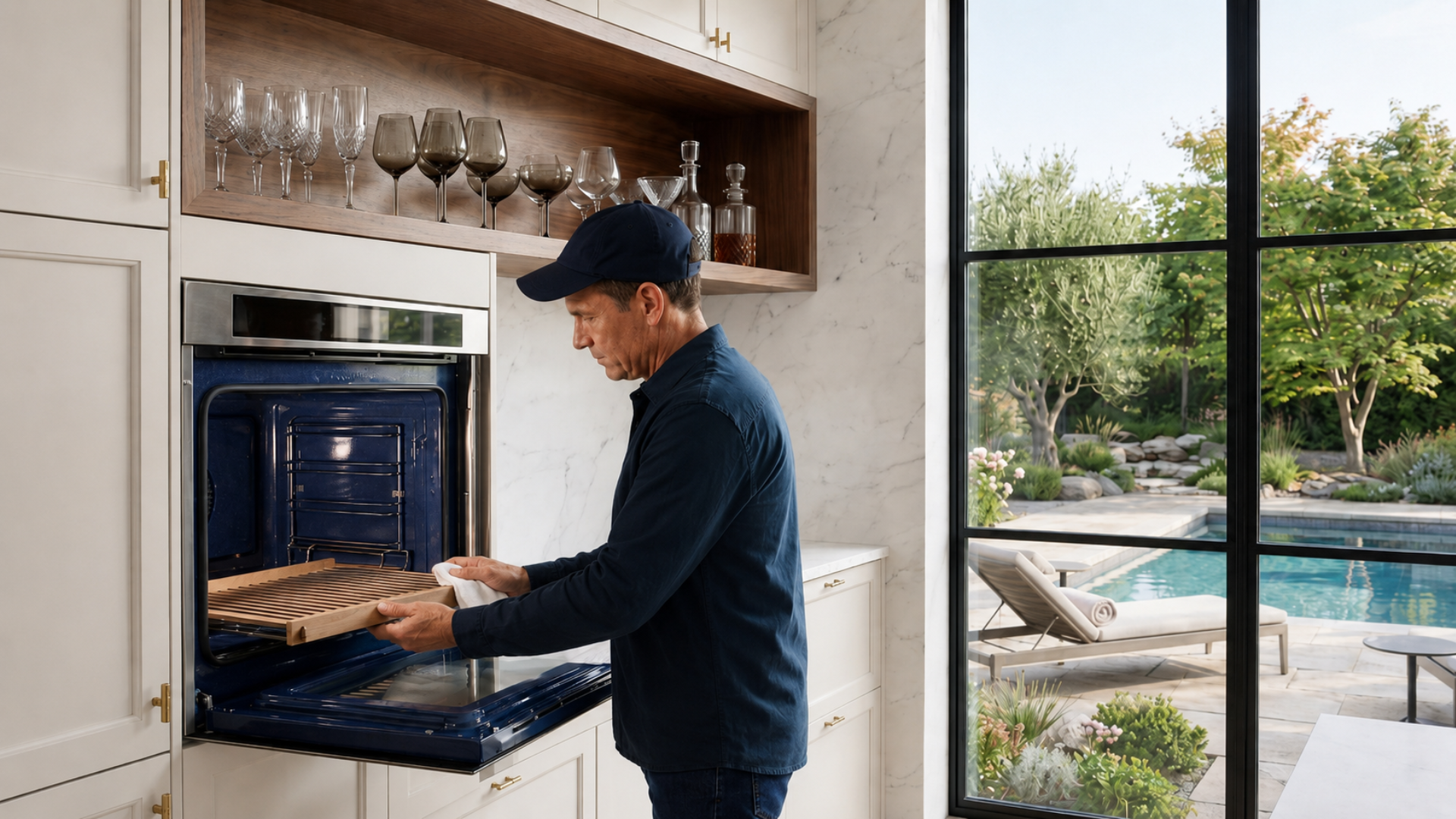
TL;DR: Gaggenau combi-steam ovens use a sealed boiler-and-pump circuit that generates and delivers pressurized steam — a design that differs fundamentally from most residential steam ovens on the market. When fault codes appear, most technicians misdiagnose them because they test the end symptom (no steam) rather than the upstream cause (boiler pressure cycle, flow sensor, or pump prime state). In Houston and Dallas, where tap water averages 136–160 mg/L hardness, scale-accelerated failures account for the majority of Gaggenau steam oven service calls.
Gaggenau steam oven service in Texas requires a technician trained on BSH’s proprietary boiler-pump architecture. The most commonly missed faults are a stuck or vapor-locked pump, a clogged flow sensor impeller, and descaling-induced boiler pressure imbalance — each producing overlapping error codes that point in the wrong direction if you don’t understand the circuit sequence.
Why a Gaggenau Steam Oven Is Mechanically Different
Gaggenau’s BS-series combi-steam ovens — the 400 Series models priced around $9,900 and up — are not steam injection systems. They are boiler-based systems. That distinction matters more than most homeowners (and more than a few appliance technicians) realize.
In a basic steam-injection oven, water is dripped or misted onto a heating element and flashed to steam on contact. The system is simple: water in, steam out, no pressure management required. Gaggenau’s approach — shared with its parent BSH Home Appliances’ broader engineering philosophy — uses a dedicated boiler vessel that heats water to a controlled pressure before releasing steam into the cavity. The boiler doesn’t just produce steam; it maintains a pressure differential that allows precise humidity control across five adjustable levels, from a light mist to full saturation steam at 212°F.
Between the water reservoir and the boiler sits a dosing pump. That pump moves water in metered pulses — not a continuous stream — and its timing is synchronized with the boiler’s heating cycle. A flow sensor monitors every pulse. The control board reads the sensor data and calibrates the next pump cycle accordingly. This is the feedback loop that makes Gaggenau steam so precise. It’s also why the fault logic is opaque to anyone who hasn’t studied the circuit.
When this system fails, it rarely fails at one point. It fails as a cascade: scale narrows the boiler tube → the pump works harder to maintain flow → the flow sensor reports anomalies → the control board interprets an ambiguous fault → the oven stops and displays a code that looks like a sensor error when the actual problem is mineral accumulation two components upstream.
The Boiler-Pump Fault Codes — and What Most Technicians Get Wrong
Gaggenau’s fault code system for the BS-series uses E-codes (E115, E182, E003, and related variants) that map to condition categories — thermal overload, water flow failure, and system lockout — but do not pinpoint the component. That ambiguity is by design: the oven protects itself from running in a damaged state by locking out before it can confirm which element caused the fault.
Here’s where technicians who aren’t BSH-trained go wrong:
Misread #1 — Treating E182 as a sensor problem. E182 is the most common steam-system fault code and indicates a water-flow anomaly during a heating or descaling cycle. The quick diagnosis is “bad flow sensor” — and that’s wrong often enough to be a pattern. The flow sensor (a magnetic impeller inside a meter housing) fails by getting stuck, not by failing electrically. Before condemning the sensor, a trained technician checks whether the impeller spins freely by tapping the housing or clearing the inlet. Scale deposits lock the impeller in position and produce identical electrical readings to a failed sensor. If you replace the sensor without clearing the scale pathway, the new sensor fails within months.
Misread #2 — Not testing pump prime state. The dosing pump in a Gaggenau steam oven can vapor-lock after a long idle period or after a partial descale. When vapor-locked, the pump runs — you can hear it — but moves no water. The flow sensor reads zero flow, and the board throws a water-supply fault. Technicians who check water supply (full tank, correct hose position, clean inlet strainer) and find nothing wrong sometimes stop there, assuming the fault is intermittent. It isn’t. A vapor-locked pump needs to be primed manually, which requires accessing the pump housing and bleeding the air pocket from the water line. This is not a homeowner procedure; it requires disassembling the oven’s rear access panel.
Misread #3 — Conflating boiler pressure fault with thermal overload. E115 and E003 indicate the appliance is too hot, but in a scaled boiler, “too hot” is a consequence of scale, not the cause. Scale deposits on the boiler wall act as insulation. The heating element drives more power to reach target temperature, the element overheats, and the thermal fuse trips. A technician who replaces the thermal fuse and returns the oven to service has fixed the symptom. The boiler is still scaled. The thermal fuse will trip again within weeks.
The correct diagnostic sequence always starts upstream: confirm water supply → test flow sensor mechanics (not just electrical continuity) → assess pump prime state → run a boiler pressure check → evaluate scale level before drawing any conclusions about component failure.
Diagnostic Walkthrough: How a Trained Technician Reads the Circuit
If your Gaggenau steam oven is displaying a fault code or refusing to generate steam, here is the sequence a qualified technician follows:
- Confirm water supply. Check the reservoir level. Verify the supply hose is routed correctly — the outlet must sit less than four inches below the exit port, or the oven will generate a supply error regardless of how much water is present. This is a Gaggenau-specific installation requirement that trips up technicians unfamiliar with the brand.
- Inspect the inlet strainer. The water inlet has a small mesh screen that captures debris. In Houston and Dallas, this screen catches mineral fines before they reach the pump. A partially clogged strainer reduces flow to the pump and creates intermittent E182 codes that look like sensor failures.
- Test the flow sensor mechanically. Remove the flow meter and confirm the magnetic impeller spins freely by hand. If it resists or is locked, clean it with a citric acid solution. Do not replace the sensor until you’ve confirmed the impeller is the problem, not scale debris that can be cleared.
- Check pump prime. With the oven powered and in diagnostic mode, initiate a manual pump cycle. Listen for the pump running vs. actually moving water. If the pump runs silently with no water reaching the boiler, the pump is vapor-locked or failing. Bleed the line before condemning the pump.
- Assess boiler scale level. Even if no descale warning has appeared, visually inspect the boiler outlet for mineral deposits. Gaggenau’s onboard descale prompt is calibrated to a usage average; in hard-water markets like Houston (136–137 mg/L) and Dallas (140–160 mg/L), scale accumulates faster than the algorithm expects. The descale prompt may not have triggered yet, but scale can already be narrowing flow.
- Run a pressure cycle check. After clearing the flow path, run a steam cycle and monitor how long the oven takes to reach 212°F. If preheat exceeds seven minutes on a clean boiler, scale has already reduced the boiler’s heat transfer efficiency. A full descale — not just a rinse — is required before any further diagnosis is meaningful.
- Evaluate component failure only after ruling out flow and scale issues. If all upstream conditions are clear and the fault persists, component-level diagnosis begins: the pump itself (check for dead windings with a multimeter), the flow sensor (electrical continuity), the control board (logic errors after confirmed clean inputs).
Texas Hard Water and Your Gaggenau: A Scale Timeline Most Owners Don’t Expect
Houston’s tap water averages 136–137 mg/L (8.0 grains per gallon) hardness according to Houston Public Works’ 2023 water quality report. Dallas runs slightly harder at 140–160 mg/L per Dallas water quality data. Both cities classify as moderately hard to hard — and both push well past the 7°dH (about 125 mg/L) threshold above which Gaggenau’s own documentation recommends supplemental descaling measures.
In practice, what this means for a Gaggenau steam oven used three to four times per week in a Houston or Dallas kitchen:
- Standard descaling interval (as programmed for European water averages): every 200 hours of steam use, roughly 6–12 months at typical home frequency.
- Actual recommended interval in Texas with unfiltered tap water: every 3–4 months, or approximately every 80–100 hours of steam use. The oven’s onboard algorithm does not automatically adjust for local water hardness — it uses a fixed usage-hour counter. If you’re in Houston running tap water through your Gaggenau, you will accumulate meaningful scale before the oven tells you to descale.
The Wolf convection steam oven’s water requirements guide captures the logic well: “The unit contains an electromagnetic level sensor to measure the flow of water into the boiler” — and that sensor requires mineral-containing water to function correctly. The principle applies equally to Gaggenau’s boiler-based BS-series: neither demineralized nor reverse-osmosis water is appropriate. But standard Houston and Dallas tap water, without at least a moderate carbon filter, will scale your boiler faster than the machine expects.
The practical recommendation: Install an in-line carbon sediment filter on the water supply to your Gaggenau. It won’t eliminate hardness — nor should it, because the boiler sensor requires minerals — but it will remove the fine particulate matter that accelerates deposit formation on the boiler wall and inlet strainer. And descale on a calendar schedule, not just when the prompt appears.
When the Boiler Module Is Repairable vs. When It Isn’t
The boiler assembly in a Gaggenau BS-series oven can be serviced — flushed, chemically descaled, and in most cases restored — without replacement. The distinction:
Repairable: surface scale on the boiler tube interior (chemical flush restores flow); flow sensor impeller freeze (mechanical cleaning, occasionally sensor swap); pump vapor lock or degraded prime (bleed procedure, pump replacement if windings are dead).
Replacement-warranting: boiler tube scaled past the point where acid flush can restore flow (confirmed by bore inspection + flow rate testing after a full descale); pinhole leaks from long-term electrolytic corrosion; control board burned out from extended compensated-power operation to overcome scale resistance.
Early-model BS-series ovens (pre-2010) face a parts availability complication — some boiler module components are no longer stocked as OEM through BSH Home Appliances, Gaggenau’s parent. For late-model BS 470/471, BS 474/475, and BS 484/485 series, parts availability through BSH’s North American distribution is generally strong.
Houston and Dallas Gaggenau Service: Why the Assessment-First Approach Matters Here
Gaggenau requires proprietary diagnostic software for full fault-code readout. Without it, you’re reading the oven’s self-reported codes — which, as described above, point at symptoms rather than root causes. A technician without BSH software access cannot perform a complete boiler pressure cycle check or a pump diagnostic at the firmware level. They’re guessing from the outside.
The most expensive Gaggenau service mistakes happen when technicians replace components based on a surface fault code without clearing the upstream cause. A replaced flow sensor fails again in months because the boiler scale was never addressed. A new pump vapor-locks again because the inlet restriction was never cleared. Each unnecessary part replacement on a $9,900+ appliance runs into the hundreds of dollars before labor.
Our approach: assess first. For Gaggenau steam ovens, that means a structured diagnostic visit — boiler circuit check, pump prime test, scale assessment, and full fault-code readout with BSH software — before any part recommendation is made. The Thermador steam oven service model shares the same boiler-based architecture, and we apply the same discipline to both.
We serve Houston and Dallas, including River Oaks, Memorial, Tanglewood, Bellaire, Highland Park, Preston Hollow, University Park, and Southlake. Our technicians carry genuine OEM parts for the current BS-series lineup and hold BSH certification updated annually.
FAQ
Why does my Gaggenau steam oven show a fault code right after a descale cycle?
Scale debris dislodged during the flush can migrate to the flow sensor or inlet strainer. Run two full rinse cycles and inspect the strainer before resuming normal use. If the fault persists, a second descale pass or technician assessment may be needed to confirm the boiler tube has fully cleared.
How often should I descale a Gaggenau steam oven in Houston or Dallas?
The oven’s built-in descale counter is calibrated to average European water hardness — significantly lower than what comes from Houston and Dallas taps. With unfiltered tap water in either city, descale every 3–4 months regardless of whether the oven has prompted you. Install an in-line carbon sediment filter to extend intervals and protect the boiler between service visits.
Can I use filtered or softened water in my Gaggenau steam oven to reduce scale?
Filtered tap water (carbon filtration) is appropriate and recommended. Fully softened water or reverse osmosis water is not — Gaggenau’s electromagnetic flow sensor requires mineral content to function correctly. Using demineralized or RO water will cause the flow sensor to read incorrectly and can cause electrolytic corrosion of the boiler tube over time.
What does the E182 error code mean on a Gaggenau BS-series steam oven?
E182 indicates a water flow anomaly — the control board detected insufficient or no water reaching the boiler during a cycle. The most common causes in order of frequency are: (1) a scale-locked flow sensor impeller, (2) a partially blocked inlet strainer, (3) a vapor-locked pump, and (4) a faulty flow sensor. A trained technician works through these in sequence rather than replacing the sensor first.
Is it worth repairing a Gaggenau steam oven versus replacing it?
For current BS-series models, repair is almost always the right answer. These ovens are built to a 20-year service life and BSH parts support current models well. A boiler descale and pump service costs a fraction of the appliance’s value. Replacement-warranting conditions — boiler tube perforation, board-level failure, unavailable OEM parts on early models — are specific and uncommon. A diagnostic visit gives you an honest picture before any parts are ordered.
Does Uptown Appliance Repair service Gaggenau steam ovens in the Dallas area as well as Houston?
Yes — we cover both markets. Houston and Dallas service areas include the neighborhoods where Gaggenau kitchens are concentrated: River Oaks, Memorial, Bellaire, and Tanglewood in Houston; Highland Park, Preston Hollow, University Park, and Southlake in Dallas. Contact us at (281) 758-9978 to schedule a diagnostic visit.
Schedule a Gaggenau Steam Oven Assessment
If your BS-series steam oven is throwing fault codes, taking too long to reach temperature, or hasn’t been descaled on a Texas-appropriate schedule, we’re a call away. We assess before we recommend — and we only recommend what the diagnostic confirms.
Uptown Appliance Repair — (281) 758-9978 Schedule a service visit at uptownappliancerepair.com
Sources
- Houston Hard Water Report — Culligan Houston — documents Houston tap water averaging 136–137 mg/L (8.0 GPG) hardness; load-bearing for the Texas descaling frequency argument
- Dallas Water Quality Report — Culligan Dallas — confirms Dallas tap water at 140–160 mg/L; directly supports the accelerated scale timeline for Dallas Gaggenau owners
- Wolf Convection Steam Oven Water Requirements — Sub-Zero/Wolf — manufacturer documentation of the electromagnetic flow sensor mineral requirement; establishes the principle that applies equally to Gaggenau’s boiler-based BS-series
- BSH Home Appliances — Corporate — parent company of Gaggenau; referenced for OEM parts distribution and brand engineering philosophy context
Related Reads from Uptown
- Gaggenau Appliance Repair in Houston and Dallas: Why Most Technicians Can’t Service a 341-Year-Old Brand — the foundational Gaggenau pillar covering brand history, BSH certification requirements, and why proprietary diagnostic software access separates qualified technicians from the rest
- Thermador Steam Oven Problems: Professional Solutions — Thermador’s combi-steam ovens share the same boiler-based architecture as Gaggenau’s BS-series; the diagnostic discipline is identical and this article covers the Thermador-specific fault patterns
- Common Miele Problems in the Houston–Dallas Climate — how Texas heat, humidity, and hard water accelerate failures across Miele’s appliance lineup; the water hardness data and scale timelines mirror the Gaggenau context covered here