




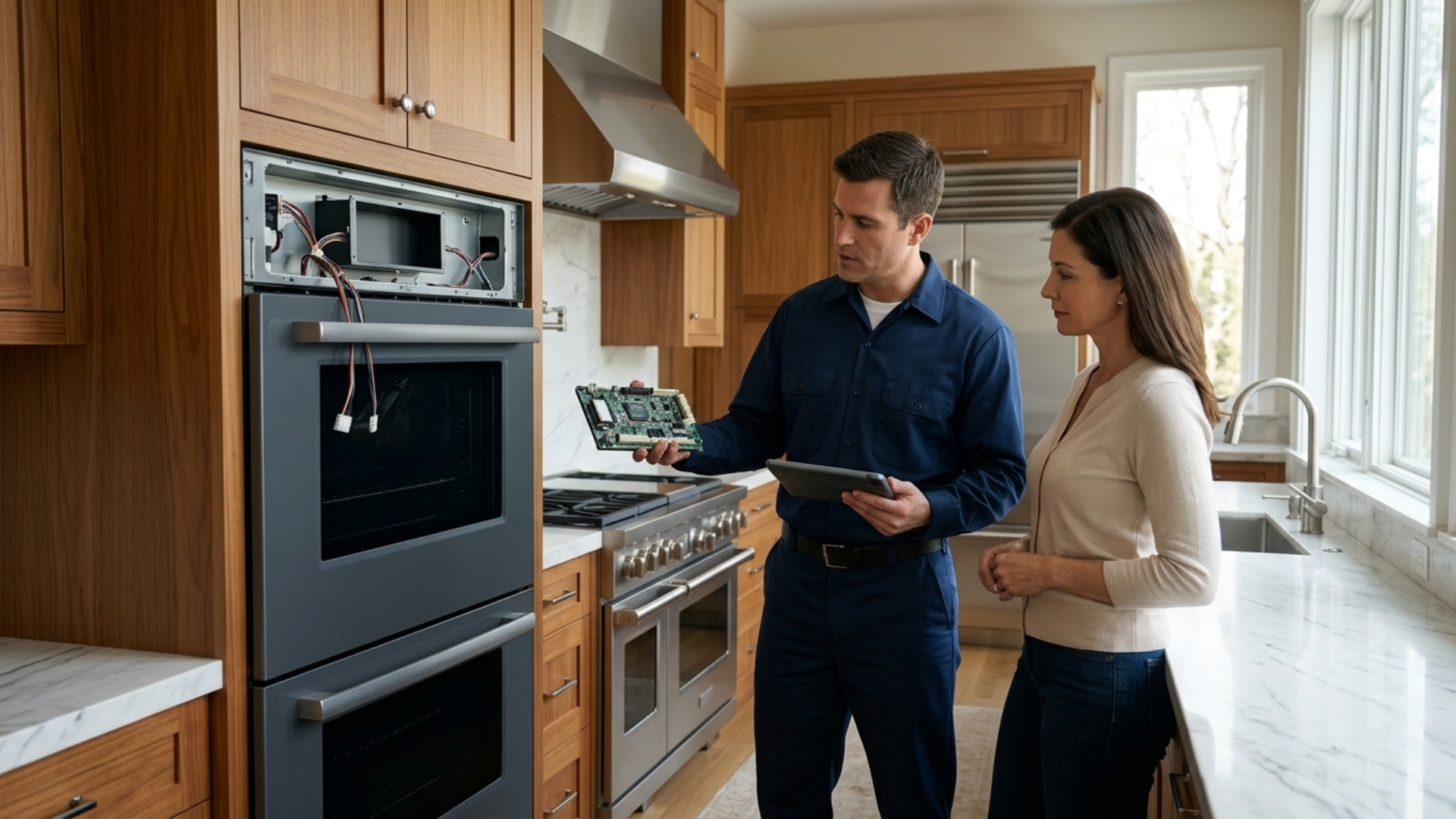
The industry benchmark for first-time fix rates on complex luxury appliances is 65–75%. That means one in three repairs requires a second visit under good conditions — before factoring in pandemic-era supply disruptions whose effects still haven’t fully unwound. Aberdeen Strategy & Research identified parts availability as the single largest driver of failed first visits, accounting for 51% of cases.
None of this gets explained when the technician leaves without finishing the job. Here’s what’s actually happening.
The Supply Chain Architecture Varies by Brand
How quickly a part arrives depends almost entirely on which brand you own — not how common the failure is.
Sub-Zero and Wolf operate the tightest distribution model in the luxury segment. Factory Certified Service companies access parts through a centralized factory-direct system, with most components arriving within two days. Sub-Zero commits to maintaining replacement parts for at least 15 years post-production — a meaningful guarantee for appliances designed to last 20+ years. The tradeoff: only approximately four Factory Certified Parts Distributors exist in the entire U.S., so non-certified companies simply can’t access this channel.
Miele offers the longest formal commitment in the industry — 15 years of spare parts availability after a model ceases production. German manufacturing creates baseline lead times of one to three weeks for non-stocked items. The more critical constraint: Miele’s proprietary MDU diagnostic unit is required to service their newest generation products. Without it, the technician can’t properly diagnose the failure, let alone order the right part.
La Cornue sits at the extreme end. Approximately 40–50 authorized U.S. dealers exist nationwide, and all parts are ordered from the French factory. Lead times for specialized components reach 8–16+ weeks. Scheduling a La Cornue repair in Dallas or Houston requires accepting that timeline upfront, not discovering it after the first visit.
Gaggenau and Thermador share BSH distribution infrastructure, but niche Gaggenau components still require European sourcing. The shared parent company (BSH Hausgeräte, which also owns Bosch) creates cross-brand parts access for some components, while others remain model-specific with long lead times.
What COVID Left Behind
Pre-pandemic, Houston and Dallas repair companies could obtain most parts within the same day to three days. By 2021–2022, factories operated at 40–70% of normal output, and control board shortages became acute as the semiconductor shortage affected 169 industries simultaneously.
The broad disruption has largely normalized — J.P. Morgan confirmed semiconductor supply recovery beginning in 2023, accelerated by CHIPS Act funding. But one structural problem persists: legacy chips (200mm wafer fabs) used in appliance control boards remain undersupplied because, as IEEE Spectrum reported, “the return on investment just isn’t there” for building new legacy fabs. A 2024 Bosch or Sub-Zero control board requires the same chip geometry as a 2015 model — and those chips are still constrained.
For owners of appliances manufactured between 2019 and 2023, this is the most likely explanation for a multi-week repair that shouldn’t have taken that long.
When Parts No Longer Exist
Discontinued components create a different problem entirely. CoreCentric Solutions leads the remanufacturing industry for appliance parts — ISO 9001 and ANSI-certified, operating a 350,000-square-foot facility that diverts over one million parts annually from landfills. Their process identifies the original failure point, repairs it, and proactively replaces other failure-prone components in the same assembly.
Remanufactured parts typically cost 40–60% of new OEM and often represent the only path forward for discontinued Dacor, Viking, or early-generation Thermador components. For owners of 15–20 year-old luxury appliances in custom kitchens where replacement means a full cabinetry project, remanufacturing is frequently the correct answer — not a compromise.
What To Ask Before Booking
The right questions to ask any repair company before the first visit:
Do you stock OEM parts for this specific brand, or will you need to order? (Order means a minimum of two visits.) Do you hold current factory certification for this brand? (Non-certified companies can’t access factory-direct parts channels for Sub-Zero, Wolf, or Miele.) What’s your typical lead time if the part isn’t on the truck?
For service plans that include parts coverage and guaranteed OEM sourcing, confirming these answers upfront eliminates the most predictable source of multi-visit delays. The failed truck dispatch costs a repair company $200–$300 in direct expense, and costs the client days of downtime on equipment that may be central to a functioning kitchen or wine cellar.
Every additional visit is a supply chain problem that was largely predictable before the first appointment was booked.
Uptown Appliance Repair serves Dallas (Highland Park, Preston Hollow, University Park) and Houston (River Oaks, Memorial, The Woodlands). Factory-certified technicians available same day. Call (281) 758-9978.