




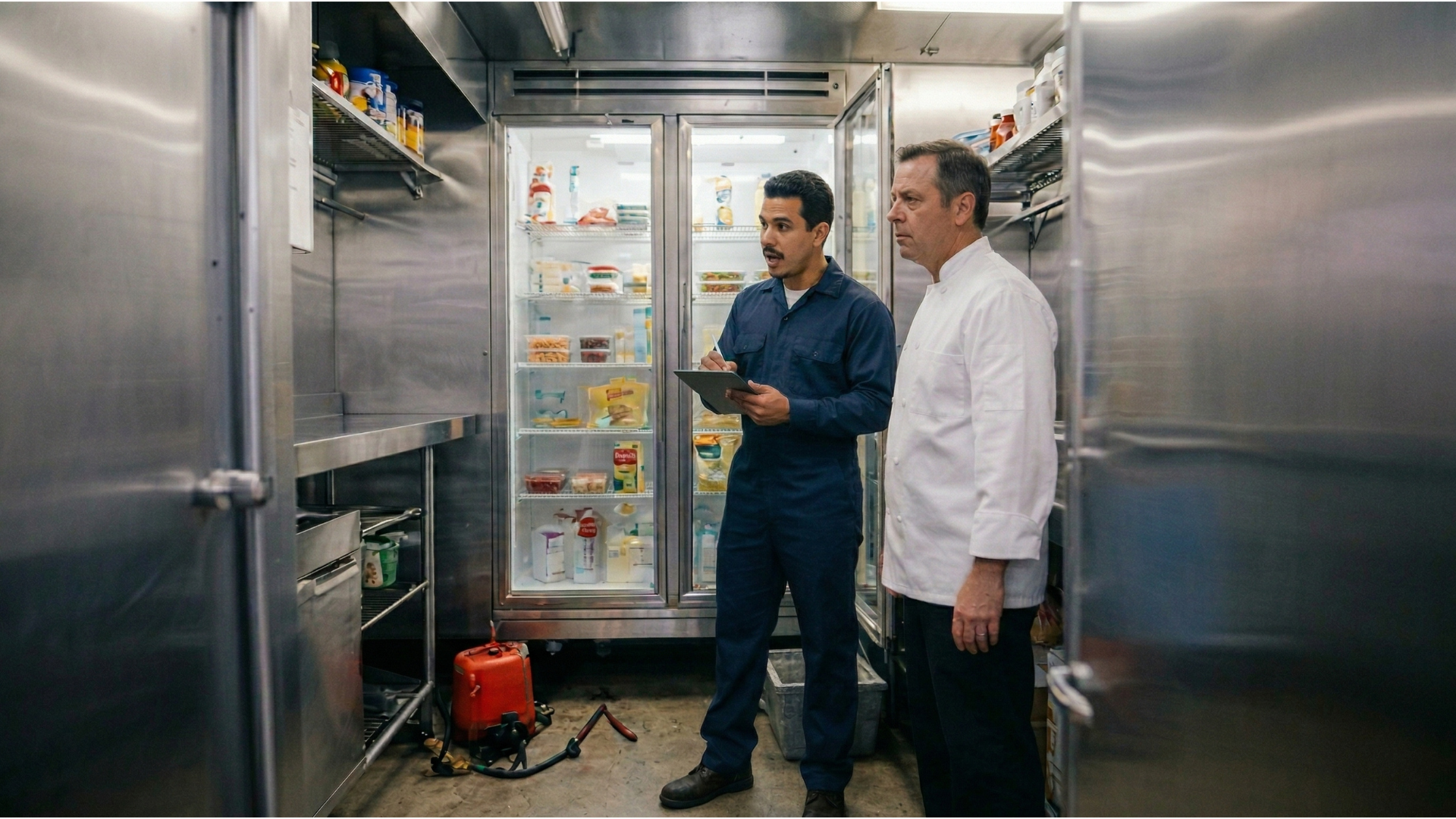
A walk-in cooler failure in a Houston restaurant costs between $3,000 and $15,000 in spoiled inventory for a small operation. For high-volume kitchens, that number climbs to $50,000 or more — before accounting for the FDA violation exposure, the emergency service premium, and the revenue lost during downtime. Houston earned its Michelin designation in 2024 with 30 recognized restaurants. For those kitchens, a compressor failure at 2 p.m. on a Saturday isn’t an inconvenience — it’s an existential event.
Houston’s climate makes this worse than it needs to be. ASHRAE design conditions specify 96°F dry bulb and 79°F wet bulb for Houston, but the city regularly exceeds 100°F. At those temperatures, air-cooled condensing units experience 5–10% capacity derating, meaning a system sized for normal conditions is already running at a deficit on hot days. Average humidity of 75–80% year-round drives excessive condensation, accelerated biological growth in drain systems, and more frequent defrost cycles. Walk-in systems in Houston rarely get rest — they cool 10+ months annually.
The Three Failures That Drive Most Emergency Calls
Compressor failure accounts for the largest share of emergency dispatches in Houston. Replacement runs $1,500–$3,000 — and that’s the repair cost alone, not the inventory loss. Warning signs include unusual noise (grinding or banging), excessive heat near the compressor housing, or a system where fans run normally but temperatures won’t drop. In Houston’s heat, a compressor working at thermal limit for months before failure gives almost no warning before it stops.
Refrigerant leaks are subtler and more damaging over time. A slow leak reduces cooling efficiency while forcing the compressor to compensate — accelerating wear on the component you least want to replace. Electronic leak detection is required; the leak itself is rarely visible or audible. All sealed system work requires an EPA Section 608 certified HVAC-R technician — a credential that eliminates most general repair companies from the conversation.
Condenser coil fouling is the most preventable failure mode and the most commonly ignored. Houston’s humidity drives biological growth inside drain pans and on coil surfaces faster than in drier climates. A fouled condenser forces every other component to work harder. Cleaning intervals that make sense in Dallas need to be cut in half in Houston.
What Texas Food Code Requires
Texas adopts the FDA Food Code 2017 through the Texas Food Establishment Rules (25 TAC Chapter 228). Cold-holding requires TCS foods at 41°F (5°C) or below. Each unit must have a visible, accurate thermometer at the warmest point, accurate to ±2°F. The cooling timeline is unforgiving: food must move from 135°F to 70°F within two hours, then 70°F to 41°F within the next four.
A compressor running at reduced capacity in July heat may maintain 41°F overnight and fail to hold it during peak service hours — the exact window when a Health Department inspector is most likely to be present. Walk-in cooler failures and food safety violations rarely arrive separately.
The Grid Problem Houston Restaurateurs Can’t Ignore
ERCOT’s reliability record adds a layer of risk that doesn’t exist in most U.S. markets. During Winter Storm Uri in 2021, over 2.7 million Houston-area customers lost power — the grid came within four minutes of complete collapse. Hurricane Beryl in July 2024 knocked out power to 2.7 million customers, with nearly 2 million still dark the following day.
For walk-in coolers, power interruptions don’t just cause temperature drift — voltage irregularities during restoration damage compressor start capacitors and control boards. Surge protection on commercial refrigeration circuits and a documented response protocol for extended outages (dry ice sourcing, off-site cold storage contacts) are operational necessities in Houston, not contingencies.
What Separates a Good Repair From a Repeat Call
Industry research puts the first-time fix rate for complex commercial refrigeration at 65–75% under normal conditions. The primary driver of repeat calls is parts availability — approximately 54% of service visits require a part to complete the job, and nearly 25% require follow-up. For Houston operators, that means the technician’s parts access matters as much as their diagnostic skill.
The dominant brands in Houston walk-in installations — Kolpak, Norlake, Master-Bilt for boxes; Copeland scroll and semi-hermetic compressors; Bohn/Heatcraft and Russell for condensing units — each have distinct parts channels. A technician who services all of them regularly maintains stock and distributor relationships that a general repair company doesn’t.
Preventive maintenance programs reduce emergency calls by approximately 60% and extend equipment lifespan by 5–10 years. The math is straightforward: an annual PM contract at $200–$500 per visit versus a compressor replacement at $1,500–$3,000 plus $15,000+ in inventory loss. For Houston kitchens running 10+ months of continuous cooling under grid volatility, the choice isn’t close.
For walk-in cooler service alongside full commercial kitchen appliance coverage, Uptown’s technicians carry EPA Section 608 certification and serve restaurant clients across River Oaks, The Galleria, Rice Village, West University, Bellaire, and Downtown Houston. Same-day emergency response available.
Call (281) 758-9978 for emergency walk-in cooler service in Houston.