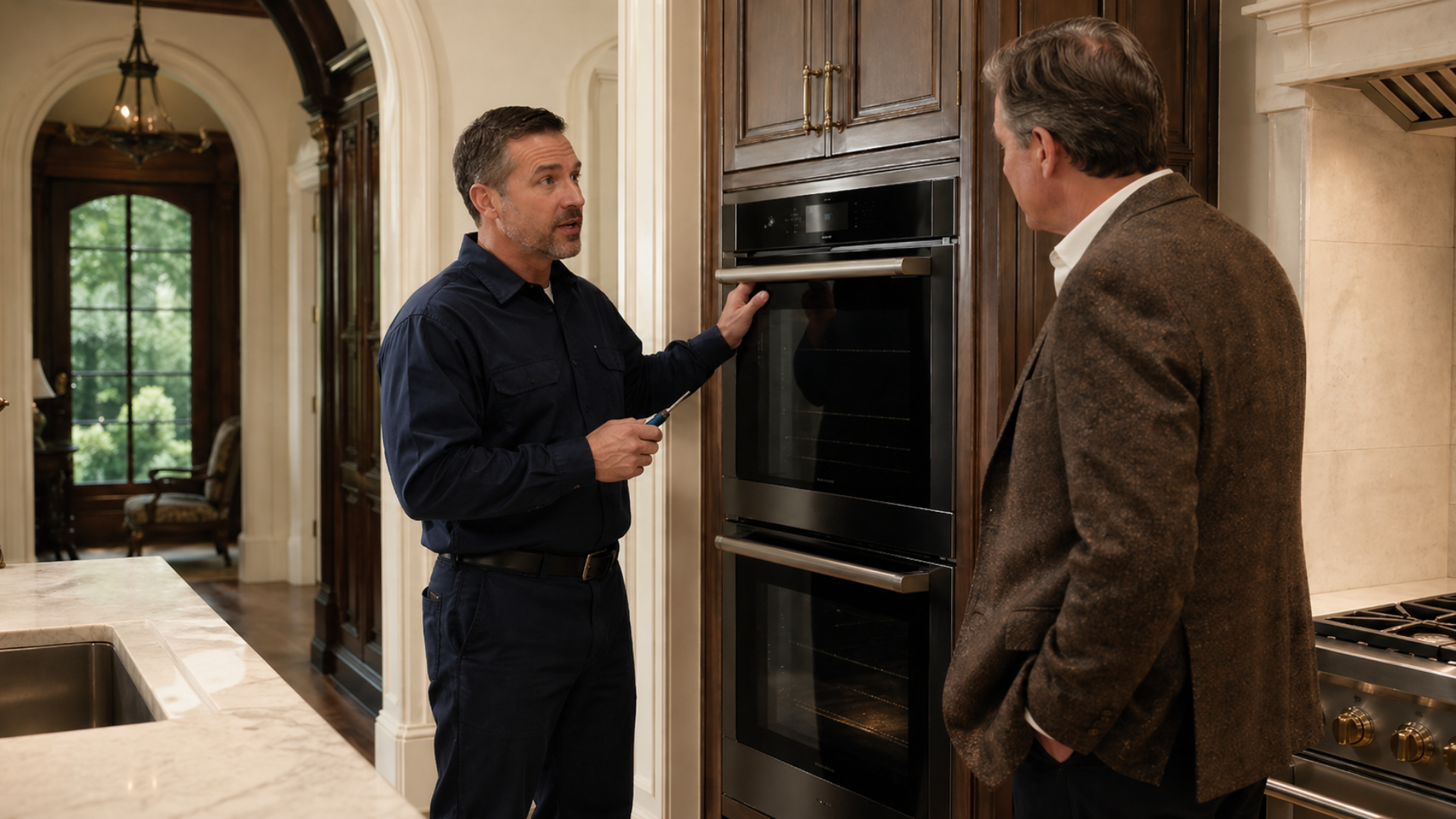






A property manager overseeing a dozen high-end residential properties across River Oaks, Memorial, and Highland Park opens last year’s appliance-repair invoices and sees the pattern every seasoned operator eventually confronts: 34 reactive service calls, six that required second visits, two that escalated into tenant-complaint cycles, and an aggregate spend 40% higher than the preventive-maintenance alternative would have cost.
The problem is not the technicians, the appliances, or the tenants. It is the contract — or the absence of one. Luxury appliance maintenance at the portfolio level is a procurement problem disguised as a service problem, and the five terms inside the service agreement determine whether a property manager spends the next year controlling costs or being surprised by them.
Why Luxury Portfolios Need Purpose-Built Contracts
Standard facilities maintenance contracts were built for HVAC, plumbing, and general handyman services on commodity equipment. They assume interchangeable parts, generalist technicians, and replace-over-repair economics. Applying that framework to a portfolio containing Sub-Zero, Wolf, Miele, Gaggenau, and specialized wine cellar equipment produces three predictable failures.
First, the wrong technician arrives. A service provider who treats a $22,000 Sub-Zero built-in like a standard refrigerator will misdiagnose, replace parts unnecessarily, and occasionally void the manufacturer’s warranty — Sub-Zero’s residential warranty explicitly requires factory-certified service for all tiers of coverage. That failure lands on the property manager’s desk months later when the next breakdown isn’t covered.
Second, the parts delays cascade. Luxury appliance parts run on different supply chains than standard equipment. A dishwasher control board that a generalist stocks will arrive in 24 hours; Miele’s 15-year spare parts commitment is one of the strongest in the industry, but cross-border logistics from Germany still add 7 to 14 days on non-stocked items. Contracts that don’t anticipate this create tenant-experience emergencies.
Third, liability compounds. Industry research on property maintenance cost structures — including U.S. Department of Energy Federal Energy Management Program (FEMP) studies — consistently shows reactive maintenance costing 3 to 9 times more than planned maintenance across equipment lifecycles. For a portfolio of luxury rentals, every unscheduled failure is also a tenant who may not renew.
The Five Terms That Actually Matter
Every meaningful difference between a commodity appliance service agreement and a purpose-built luxury contract lives in five clauses.
Response time by severity tier. The contract should define at least three tiers: emergency (refrigeration failure, water leak, gas odor — response within a defined window, typically 2 to 4 hours), urgent (non-cooling appliance down, affecting tenant experience — next business day), and scheduled (preventive service, non-critical repairs — within 5 to 7 days). A single blanket response time across all calls is a sign the provider hasn’t thought through portfolio service.
Factory-certified scope by brand. The contract should name the specific brand certifications the provider holds and the technicians who hold them. Sub-Zero and Wolf factory certification is distinct from Miele, which is distinct from the BSH family (Bosch, Gaggenau, Thermador). Generic claims of “luxury appliance expertise” without named certifications are marketing, not coverage.
Parts commitment. OEM-only policy, in writing. Aftermarket substitution is a warranty-voiding event on most luxury brands and a hidden failure accelerant on all of them. The contract should also specify parts-availability guarantees for discontinued models — whether the provider maintains remanufacturing capability for legacy components, which materially extends the service life of equipment past manufacturer support windows.
Labor warranty duration. The industry-standard labor warranty on residential appliance repair is 30 to 90 days. Two-year labor warranties exist but are uncommon, and the difference matters enormously when a tenant reports the same issue four months after the original repair. The contract should specify labor warranty duration, what it covers, and what voids it.
Documentation and reporting cadence. The contract should require monthly or quarterly portfolio reports covering service history by unit, recurring issues by property, and preventive maintenance status. For property managers presenting to ownership or HOA boards, these reports are the evidence that maintenance spend is producing measurable results.
The Signals That You’re Looking at a Commodity Provider
Three signals surface during the proposal stage and predict where the service relationship will fail.
A service provider who cannot name specific technicians and their specific brand certifications is a staffing commodity. A provider who proposes a flat per-call rate without severity tiering is managing their own cost, not the property manager’s risk. And a provider who is reluctant to commit to OEM-only parts in writing has already built aftermarket substitution into their economics.
The inverse is also true. Providers who lead with response-time commitments they’re prepared to stand behind, certification documentation by brand, and extended labor warranties are signaling that their economics work on repair quality rather than call volume. The companion question — how to vet a luxury appliance repair company — covers the diligence layer beneath the contract terms.
The Preventive-vs-Reactive Math
DOE and industry data converge on the same directional finding: preventive maintenance runs at a fraction of the total lifecycle cost of reactive maintenance when properly scoped. For a luxury residential portfolio, the multiplier is often larger than the raw numbers suggest because the cost of tenant-experience failure — not just the repair invoice — is the dominant variable.
A property manager overseeing 30 luxury units with roughly 10 major appliances each is managing approximately 300 appliance installations. Industry averages suggest 8 to 12% of that inventory will experience a significant service event in a given year. Whether those events are scheduled maintenance visits that catch problems early or emergency calls after a tenant complaint is determined almost entirely by contract design. Luxury appliance insurance coverage gaps compound this math — owner-level policies rarely absorb the failures that preventive contracts are designed to eliminate.
Evaluating a Portfolio Agreement
A property manager weighing a prospective contract can ask five questions that reveal whether the provider is purpose-built for luxury residential work:
Does the agreement tier response times by severity, with named windows? Is factory certification documented by the brand and by technician? Is the parts policy OEM-only in writing, with remanufacturing capability for discontinued components? Does the labor warranty meaningfully exceed the industry 30-to-90-day standard? Will the provider produce regular portfolio reports showing service history and preventive maintenance status?
Providers who answer yes to all five on paper are a small minority of the market. They are also the only category worth contracting with for a luxury residential portfolio.
For property managers across Houston and Dallas, Uptown’s service plan structure is built around this framework — factory-certified technicians, OEM-only parts, a two-year labor warranty that runs four to eight times the industry standard, and dual-market coverage from offices in Houston and Dallas.
A good contract is not the one with the lowest per-call rate. It is the one that turns maintenance from an unpredictable expense into a managed line item.