




A built-in coffee machine is the most mechanically complex appliance in a luxury kitchen. A refrigerator has a compressor and a fan. An oven has heating elements and a fan. A plumbed-in espresso machine — the kind that sits flush in a cabinet column next to a Wolf wall oven and lists for $4,349 on the Thermador side, $3,500 to $5,500+ on the Miele side — contains a grinder, a brew unit, a high-pressure pump, a heating boiler, a steam wand, a milk frothing circuit, a control board, and on current models a Wi-Fi radio. Each sub-system has its own failure mode. Most field service calls diagnose the wrong one.
Understanding where a built-in coffee machine actually breaks — and which failures are user-serviceable versus which require a factory-trained technician — starts with understanding the machine as five distinct systems inside one cabinet.
System One: The Grinder
The grinder is the most visible wear component. Current Miele CVA 7xxx and Thermador TCM24 machines use ceramic or hardened-steel burr grinders rated for approximately 8,000 to 15,000 shots of espresso before burr wear becomes measurable in cup quality.
Two failure signatures matter. The first is gradual: coffee cup temperature drops, extraction time shortens, and the strength setting has to be increased to compensate. This is burr wear, and on both Miele and Thermador platforms, it is addressable without replacement — the grind setting can be adjusted finer to recover extraction quality. On the Miele platform specifically, the onboard diagnostic will not flag a worn burr; it will simply report insufficient ground coffee pressure through the brew-unit fault path, which leads most technicians to misdiagnose the grinder problem as a brew-unit problem.
The second grinder failure is catastrophic: a foreign object (a small stone that made it through bean sorting, a staple from bean packaging) jams the burrs, and the grinder motor either stalls or strips gears. Both Miele and Thermador machines will lock out coffee dispensing when this occurs. The repair is mechanical — bean hopper removal, burr extraction, inspection — and should not be attempted by a non-certified technician because reassembly torque specifications vary by model generation.
System Two: The Brew Unit
The brew unit is where the majority of service calls originate, and where the most diagnostic confusion happens.
On the Miele CVA platform, fault F73 — “Check brew unit” — is the single most common error code across current and recent-generation machines. The fault indicates the brew unit cannot move to its home position, or that ground coffee cannot be properly compressed during the brewing cycle. Miele’s published service procedure is straightforward in theory: remove the brew unit, rinse under running water (no cleaning agent), confirm the coffee ejector is in its home position, and reinsert. In practice, a brew unit that has been returning F73 for weeks has usually accumulated enough coffee-oil buildup in the drive-gear assembly that a surface rinse will not restore function. The full remediation involves a Miele-specified degreasing cycle using dedicated cleaning tablets, followed by mechanical verification that the drive gears have returned to home position.
On the Thermador TCM platform, the equivalent issue surfaces differently. Thermador machines are less likely to throw a specific brew-unit fault and more likely to fail the brew cycle silently — the machine runs, water cycles, but no coffee dispenses or the coffee dispenses weak and cool. Thermador’s official troubleshooting guide directs owners to two parallel checks when coffee output degrades: a limescale/descaling issue in the brew path, or a dirty brew unit that requires manual removal and cleaning. Diagnosis requires the technician to verify grinder output, brew-unit seating, and the ceramic grinding disk alignment independently, because Thermador’s fault logic consolidates these conditions.
The brew unit is also the component most affected by Texas water quality. Mineral scale that defeats dishwasher heating elements also accumulates on brew-unit seals and pressure surfaces, shortening service life on both platforms.
System Three: The Plumbing Interface
Most luxury built-in coffee machines are plumbed — connected directly to the home’s water supply rather than using an internal tank. The Thermador TCM24PS and most Miele CVA 7xxx installations run this configuration, and it introduces three failure modes that tank-fed machines don’t share.
The first is water-inlet valve failure. A plumbed machine cycles its inlet valve dozens of times per day. Hard Texas municipal water accelerates valve-seat wear. When the valve begins to leak internally, the machine reports water-tank-related errors — confusingly, since there is no tank — because the logic board interprets inconsistent water pressure the same way it would interpret a tank issue.
The second is line-kink damage from the original installation. Plumbed coffee machines sit in deep cabinet cavities. A water line routed with insufficient slack at install time will stress-fracture at the bend point over six to eighteen months. The failure is progressive: first intermittent low-pressure errors, then full dispensing failure, and occasionally a water-leak event into the cabinet below. Installations done during a kitchen remodel frequently show up in post-renovation calibration reports for exactly this reason — the contractor installed the line, but no one ran the machine through a full operating cycle to confirm flow before closing up the cabinet.
The third is descale-cycle interruption. Both platforms require periodic descaling. Thermador machines in particular can get stuck in “special rinse” mode if the descale cycle is interrupted or if water flow fails mid-cycle — a state that is not recoverable through normal user interaction and requires service intervention.
System Four: The Steam and Milk Circuit
Cappuccino and latte functions depend on a separate thermal and pressure circuit: a steam boiler (on some models, a second heating element) and a milk-drawing line that runs from a dedicated milk container through the machine and out the dispensing head.
Two problems concentrate here. The milk-drawing line requires daily rinse cycles — both Miele and Thermador run automatic rinse-on-start and rinse-on-shutdown cycles specifically to keep this line clear — but dairy residue buildup over weeks still restricts flow. The symptom is inadequate milk foam volume, and the remediation is a full milk-circuit degrease, which on Miele’s current platform is a 40-minute documented service procedure.
The steam wand itself is the simpler of the two. Mineral scale is the dominant failure mode; the remediation is descaling plus mechanical cleaning of the wand tip.
System Five: The Control Board and Wi-Fi
Current-generation machines on both platforms ship with Wi-Fi connectivity (Miele’s MobileControl, Thermador’s Home Connect). The networking layer is the most common post-installation service call and the most frequently misdiagnosed.
A coffee machine that has lost Wi-Fi connectivity but still makes coffee is not a repair event — it is a router or network configuration issue. A coffee machine whose touchscreen has gone dark or is unresponsive to touch is a control-board event, and those are platform-specific: Miele’s display modules and Thermador’s TFT panels are sourced differently and diagnosed differently.
A smart-appliance diagnosis framework that separates network issues from hardware issues is the first step in any control-board service call.
The Factory-Certified Difference
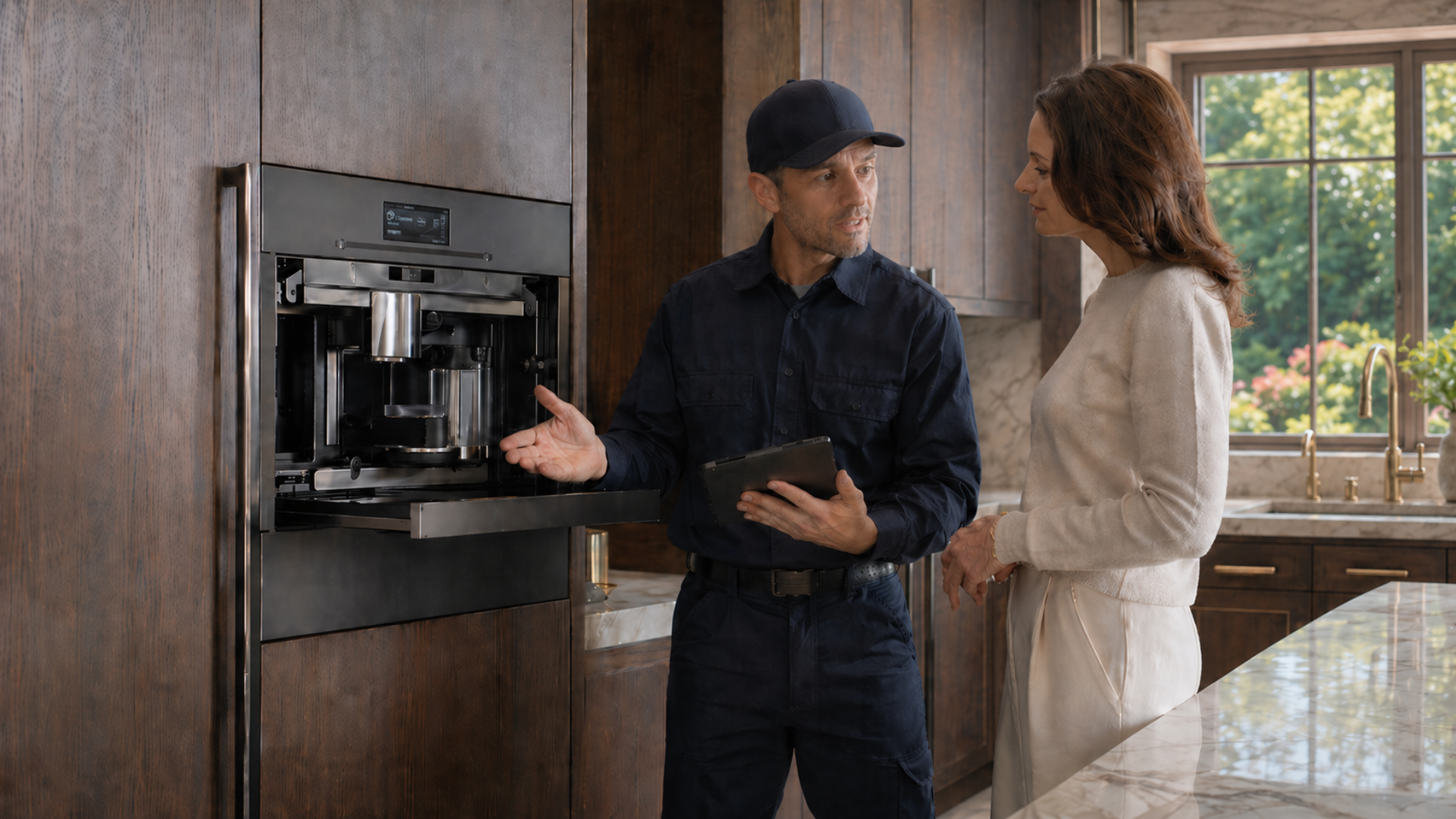
Built-in coffee machines are the most commonly misdiagnosed luxury appliance in a kitchen because their symptoms cross multiple systems. A “machine won’t make coffee” complaint can originate in the grinder, the brew unit, the water inlet, or the control board — and the wrong first guess means the second service visit.
Factory-certified service on these platforms closes the diagnostic gap in two ways. Access to Miele’s Diagnostic Unit (MDU) and Thermador’s BSH diagnostic software reads internal error logs that aren’t visible on the display. And knowledge of the platform-specific failure hierarchy — checking grinder output before brew-unit function, confirming inlet pressure before tank errors — eliminates the guesswork that makes coffee-machine service unusually expensive when done by generalists.
Uptown services both platforms across Houston and Dallas with factory-trained technicians on the Miele, Bosch, Gaggenau, and Thermador BSH family of products. For luxury kitchens that depend on a built-in coffee machine as a daily appliance — and for households where the machine is expected to last the full 10-to-15-year service life its price suggests — the diagnostic framework is the point.