




TL;DR
Brownout vs. power surge appliance damage is one of the most misunderstood distinctions in luxury home appliance repair — and it matters. The failure mode, the affected components, and even your insurance options differ dramatically depending on whether a voltage sag or spike hit your sophisticated kitchen. A brownout slowly starves motors and compressors of voltage, generating heat that accumulates over minutes or hours. A power surge, conversely, slams control boards and electronics with a violent spike of excess voltage in milliseconds. Understanding which event occurred helps you describe the problem accurately, set realistic repair expectations, and potentially support an insurance claim before you ever pick up the phone to an Uptown Appliance Repair expert.
What Actually Happens During a Brownout vs. a Power Surge?
Before delving into the specific types of damage, it’s essential to understand the fundamental electrical events at play in your home.
A brownout is a voltage sag. Your wall outlets in Houston or Dallas are engineered to deliver 120 volts of alternating current (240V for larger, professional-grade appliances like a Sub-Zero freezer or Wolf range). During a brownout, that voltage drops — sometimes to 90V, sometimes lower — while power remains technically “on.” The term itself dates to the visible dimming of incandescent lights when voltage falls. These events are often intentional on ERCOT’s part during peak demand emergencies, but they can also happen unintentionally during severe weather, a neighborhood transformer issue, or a nearby fault on the grid.
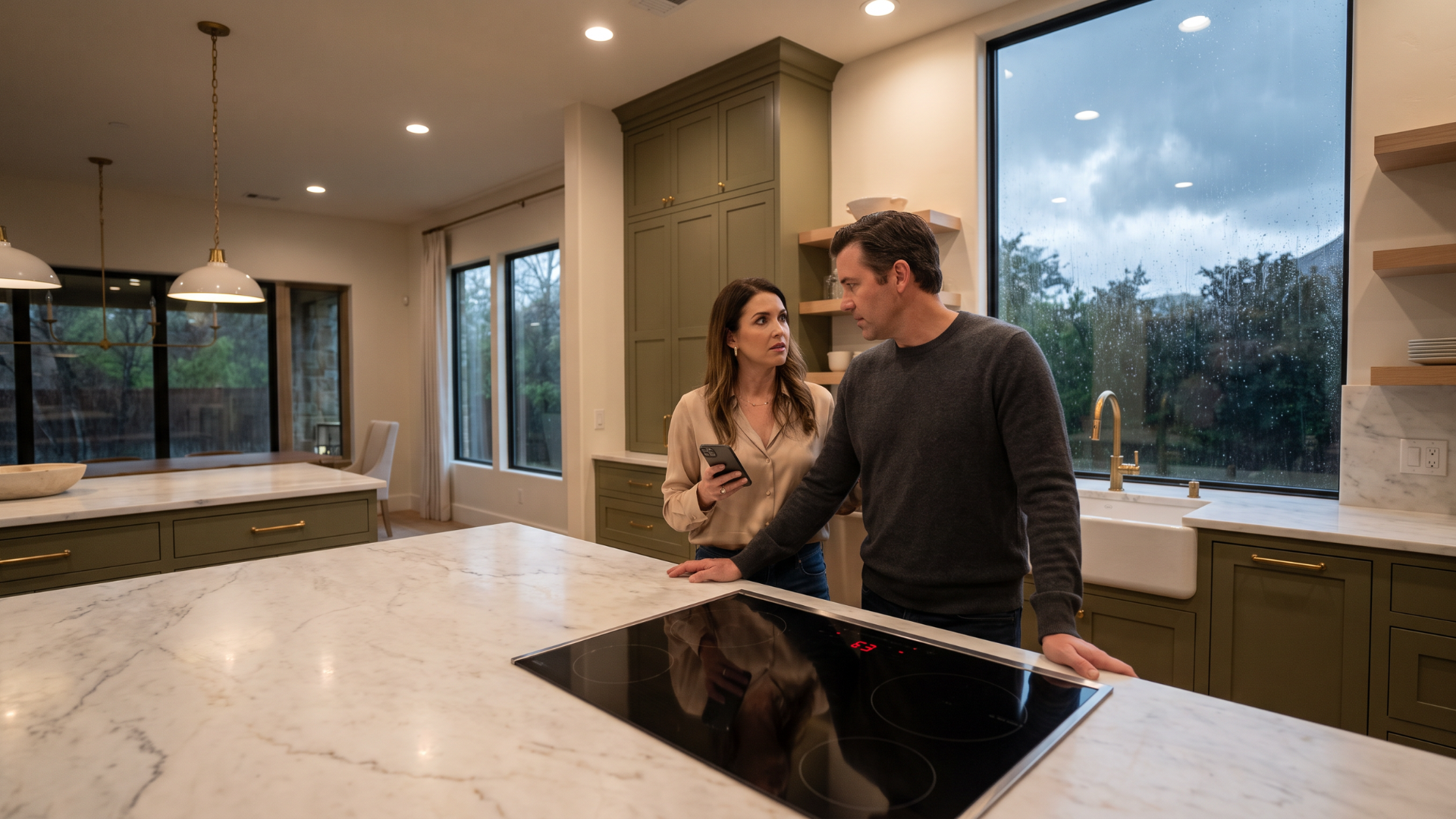
Houston homeowners are intimately familiar with this scenario. The intense summer heat pushes the Texas grid to its limits, and voltage fluctuations — even brief, subtle ones — are a real byproduct of that strain. You may not even notice a brownout is happening until your Sub-Zero refrigerator starts making an unfamiliar sound or your Wolf range hood display flickers.
A power surge is the opposite: a voltage spike. During a surge, voltage exceeds the normal 120V peak (which, in alternating current, actually oscillates up to 169V as its peak). As State Farm’s electrical safety resources explain, when voltage climbs above that peak level, it can cause an arc of electrical current inside your appliance. Surges can originate from a lightning strike near your home, from the utility grid switching equipment, or even from within your own house when a large appliance like a central AC unit cycles off and releases stored energy back into your wiring. The NEMA Surge Protection Institute estimates that 60–80% of surges are internally generated — meaning your own appliances cycling on and off are a common culprit.
The fundamental difference: a brownout is slow starvation; a surge is a sudden, violent overload. Both can ruin an expensive, high-end appliance, but they ruin very different internal systems.
How Does a Brownout Damage Premium Appliances?
This is where many homeowners get confused, because brownout damage rarely announces itself with a dramatic, immediate failure. It’s cumulative, thermal, and often delayed.
Here’s the core physics: electric motors — including the compressors inside your Sub-Zero refrigerator, your Wolf range hood blower, and your Miele dishwasher’s circulation pump — are engineered to spin at a specific voltage. When voltage drops during a brownout, the motor doesn’t simply slow down and give up. Instead, it draws more current in an attempt to maintain its rated output. That extra current generates extra heat. According to engineering data cited by VIOX’s electrical protection research, a compressor operating at just 15% reduced voltage may draw 30% additional current — more than enough to degrade motor winding insulation and meaningfully shorten compressor life during a single prolonged brownout event.
What an Uptown Appliance Repair tech looks for after suspected brownout damage:
- Compressor failure with thermal evidence. On a premium refrigerator or wine cooler, a technician will check whether the compressor is attempting to start but immediately overloading on its start relay. The windings inside the motor may show signs of heat damage — a distinct burned smell, discolored insulation, or a failed start capacitor that gave out under sustained thermal stress.
- Motor-driven appliance degradation. Your Miele dishwasher’s wash motor or drain pump may exhibit weakened seals or bearings from repeated heat cycling. It may still run — but run noisily, or fail to reach the RPMs needed to clean properly. Similarly, a Viking garbage disposal might hum but struggle to grind effectively.
- Gradual, not sudden failure. Brownout damage almost never presents as an instant “dead” appliance. More typically, your Sub-Zero may take longer to reach its set temperature, your wine column’s compressor may short-cycle, or your Miele dishwasher may run a full cycle but leave dishes inadequately cleaned. The appliance still works — it just works poorly, and the underlying damage is already done internally.
- Absence of visible burn marks on circuit boards. This is a key diagnostic differentiator. Brownout damage almost never scorches electronics, because the primary mechanism is thermal stress on mechanical and motor components — not electrical arcing on silicon.
One important caveat: if a brownout ends and power is restored suddenly at full or elevated voltage, that restoration can itself cause a small surge. So, in some cases, you’re dealing with both events at once, which makes diagnosis even more nuanced for our expert technicians.
How Does a Power Surge Damage Premium Appliances?
A surge targets a completely different part of your appliance: its brain, not its muscles.
Modern premium kitchen appliances — such as a Thermador Pro Grand range, a Sub-Zero integrated column fridge, or a Wolf steam convection oven — contain sophisticated electronic control boards, inverter modules, display panels, and communication relays. These boards operate at low voltages (5V, 12V, 24V internally) and contain transistors, capacitors, and microprocessors that are exquisitely sensitive to over-voltage events.
When a surge enters your circuit, it can push far more voltage through those board traces than they were designed to handle. The result, as described by the Electrical Safety Foundation International’s NEMA BI 50029-2025 report on transient overvoltages, is that transient overvoltages damage, degrade, or destroy sensitive electronic equipment, causing immediate failure or latent degradation that surfaces weeks or months later.
What an Uptown Appliance Repair tech looks for after suspected surge damage:
- Dead control board with a sudden, clean failure. The most common presentation is a touchscreen display that simply went black, or an appliance that powered off mid-cycle and won’t respond at all. There was no warning; it worked one moment and didn’t the next.
- Visible burn marks, scorch traces, or “blown” capacitors on the PCB. A trained and experienced technician will carefully remove the control board and inspect it under adequate lighting. Arced traces appear as blackened lines or pits on the board surface; failed capacitors often show a domed or cracked top.
- Intermittent, erratic behavior before complete failure. Smaller surges — the kind your AC unit can generate internally dozens of times a day — don’t always kill a board outright. They degrade it over time. Your Wolf oven may start throwing unexplained error codes, or your Miele dishwasher’s program selector may begin skipping cycles. This “weird behavior out of nowhere” pattern is often a surge-degraded board in its final weeks of function.
- Multiple appliances failing at the same time. If your Sub-Zero refrigerator, Thermador range hood, and Miele dishwasher all behave strangely after the same storm event, a surge is almost certainly the explanation. A brownout typically causes a single appliance to fail — whichever one happened to be running a motor under load at the worst moment.
- Ice maker and sensor failures on refrigerators. As noted by repair technicians specializing in post-storm calls, a surge can specifically target ice maker electronics and temperature sensor circuits while leaving the main compressor board intact. Your Sub-Zero or Monogram refrigerator keeps cooling perfectly, but the ice maker stops producing — a classic partial-surge symptom.
How an Uptown Appliance Repair Tech Actually Tells Them Apart in Your Kitchen
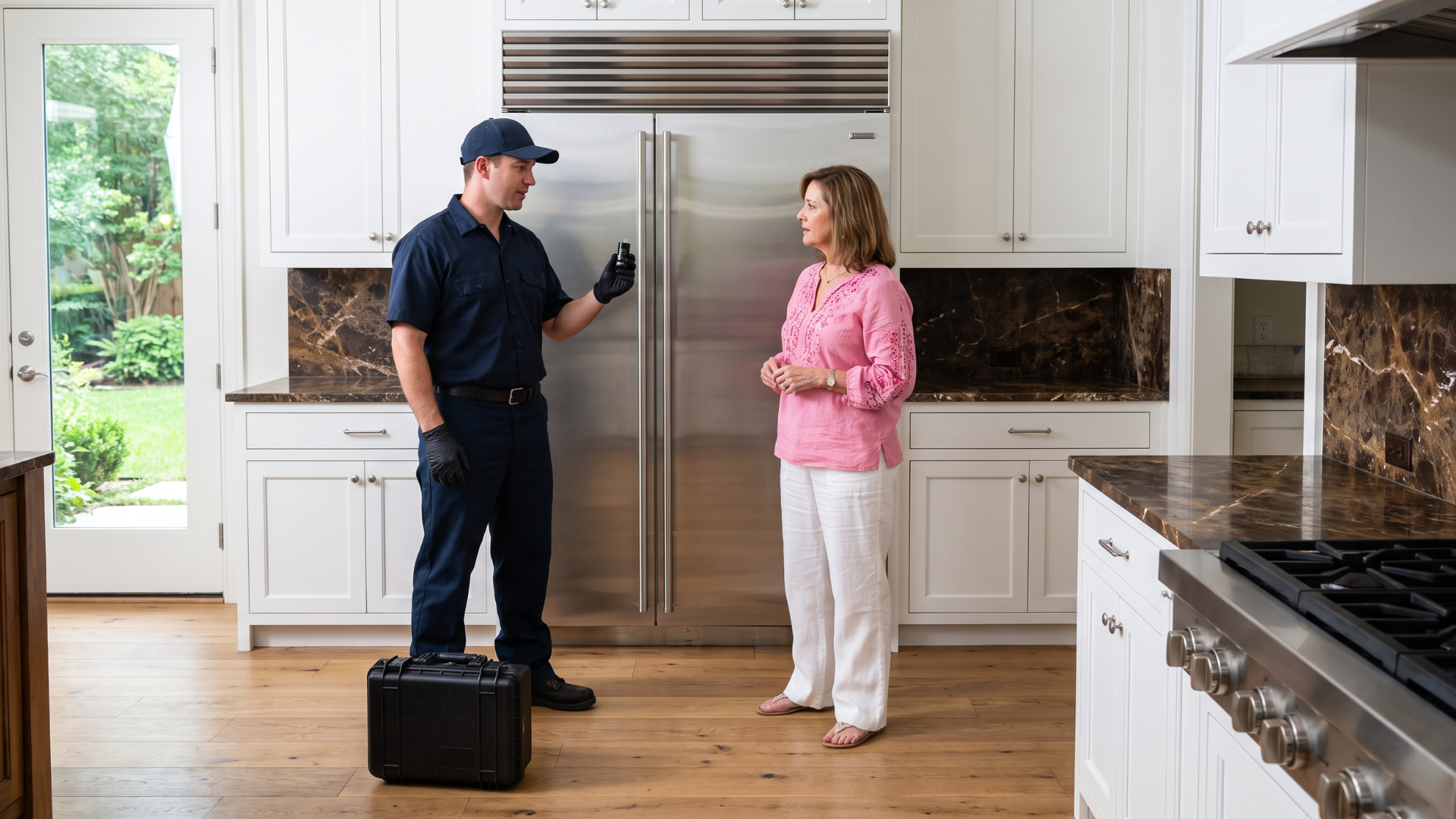
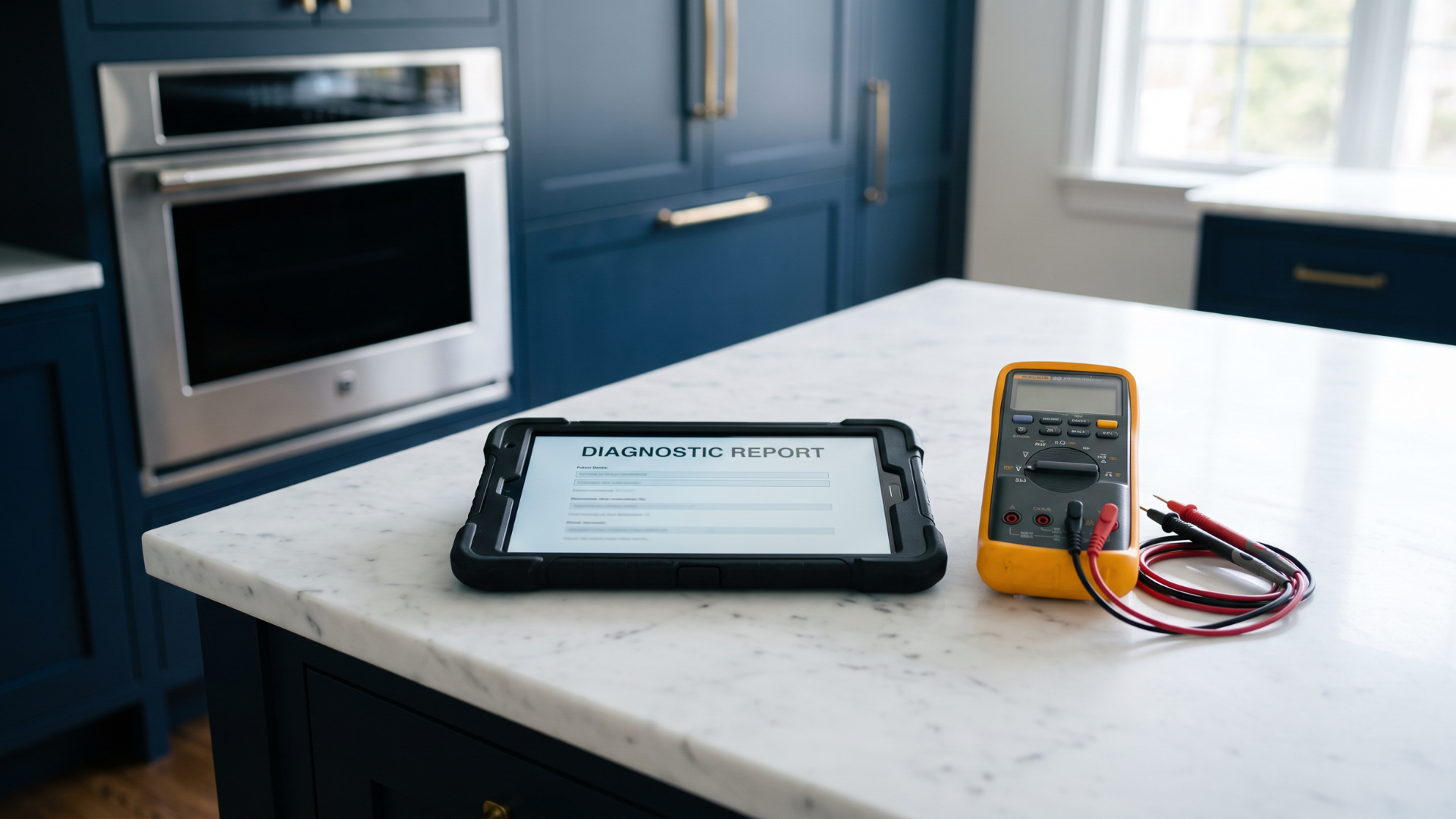
Here’s what an Uptown Appliance Repair diagnostic visit for a suspected electrical event looks like when one of our trained and certified technicians walks through your exclusive Houston or Dallas home:
Step 1: The conversation. Before touching any tools, your technician will engage you in a detailed discussion about when the appliance failed, what the local weather conditions were, how it failed (sudden vs. gradual degradation), and whether other appliances showed problems simultaneously. This meticulous history-taking is diagnostic gold for our experts.
Step 2: Voltage check at the outlet. A precise multimeter reading at the outlet confirms current electrical delivery. If voltage is low now, there may be an ongoing utility issue. If it’s normal, that doesn’t rule out a past event — it just means the grid has recovered.
Step 3: Physical inspection of mechanical components first. The compressor, start relay, capacitor, and motor components are meticulously checked before the electronics. Thermal damage — such as burned windings, seized bearings, or failed start capacitors — points to a brownout event. Clean mechanical components coupled with a completely dead board, however, point strongly to a surge.
Step 4: Control board examination. Removing and meticulously inspecting the control board under excellent illumination reveals burn marks, blown components, or arc tracks that serve as the undeniable fingerprint of a surge event.
Step 5: Error code history. Many premium appliances — particularly Sub-Zero, Wolf, Miele, and Thermador models — log fault codes to non-volatile memory. These codes can tell an Uptown tech precisely what the appliance “thought” was wrong at the moment of failure, and in many cases, the fault log distinguishes between a power supply anomaly (suggesting brownout) and an internal component failure (consistent with surge damage).
Does It Matter for Your Insurance Claim?
Yes — and this is one of the most practical reasons for a homeowner to understand the distinction clearly.
According to Allstate’s homeowners insurance guidance, personal property coverage in a standard homeowners policy may cover appliance damage from a power surge, particularly when the surge originates from a covered peril like a lightning strike. The Insurance Information Institute notes that some policies cover lightning-caused surges specifically, and Progressive also states that “you may be able to file an insurance claim for your electronics if they’re damaged by an artificially generated electrical current, or power surge that’s caused by a covered peril.” This is especially true for delicate electronics that populate luxury kitchens.
Brownout damage, however, is significantly harder to claim. Because it represents sustained low-voltage stress rather than a discrete sudden event, many insurers classify it as equipment wear or gradual deterioration — neither of which is typically a covered peril. The Texas Department of Insurance’s homeowner FAQ is worth reading carefully if you’re navigating a storm-related claim. A detailed independent report from Rockingham Insurance also states that while outages strike fast, losses can accumulate, noting that “damaged appliances and spoiled food” require documentation.
A written diagnostic report from your Uptown Appliance Repair technician — one that clearly identifies the failure mechanism as surge damage with evidence of control board arcing, versus brownout-related thermal motor failure — can be the crucial difference between a covered claim and a denied one. Do not underestimate the value of proper, expert documentation from a qualified, premium appliance repair professional.
What Can You Do to Protect Your Luxury Kitchen Going Forward?
Understanding what happened is the vital first step. Protecting against a repeat is the equally important second.
For surge protection: Point-of-use surge protectors (the power strip variety) offer limited defense for large appliances that pull significant amperage — think Sub-Zero refrigerators and Thermador ranges. The more effective solution for high-end homes is a whole-home surge protective device (SPD) installed directly at your electrical panel. These hard-wired devices, covered by NEMA SPD 1.1-2019 specifications, are designed specifically to divert transient overvoltages before they can ever reach your delicate circuits. If you reside in a neighborhood that experiences regular thunderstorms — and in Houston’s Memorial, River Oaks, or Tanglewood areas, that describes virtually every summer — a panel-level SPD is an exceptionally sound investment for a kitchen featuring $30,000+ in professional-grade appliances.
For brownout protection: It’s crucial to understand that surge protectors offer no defense whatsoever against under-voltage conditions. If your residence is in an area prone to brownouts or grid voltage sags, a voltage regulator or automatic voltage relay (AVR) that both monitors and disconnects appliances when voltage drops below a safe threshold is well worth discussing with your trusted electrician. When you notice signs like lights dimming throughout your home, the practical advice from appliance experts is simple and proactive: turn off major appliances immediately. Unplug your refrigerator if it’s safe and practical to do so, or at minimum be aware that running a compressor-driven appliance through a sustained brownout is the single highest-risk scenario for that invaluable component.
FAQ: Brownout vs. Power Surge Appliance Damage in Premium Homes
Q: My Sub-Zero refrigerator stopped cooling the day after a storm. Which is it — brownout or surge?
A: The day-after delay is actually a useful clue for our technicians. Surge damage often presents immediately (e.g., a completely dead control board, no lights). A delay of several hours to a day suggests the compressor ran through a brownout event and failed from thermal stress — or that a subtle surge degraded a board which then failed under normal operating heat. Either way, an Uptown Appliance Repair tech needs to meticulously inspect both the mechanical components and the control board to give you a definitive answer specific to your high-end appliance.
Q: Can a brownout and a surge happen at the same time?
A: Yes, and it’s more common than many homeowners realize. When grid power is restored after a brief brownout or outage, the restoration itself can carry a transient overvoltage spike. Your appliance may have successfully weathered the low-voltage period and then taken surge damage at the very moment power came back on. This is one critical reason why unplugging sensitive appliances during and shortly after a brownout is highly recommended for luxury homeowners.
Q: My Wolf oven is showing an error code but still baking. Should I be concerned?
A: Yes, absolutely take this seriously. Error codes on a premium appliance like a Wolf oven after any electrical event — be it a storm, a flicker, or an outage — are the unit’s sophisticated way of flagging an anomaly in its power or component history. Continued operation on a surge-degraded control board can unfortunately result in a much more expensive future failure. We recommend you call an Uptown Appliance Repair technician to pull the fault log while the appliance is still functional; it’s always easier to diagnose and address issues before complete failure.
Q: Does a whole-home surge protector protect against brownouts?
A: No, this is a common misconception. Surge protective devices (SPDs) are engineered exclusively to clamp and divert overvoltage events. They do not regulate or “hold up” voltage during a brownout. For comprehensive brownout protection, you would need a voltage monitoring relay or an automatic voltage regulator — which is a separate category of device entirely. Your licensed electrician specializing in high-end residential systems can advise on what’s most appropriate for your home’s electrical service.
Q: My Thermador range is throwing random error codes but works fine most of the time. Could this be surge damage?
A: Absolutely. Incremental surge degradation of a control board is one of the most common causes of intermittent error codes on premium ranges and ovens. The board isn’t completely dead — it’s partially compromised, and thermal stress during normal cooking heats the damaged components just enough to trigger sporadic faults. This pattern tends to worsen over weeks or months until the board fails completely. Catching it now with a professional diagnosis is both a more cost-effective and less disruptive approach than waiting for a complete failure mid-dinner party.
Q: Will my homeowners insurance cover a Thermador or Miele that was damaged in a storm?
A: Possibly — but the details of your policy and the diagnostic report from a premium appliance technician truly matter. Lightning-caused surge damage is covered by many standard homeowners policies under personal property coverage. Brownout damage resulting from grid stress (not a direct lightning strike) is typically not covered as a discrete event. A detailed, documented repair invoice from Uptown Appliance Repair that specifically articulates the failure mechanism (e.g., “control board failure consistent with transient overvoltage” versus “compressor thermal failure consistent with sustained undervoltage”) significantly strengthens any claim you file. Always retain your technician’s comprehensive report.
Q: How long after a storm should I wait before calling an Uptown Appliance Repair tech?
A: Our advice is simple: don’t wait. If your premium appliance behaved abnormally during or immediately after a storm — even if it “seems fine now” — a diagnostic visit is exceptionally worthwhile. Latent damage from both surges and brownouts can often take days or even weeks to fully manifest. Catching degraded components early, typically by identifying subtle pre-failure symptoms, often means the difference between a relatively simple board replacement and a much more extensive and costly compressor replacement or even a full appliance replacement.
Sources
- ERCOT Grid and Market Conditions Dashboard
- State Farm: Are Power Surges Damaging Your Electronics?
- NEMA Surge Protection Institute: Protecting Your Most Valuable Assets
- Electrical Safety Foundation International: NEMA BI 50029-2025 — Impact of Transient Overvoltage on Equipment
- VIOX: Brownout vs. Blackout — Which Is More Dangerous for Your Appliances?
- Allstate: Does Home Insurance Cover Power Surge Damage?
- Texas Department of Insurance: Homeowners Insurance and Disaster Claims FAQ
- Rockingham Insurance: Power Outage Damage: What Your Home Insurance Covers
- Progressive: Does Homeowners Insurance Cover Power Surges?
Related Reads from Uptown Appliance Repair
- Thermador Steam Oven Surge Damage Repair: Why the Failure Hides in the Boiler Module
- Uptown Appliance Repair Blog Archive
- Schedule a Service with Uptown Appliance Repair
If your high-end kitchen took a hit during a recent storm — or if something just doesn’t seem quite right with your Sub-Zero refrigerator, Wolf oven, or Miele dishwasher after a grid event — the Uptown Appliance Repair team is here to provide expert diagnostics and meticulous repair. Reach us directly at (281) 758-9978 or schedule a white-glove service visit at uptownappliancerepair.com/contact. We’d rather find nothing wrong than have you discover an expensive failure at the worst possible moment.