




TL;DR
If your Wolf range stopped igniting after a power outage, you’re almost certainly dealing with a wolf range power surge ignition repair scenario — not a gas problem. The surge that rides in when the grid restores can overwhelm the low-tolerance electronics inside your range’s spark module, leaving your burners silent or endlessly clicking. Here’s what actually happened inside that module, what you can safely check yourself, and when it’s time to call a pro.
Why Does Grid Restoration Cause More Damage Than the Outage Itself?
It’s counterintuitive, but it’s one of the most consistent things we hear from Houston homeowners after a storm: “The power went out, I waited it out, the lights came back on — and then my Wolf range stopped working.”
Here’s why.
When your power cuts out, your Wolf range simply powers down. That’s not the dangerous moment. The dangerous moment is when the grid comes back online. CenterPoint Energy’s own power restoration safety guidance explains it plainly: “When power is restored to a large number of customers at once, large appliances can cause a short-term power surge which may damage electrical appliances.” They even recommend unplugging sensitive equipment before restoration — advice that most of us, understandably, never think to follow while waiting out a summer storm.
What happens at the electrical level is this: normal household current in the U.S. oscillates between 0 and a peak of 169 volts for a 120-volt circuit. During a grid restoration event, that peak can spike well beyond those limits — sometimes dramatically. State Farm’s technical breakdown of power surge damage describes how voltage above an appliance’s normal operating range “can cause an arc of electrical current within the appliance, and the heat generated in the arc can cause damage to the electronic circuit boards and other electrical components.”
Your Wolf range — even though it’s a gas appliance — has a surprisingly sophisticated electrical brain sitting inside it. And that brain is exactly what a restoration surge likes to find.
What’s Actually Inside a Wolf Spark Module — and Why It’s Vulnerable
Most homeowners assume that because their range burns gas, electricity is just a convenience feature. In reality, Wolf’s Direct Spark Ignition (DSI) system is a tightly coordinated electronic circuit, and every component in that chain has specific voltage tolerances.
Here’s what lives inside your spark module assembly:
The spark module itself is a small, high-voltage transformer board mounted inside the range chassis — typically accessible from beneath the cooktop surface. It receives 120V AC from your home circuit, steps that voltage up to several thousand volts, and delivers precisely timed pulses to each ignition electrode. It’s doing this continuously whenever a burner knob is in the ignition position.
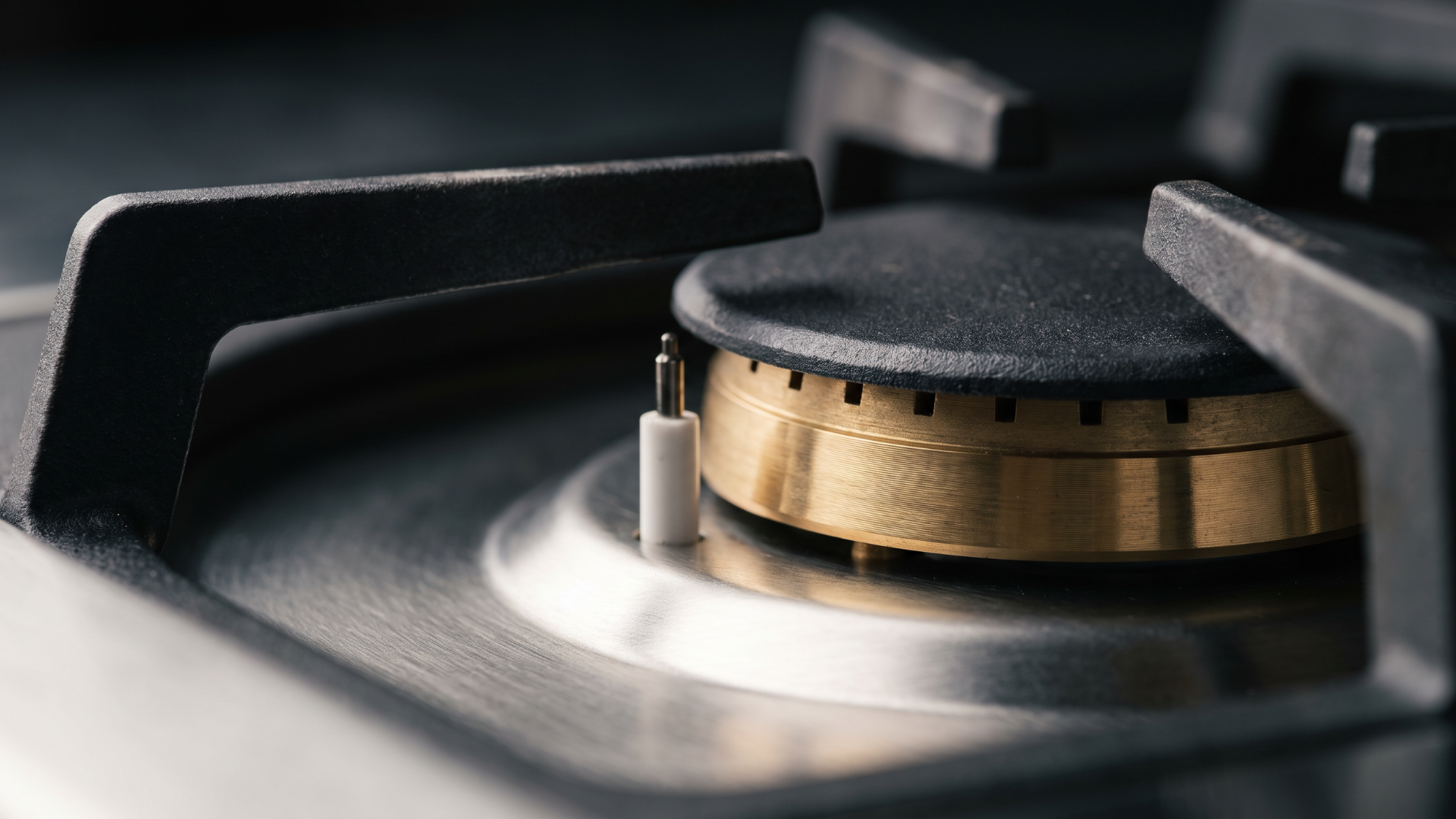
The ignition electrodes (also called igniters) are the ceramic-tipped probes you can see sitting beside each burner cap. They receive the high-voltage pulse from the module and generate the actual spark across a small gap to the burner head. Wolf’s official ignition operation documentation notes that once a burner ignites, “a resistance is created between the electrode (ignitor) and the burner.” The module constantly monitors this resistance to confirm the flame is present — it’s a feedback loop, not just a one-time trigger.
Microswitches at each burner knob tell the module which burner to fire. These are mechanical switches, but they’re wired into the same low-voltage circuit board.
The wiring harness connects everything together in a daisy-chain arrangement. On Wolf dual-fuel and all-gas ranges, this harness is routed around the bottom of the cooktop and oven cavity — right where heat cycles, humidity, and now surge current can stress insulation over time.
The module’s internal circuitry — particularly its capacitors and rectifier components — is designed to handle a specific voltage envelope. A transient spike that exceeds that envelope doesn’t need to be massive to cause harm. As Sollatek’s research on voltage surge damage points out, even smaller surges cause “rapid heating and subsequent cooling of electrical wiring,” degrading components gradually — or, in a bigger event, causing immediate failure. A grid restoration surge is exactly the bigger event.
What Are the Specific Symptoms After a Surge?
Not all surge damage looks the same. Here’s how to read what your Wolf range is telling you:
Symptom 1: Complete silence — no click, no spark, no response when you turn the knob. This typically means the spark module has lost power or has failed entirely. The module receives no signal, sends no pulse, nothing happens. Check your breaker first (see below), but if the breaker is fine, the module is the likely culprit.
Symptom 2: One burner clicks but won’t light; others are fine. This is a more localized failure. A surge can overload a single electrode’s circuit path rather than the entire module. The electrode itself may have taken the hit — they’re essentially antennas for high-voltage current — or the wiring to that individual burner may have been compromised.
Symptom 3: All burners click continuously, even with the knobs off. This is the classic “stuck ignition” pattern. The feedback circuit inside the module is reading incorrect resistance values — possibly because a component burned during the surge — and the module interprets this as “no flame detected,” so it keeps firing. It will not stop on its own. Reddit users frequently report continuous clicking after a power surge with their Wolf ranges, suggesting a common symptom of a faulty spark module after such an event.
Symptom 4: Range powers on, display works, oven functions — but no burner ignites. The surge hit the ignition-specific circuit while leaving the main control board intact. This is actually a hopeful scenario: it means the damage is isolated and the repair is more straightforward.
Symptom 5: Intermittent ignition — works sometimes, then fails again. This is the “electronic rust” scenario described by surge damage researchers. Components are partially degraded but not yet fully failed. This intermittent behavior tends to get progressively worse and will eventually become a full failure.
What Can You Safely Check Yourself Before Calling?
There are a few no-risk steps worth taking before scheduling a visit. None of these require tools or opening up your range.
Reset the circuit breaker. Wolf’s official troubleshooting guidance recommends this as a first step: turn off power to the unit, leave it off for at least 30 seconds, then restore. Sometimes a surge trips an internal protection circuit, and a full power cycle resets it. Go to your breaker panel, flip the range breaker to OFF, wait a full minute, and flip it back.
Check for a dedicated fuse. Some Wolf models — particularly older GR series and certain dual-fuel configurations — have an in-line ignition fuse mounted near the spark module. If a surge blew this fuse (they’re designed to sacrifice themselves for the module), replacing it may restore full function. This does require accessing under the cooktop, which means removing the grates and burner caps. If you’re comfortable with basic appliance disassembly, the fuse location is described in your owner’s manual; if not, leave it for a technician.
Confirm the gas supply is unaffected. Turn a burner knob to the light position and carefully use a long lighter or match near the burner head. If it lights with a flame source but not the electronic igniter, your gas supply is intact and the fault is definitively electrical — which is reassuring because it means you’re not dealing with a gas valve or regulator issue.
Dry out the burner area. Houston humidity after a storm can leave moisture trapped in the burner caps and under the cooktop. This is a separate issue from surge damage, but it can produce similar symptoms: a damp electrode won’t spark reliably. Remove the burner caps and grates, wipe everything thoroughly, and let the area air dry for several hours.
If none of these steps restore ignition, you’re past DIY territory, and here’s why that matters: the spark module on a Wolf range operates at several thousand volts. Probing it with a multimeter or attempting to bypass components without proper training and discharge procedures creates a genuine safety risk. The module should only be diagnosed and replaced by a technician with specific Wolf training.
Why Does This Happen More in Houston (and What Dallas Homeowners Should Know)
Houston’s climate layers two problems on top of each other. The Gulf Coast humidity that Uptown’s Wolf service page describes as aggressively attacking high-voltage gas ignition systems means that spark modules here work harder — and accumulate more moisture-related stress — than the same unit would in a drier climate. When a surge arrives on top of an already-stressed module, the failure threshold is lower.
Add to that the reality of CenterPoint Energy’s restoration patterns: Houston outages spiked in 2026 across areas including Fulshear, Kingwood, and Crosby, and restoration events — where large numbers of customers come back online simultaneously — create exactly the kind of load-rush surge that damages sensitive electronics.
Dallas homeowners aren’t immune. Oncor’s grid has its own storm-season stress points, and while the humidity profile is lower than Houston’s, summer convective storms produce the same kind of abrupt restoration surges. The difference is that Dallas Wolf owners are slightly less likely to have pre-existing humidity degradation compounding the damage.
What Does a Professional Repair Actually Involve?
When a Wolf-trained technician arrives for a post-surge ignition diagnostic, here’s what a proper assessment looks like:
Visual inspection of the spark module and wiring harness. Surge damage often leaves visible evidence: scorched traces on the circuit board, discolored or brittle wire insulation near the module, or a blown fuse. A burned smell under the cooktop that you may have noticed is a reliable indicator.
Resistance and continuity testing. With the range safely de-energized, the technician measures resistance at each electrode connection point and across the module’s input and output circuits. This identifies whether the module has failed, whether a specific electrode has been damaged, or whether the harness has compromised wiring.
Confirmation of the gas valve solenoid circuit. On dual-fuel ranges, the gas valve solenoid that opens to allow gas flow is also electrically controlled. A severe surge can damage this circuit independently of the spark module, meaning a range might spark but not release gas. A thorough post-surge evaluation checks both.
Replacement with OEM parts. Wolf’s Factory Certified program — the same training and parts standards that govern authorized service — specifies the use of genuine Sub-Zero/Wolf components backed by a one-year parts warranty. Aftermarket spark modules are available, but they’re manufactured to different tolerances and can introduce new ignition behavior that doesn’t match Wolf’s DSI feedback calibration.
The repair timeline for a straightforward spark module replacement is typically a single visit. If the wiring harness also requires replacement — which happens when surge current has traveled through the insulation — it adds time but remains well within a reasonable service scope for a range that may have cost $8,000–$18,000 new.
FAQ
Q: My Wolf range was completely off during the outage. How did the surge still damage it?
A: “Off” via the knob or control panel doesn’t disconnect your range from the circuit — it’s still electrically connected to the wall. The surge travels through the live wiring and into the spark module’s circuitry whether the range is in use or not. The only way to fully protect an appliance from a restoration surge is to unplug it or trip its dedicated breaker before power returns.
Q: The burner clicks constantly but nothing lights. Is this a gas problem or an electrical one?
A: Almost always electrical when it follows an outage. Continuous clicking after a surge typically means the spark module’s feedback circuit is reading a false “no flame” signal due to component damage. The gas valve itself is usually fine. A match test — carefully attempting to light the burner with an external flame source — will confirm whether gas is flowing normally.
Q: Can I use my Wolf range oven while the surface burners aren’t igniting?
A: On dual-fuel Wolf ranges, the oven bake/broil circuit is largely independent of the surface burner ignition system. In many cases, yes, the oven will function normally even when the cooktop spark module has failed. That said, if the surge was severe enough, it’s worth having a technician verify the full range before extended use.
Q: Will my homeowner’s insurance cover a Wolf range damaged by a power surge?
A: It depends on your policy. Standard homeowner’s policies typically cover sudden and accidental damage to personal property, which can include appliance damage from a grid event — but coverage varies significantly by insurer and policy tier. Document the failure, note the date it occurred in relation to the outage, and file a claim before authorizing repair. Your technician can provide a written diagnostic that supports the claim.
Q: Is there anything I can do to prevent this from happening again?
A: Yes. A whole-home surge protector installed at your main panel is the most comprehensive protection — it catches the bulk of a restoration surge before it reaches your appliances. Individual point-of-use surge protectors at the range’s outlet add a second layer. CenterPoint Energy also recommends unplugging sensitive appliances before a known restoration event whenever possible.
Q: My Wolf range is still under the factory warranty. Does a surge void it?
A: Wolf’s warranty covers manufacturing defects, not damage caused by external electrical events like surges. Power surge damage is a homeowner’s insurance matter, not a warranty matter. Using a Factory Certified technician for the repair, however, preserves your warranty on any unrelated components that may need attention in the future.
Q: How long should a Wolf spark module last under normal conditions?
A: With routine maintenance and no surge events, a Wolf spark module typically has a very long service life — often 10–15 years or more. The components most likely to wear out naturally are the electrode tips themselves, which can crack or corrode with heavy use or repeated moisture exposure. Annual cleaning and inspection of the burner caps, electrodes, and burner ports is the best way to catch early degradation before it becomes a no-ignite failure.
Sources
- Wolf Gas Surface Burner Does Not Ignite — Sub-Zero & Wolf Official Troubleshooting
- Wolf Gas Surface Burner Ignition: How It Works — Sub-Zero & Wolf Official Guide
- Are Power Surges Damaging Your Electronics? — State Farm
- Voltage Surges: Causes and Control — Sollatek
- Power Restoration and Safety Information — CenterPoint Energy
- Factory Certified Programs — Sub-Zero, Wolf, and Cove
- Houston Power Outages Surge After Months of Progress — Click2Houston / KPRC
- Fixing Wolf Oven Post-Power Surge: Burner Click Issue – JustAnswer
- Wolf GR366 Power Surge Damage. : r/appliancerepair – Reddit
Related Reads from Uptown
- Houston’s Wolf Appliance Repair & Maintenance — Wolf’s DSI System and Gulf Coast Climate
- What Sub-Zero and Wolf Factory Certification Actually Means — and Why Most Technicians Don’t Have It
- Wolf Range Power Surge Ignition Repair: Why Your Burners Click But Won’t Light
If your Wolf range went quiet after the grid came back on, you don’t need to panic — but you do need someone who knows exactly what they’re looking at inside that spark module. Give Uptown Appliance Repair a call at (281) 758-9978 or schedule a visit at uptownappliancerepair.com/contact. We’ll have your kitchen back to work.